

This post is also available in:
 Español
  Português
Hop production in Brazil is reaching a turning point thanks to the advancement of clean technologies applied to its processing.
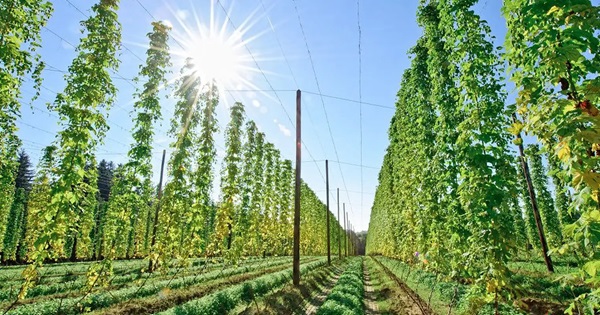
Researchers from CBioClima (Unesp), together with INCT NanoAgro and companies in the sector, have demonstrated that supercritical CO₂ extraction can drastically increase the yield of key hop compounds and simultaneously open new opportunities for the cosmetic, pharmaceutical, and functional ingredients industries.
This advance not only benefits producers seeking to compete with traditional markets like the United States or Germany.
It also redefines the role of hops in Latin America, projecting a new value chain based on high-yield, sustainable products with broader applications than just beer.
Contenido
A leap that changes the production equation
The Brazilian study managed to compare traditional extraction with supercritical CO₂ extraction, a technique used for decades in major hop-growing regions.
Conventional methods yielded extracts with about 15% concentration and around 9% alpha acids, responsible for beer’s bitterness.
Using supercritical CO₂, researchers achieved concentrations of up to 72% alpha-acids, unprecedented for hops grown in Brazil.
The difference is not just numerical. The technique allows for better preservation of aromatic compounds, avoids the use of petroleum-derived solvents, and recycles the CO₂ at the end of the process, reducing environmental impact.
In brewing terms, the study estimates that using these extracts could improve productivity by at least 20%, in addition to standardizing results between batches.
Even after extraction, the residues retain high levels of antioxidant phenolic compounds and flavonoids, opening doors for industrial uses ranging from anti-aging creams to natural supplements and functional foods.
A growing global market
This trend is not occurring in a vacuum. International reports show that the market for hop derivatives, including extracts, lupulin, and aromatic fractions, will reach approximately USD 1.30 billion in 2024, with an annual growth rate close to 6.5% until 2030, driven by brewing demand and new industrial applications.
Growth projections analysis towards 2035 also indicates sustained advancement, reaching a valuation in the range of USD 1.44 billion, where sustainable extraction methods play a central role in product innovation and differentiation.
This scenario confirms that hop extracts no longer depend solely on the craft beer boom. Their value lies in the bioactive compounds that can be used in multiple industries, making technologies like supercritical CO₂ strategic.
Implications for Latin America
Although the study comes from Brazil, its results are especially relevant for other Latin American countries that currently depend on imports.
The technical viability demonstrated by Brazilian researchers suggests that local cultivation, combined with clean processing technologies, could enable the development of a regional hop industry with its own identity.
For agricultural producers, it means the possibility of diversifying crops and generating added value beyond the sale of dried flowers.
For craft breweries, it opens the option to access more stable, concentrated, and consistent extracts, reducing logistical costs and strengthening local identity.
For entrepreneurs in bioproducts, cosmetics, or functional supplements, hops emerge as a new botanical player with high potential.
An opportunity that is just beginning
The technological advance achieved in Brazil marks a paradigm shift: hops, historically seen as a complex and import-dependent crop, could become a strategic raw material for Latin America.
The combination of specialized agriculture, applied research, and “green” extraction technologies allows for the diversification of industries and opens a range of high-value products.
For those working in beer, agribusiness, botanical innovation, or sustainable business models, this is an ideal moment to closely observe what is happening in Brazil.
The region could be on the verge of a new stage for Latin American hops, with productive, economic, and technological implications that will go far beyond the pint glass.
We recommend
- How to prepare Koreans’ favorite beer cocktail (Somaek)
- The importance of cleaning beer serving lines