This post is also available in:
 Español
  Português
  Français
In simple words, tasting means trying a food or beverage to examine its aromas, flavors, and quality—something most of us already do naturally when consuming anything, though not necessarily consciously.
Although there are nuances between tasting beer and savoring beer, beer tasting is not strictly a professional exercise reserved only for competition, but rather an activity that can be everyday and that, with study and practice, anyone can perfect.
In short, anyone can learn to taste beer, identifying and appreciating in detail its qualities and/or defects, understanding what is right or wrong.
This is why there are no differences in the tasting of craft beer, homebrew, or products from large breweries; the evaluation structure is always the same, established under the same objective parameters.
The definition of a beer’s quality is given by the nature of the type or style of beer and its organoleptic characteristics, not by who brews it.
This small reference guide is a compilation that seeks to provide more information to help beer enthusiasts learn about the various aspects that can be considered as structure in the overall evaluation of a beer, the detail of all its characteristics, their understanding, and their application.
Beer tasting vs. beer savoring
From a somewhat more specific point of view, we can say that there are differences between tasting and savoring beer—terms that, despite being synonyms, in this context are developed with different objectives.
Beer savoring is an activity that usually seeks the appreciation of a product for hedonic purposes, which does not necessarily require prior preparation and is based on rather subjective parameters.
Beer tasting, on the other hand, seeks to develop the structured evaluation of a product based on trained sensory analysis, continuous practice, and knowledge of processes, based on common guidelines and objectives.
Introduction to beer tasting
Beer tasting could be defined as the appreciation of the product through the use of the senses in consideration of 5 main aspects: aroma, appearance, flavor, mouthfeel, and a final overall impression, perceiving, identifying, and appreciating the organoleptic qualities of each in the most objective way possible.
It is not about indicating that a beer or some characteristic is simply “good” or “bad”; it is about being able to use appropriate knowledge and language that allow for a precise description that evaluates strengths and weaknesses.
Beer tasting can be classified into three types according to their specific objectives:
1. Educational tasting
The main purpose of tasting beer for educational purposes is to share knowledge, guided by a trained person, presented in a structured manner and in a suitable environment to promote learning about aromas/flavors, styles, and beer history.
2. Competition tasting
Tasting beer in a competition is a structured evaluation process, carried out by trained and experienced judges, with the objective of identifying the qualities of a beer, its drinkability, and how appropriate it is to a specific style.
Additionally, it serves as a reference to detect problems and improve products. It is not only about identifying characteristics but also about recognizing their origin so that it allows correcting, adjusting, or improving the quality of a beer. Common references, evaluation sheets, and unidentified samples are used.
3. Quality control tasting
This is about tasting beer so that it is used as a tool for consistency measurement and quality control.
They are generally carried out by trained panels from the breweries themselves to evaluate that each production reaches the market complying with the defined standards for a specific product.
How to organize a beer tasting?
The most important thing in organizing a beer tasting is to have a suitable space and the essential material elements to carry it out.
1. Physical space
In general, it is required that, when tasting beer, it takes place in a well-lit environment, with light colors, free of odors, and if possible, at a room temperature close to 20°C.
It is recommended to place the samples on a white surface to allow adequate contrast in appreciation.
2. Equipment
A sufficient number of tasting glasses is required, preferably glass cups or glasses.
Evaluation sheets, pencils, and a style guide for consultation and reference (BJCP or Brewers Association) should be available.
3. Preparation and order
Depending on the type of beer tasting, set up a separate area to avoid predispositions.
In general, it is most advisable to order the service based on an increase in palate intensity and according to the recommended serving temperature.
4. Number of samples
It is recommended not to exceed six samples per session, especially if they are products with high alcohol content and good body.
Have purified water and pieces of neutral bread or salty crackers to cleanse the palate between samples.
5. Tasting sheet and beer evaluation
Beer evaluation sheets come in all types, whether for savoring or tasting beer.
Generally, the preparation of this sheet has three basic objectives: to structurally record the characteristics observed in the beer, to provide feedback to the brewer, and to create a ranking of the participating beers.
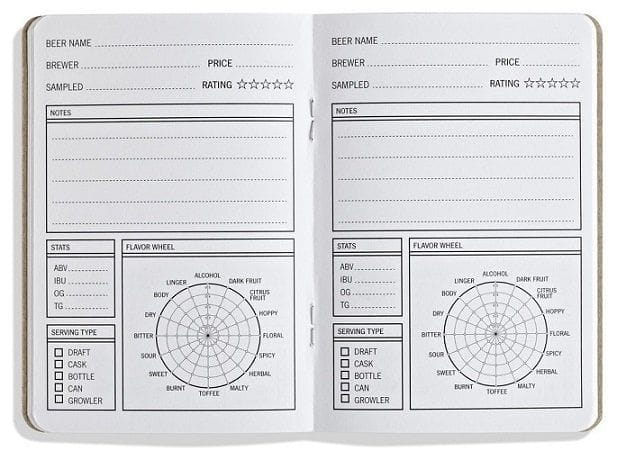
Specific considerations when tasting beer
What is important here is to have prior knowledge of the beers to be tasted: type of beer according to fermentation (Ale, Lager, or Sour), specific style (Stout, IPA, Barley Wine, etc.), alcohol content (ABV), bitterness (IBU), and whether it was made with additional ingredients (honey, fruits, etc.).
1. Beer glassware
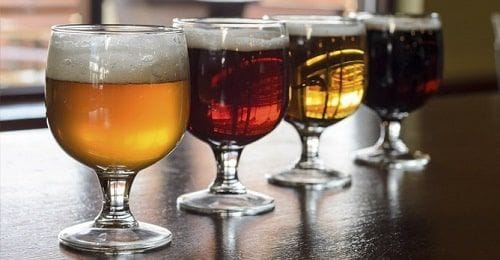
The glasses used when tasting beer should always be transparent, with smooth walls, without relief or decoration, very clean, drained upside down, and without water residue, ideally made of glass.
2. Serving temperature
Regarding the serving temperature, for each style an appropriate range is recommended that will allow its best appreciation, but in general the following ranges are established:
Beers between 4 and 6°C
Light Lager, Golden Ale, Cream Ale, low-alcohol beers.
Beers between 6 and 8°C
Hefeweizen, Premium Lager, Pilsner, German Pilsner, Fruit Beer, Golden Ale, Berliner Weisse, Dark Lager, Fruit Lambics, and Gueuzes.
Beers between 8 and 10°C
American Pale Ale, Amber Ale, Dunkelweizen, Sweet/Dry Stout, Porter, Belgian Ale, Dunkel, Vienna, Schwarzbier, Altbier, and Tripel.
Beers between 10 and 12°C
Bitter, IPA, English Pale Ale, Saison, Unblended Lambic, Dubbel, Belgian Strong Ale, Weizenbock, Foreign Stout, and Scotch Ale.
Beers between 12 and 14°C
Barley Wine, Quadrupel, Imperial Stout, Imperial/Double IPA, Doppelbock, and Eisbock.
3. Savoring and tasting notes
Each beer style has its own balance of characteristics established by its history, ingredients, and brewing processes.
It is very important to be clear that the style does not define the quality of a beer, it only identifies the attributes we should expect from it.
At a higher level of interest, the proper understanding of these characteristics requires at least a basic understanding of the brewing process that allows recognizing how and where they originate, even how to adjust or correct them.
Basic steps to perform a beer tasting
In general terms, the beer tasting process establishes a suggested sequence to approach the evaluation in the best possible way, from aromas to the overall impression, the sequence, quantities, and times that allow maximizing it.
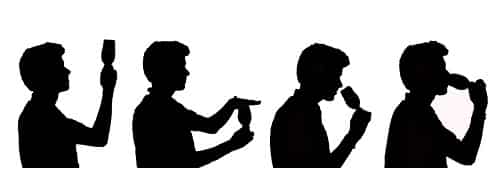
An interesting article recommended by the BJCP and written by Eduard W. Wolfe describes the process of tasting beer in a series of recommended steps that we summarize below:
1. Visually inspect the bottle
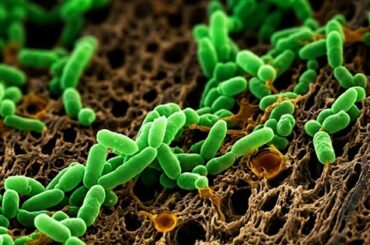
Identify possible signs of problems (for example, a ring around the neck that could indicate bacterial contamination or too much air space in the neck that could indicate possible oxidation).
These characteristics can be useful in describing the defects discovered when tasting beer; however, be careful not to prejudge.
2. Serve the beer in a clean glass
Make an effort to produce a generous, but not excessive, foam head. For highly carbonated beers, this may require carefully pouring the beer with the glass tilted.
On the other hand, for beers with low carbonation, this can be achieved by pouring from a height of about 15 centimeters from the bottle.
For each style there is a time and way that will give it its optimal appearance.
3. Smell the beer
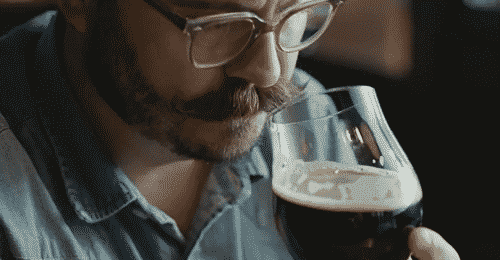
As soon as you pour the beer, swirl the glass and bring it to your nose, inhaling several times.
When a beer is cold, it may be necessary to warm it a little with the glass between your hands, or cover the top so that volatile aromas accumulate in sufficient concentration.
Take note of your impressions and in particular, of any aroma you can detect.
4. Visual inspection
Tilt the glass and examine the beer against the light, noting what you observe.
5. Smell the beer again
Once again, swirl the glass if necessary and inhale the beer’s aroma repeatedly.
Notice how the beer’s aroma changes as it gains temperature and how volatile aromas begin to dissipate. Take note again of all your impressions.
6. Taste the beer
Take about 30 ml (1 ounce) and cover the entire inside of your mouth with it. Make sure the beer comes into contact with your lips, gums, teeth, palate, and entire tongue.
Swallow the beer, exhale through your nose, and take note of your impressions of the primary and secondary flavors and aftertaste.
7. Taste the beer again
This time take note of the physical sensations in your mouth that the beer produces.
8. Establish an overall impression
Relax. Take a deep breath. Smell and taste the beer again. Finally, pause to consider which general group to rate it in, for example, excellent, very good, good, drinkable, or with serious problems.
How to taste beer like an expert
The beer tasting process is based on an analysis that considers 5 aspects: aroma, appearance, flavor, mouthfeel, and overall impression, in that order.
If you want to taste beer to keep a record or to convey this opinion to other people, even as a judge in a competition, the best way is to use a detailed procedure and a common terminology.
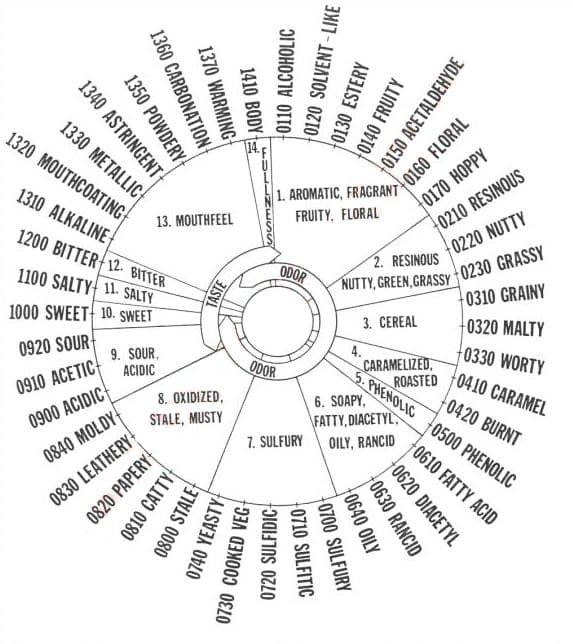
For this, one of the most used tools is the Meilgaard flavor and aroma wheel.
1. Aromas
In this stage of beer tasting, the aromas of malt, hops, esters (fruits or roses), and other aromatic compounds are appreciated and described.
In beer we can talk about primary and secondary aromas. The former are provided by raw materials (malt and hops) and the latter are formed from yeast in fermentation (esters, alcohol, spices).
In beer, there are aromas that are very volatile and dissipate quickly, which is why the first approach to evaluation should be their detection and recording before they disappear or change.
In a BJCP-type competition, for example, the aroma evaluation corresponds to 24% of the total score (10 points).
Malt aromas
Mention if they are present, quantifying the level (low, medium, high), the character (sweet, grainy, toasted, smoky, caramel, dried fruits, etc.), and any additional sensory indicator (bread, cookies, molasses, coffee, raisins, nuts, hazelnuts, etc.).
Malt aromas will depend on the types and amounts used according to the style brewed.

Hop aromas
Mention if they are present, quantifying the level (low, medium, high), the character (herbal, floral, resinous, earthy, fruity, citrus, perfumed, etc.), and any additional sensory indicator (orange, grapefruit, passion fruit, pine, grass, roses, etc.).
Hop aromas depend on the variety and the amount added to the wort during boiling and also if it has been added during fermentation or maturation. Generally, a beer uses several types of hops in its brewing.
Ester aromas
These are aromatic compounds generally formed by yeast during fermentation.
Mention if they are present, quantifying the level (low, medium, high), the character (fruity, floral, solvent, etc.), and any additional sensory indicator (banana, apple, lavender, rose, etc.).
Alcohol aromas
Alcohol is the main byproduct of fermentation (along with CO2), so its presence or absence should always be mentioned.
Mention if they are present, quantifying the level (not perceived, light, intense) and its character (spicy, winey, etc.).
Aromas added by the recipe
These are aromas originating from additional ingredients (fruits, vegetables, etc.). Mention if they are present and how well they integrate into the base beer style.
For example, typical are the aromas of raspberry, cherry, and peach of Lambic beers with fruits added in maturation or cilantro with orange peel added to Belgian wheat beers.
Others
These are aromas related to characteristics developed as a result of inadequate brewing or distribution processes (fermentation, maturation, contamination, storage, etc.).
Observe if they are present, quantifying the level (low, medium, high), the character (diacetyl, alcohol, oxidation, etc.), and any additional sensory indicator (buttery, spicy, cardboard, etc.).
2. Appearance
In this stage, the beer’s color, clarity and liveliness, foam consistency, persistence, texture, and color are analyzed and described.
Although this set of characteristics has the lowest percentage estimate in the overall evaluation of a beer—in a BJCP competition, for example, it only corresponds to 6% of the score (3 points)—many of them can function as indicators of the beer’s “health” and should be observed using a good light source and adequate contrast.
Color
Describe the beer’s color (white, yellow, reddish, brown, black, etc.) using some shade indicator (translucent, bright, matte, clear, cloudy, hazy, etc.).

The color range is associated with the style and does not represent the beer’s flavor, quality, or alcohol level, and is determined mainly by the level of malt roasting and in some cases, by the addition of additional ingredients (fruits, vegetables, herbs).
The color intensity is defined by the SRM scale (Standard Reference Method).
Liveliness
Visually quantify the release of dissolved CO2 in the beer by assigning a level (low, medium, bubbly).
Liveliness will be visible to a greater or lesser extent depending on the beer’s color.
Foam consistency
Quantify the foam depth by assigning a size (low, medium, high, huge) and describe its texture (light, dense, thick, compact, creamy, rocky).
Finally, observe and describe the size of the bubbles on the surface (small, medium, large) and their distribution (homogeneous, heterogeneous).
Foam color
Observe and describe the foam color (white, off-white, cinnamon, brown, etc.), indicating some degree of tone (translucent, bright, opaque).
These qualities are always related to the characteristic ingredients used in brewing.
Foam persistence
Observe the foam duration. As a reference, medium persistence is considered when the bulk of the foam decreases by half in one minute.
If the thickness drops faster, the foam is considered less persistent; if it does so in more time, it is considered to have good retention.
Finally, observe if it generates “legs” of alcohol (droplets of residue) or foam rings (Belgian lace) on the glass walls.
3. Flavor
In this stage, malt and hop flavors, flavors developed by fermentation characteristics, overall balance between sweet and bitter, finish/aftertaste, and other characteristics are appreciated and described.
Although flavor is mainly determined by the chemical reactions produced in the taste buds of the tongue, a very important part of its existence is determined by the sense of smell.
These characteristics are so important and complex that in a BJCP competition they correspond to 40% of the overall evaluation of a beer (20 points).
When tasting beer, you should seek for the beer to come into contact with the entire extent of the tongue and palate.
Finally, and unlike what happens in wine tasting, the beer should be swallowed, in order to evaluate the finish and aftertaste in the areas of greatest bitterness sensitivity.
Malt flavors
Mention if they are present, quantifying the level (low, medium, high), the character (sweet, toasted, caramel, etc.), and any additional sensory indicator (black fruits, dried fruits, bread, grains, etc.). Confirm the olfactory sensations and/or register new ones.
Hop flavors
Mention if they are present, quantifying the level (low, medium, high), the character (citrus, resinous, earthy, herbal, etc.), and any additional sensory indicator (grapefruit, passion fruit, peach, pine, grass, etc.).
Bitter flavors
Mention if they are present, quantifying a level (absent, low, medium, high). In beer, bitterness comes mainly from hops, originating from their alpha-acid content, but it can be influenced by roasted malts and the type of water used according to the style.

The intensity of bitterness is measured according to the IBU (International Bitterness Unit) scale. One IBU equals one milligram of iso-alpha-acids dissolved in one liter of beer.
Alcohol flavors
As with aroma, its presence should always be indicated. Mention if they are present (not perceived, light, intense) and its character (spicy, winey, etc.).
Others
Evaluate flavors related to characteristics developed as a result of inadequate brewing or distribution processes (fermentation, maturation, contamination, etc.).
Observe if they are present, quantifying the level (low, medium, high), the character (diacetyl, alcohol, oxidation, acidity, etc.), and any additional sensory indicator (buttery, spicy, vinegar, cardboard, etc.).
Balance
Evaluate the balance between the sweetness characteristics of the malt, the bitterness of the hops, and other flavor components according to the style (acidity, alcohol).
Quantify the balance by specifying a level for each component (balanced toward malt, balanced toward hops, unbalanced, etc.).
Finish and aftertaste
Mention the last characteristics perceived before the beer completely passes through the mouth (sweet, bitter, dry, attenuated, balanced, etc.).
The aftertaste is then the persistence of a flavor sensation after having passed through the mouth and being out of contact with the taste buds.
Mention and quantify its duration (absent, brief, lasting), intensity (mild, medium, intense), and character (malt, hops, toasted, etc.).
4. Mouthfeel
These are characteristics related to the physical sensations produced by the beer in the mouth: body, carbonation level, alcoholic warmth, creaminess, astringency, and other palate sensations.
Generally, in a BJCP competition, these characteristics account for 10% (5 points) of the overall evaluation.
Body
It is the sensation of fullness generated when the beer passes through the mouth (tongue, palate), caused by the dextrins and proteins of the malt.
Quantify by providing a weight (watery, light, medium, full) and describe its texture (silky, creamy, unctuous, chewy), indicating intermediate relationships if necessary.
Carbonation
Produced by the presence of dissolved CO2 in the beer. Natural carbonation is produced by adding sugar to the beer to reactivate the yeasts, and in artificial carbonation, CO2 is introduced under pressure.
Quantify by indicating a level (low, medium, high) and some descriptor if necessary (lifeless, flat, soft, sparkling, effervescent, etc.).
Alcohol
Mention any warm sensation related to alcohol and quantify using a level (low, medium, high) and any other sensation it could cause (burning, harshness, etc.).
Astringency
Often confused with bitterness or acidity, astringency produces a rough contraction sensation on the tongue and palate and can develop both in the brewing process (milling, mashing) and from the ingredients used (roasted barley, hops).
Evaluate its presence and quantify using a level (absent, low, medium, high) and eventually indicate its origin (hops, malts, process).
5. Overall impression
This is an opinion on the overall pleasure of having tasted a particular beer and is associated with all previous observations; it is the sum of objective and subjective sensations.
This final memory is a summary of the characteristics of each beer, highlighting the most representative, which you will probably remember or comment on in the future.
In a BJCP competition, these characteristics account for 20% of the overall evaluation.
Meilgaard flavor and aroma wheel
In 1979, chemical engineer Morten Meilgaard developed a Beer Flavor and Aroma Wheel in an attempt to standardize an analysis language that would allow fluent communication between brewers, consumers, judges, writers, and anyone related to beer, identifying and defining separately each identifiable aroma and flavor.
Subsequently, this work was jointly adopted as a standard by the European Brewery Convention (EBC), the American Society of Brewing Chemists (ASBC), and the Master Brewers Association of the Americas (MBAA).
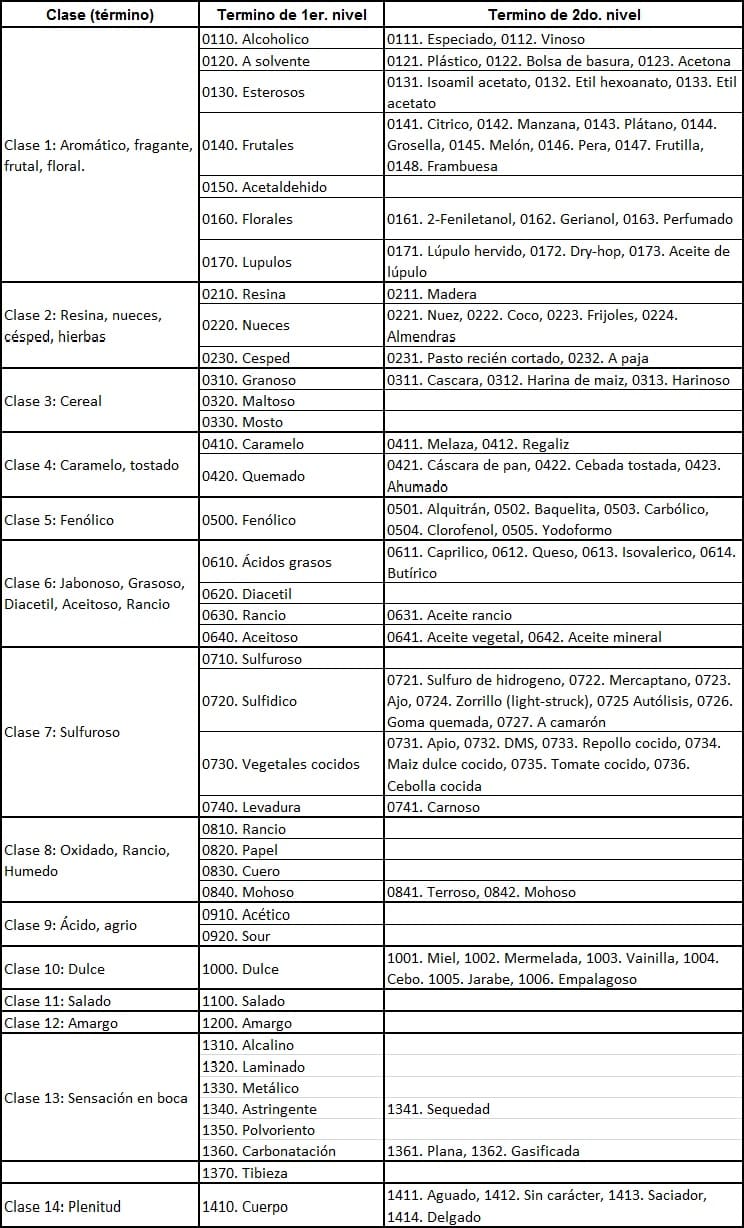
Through this system, a descriptive name is given to each aroma and flavor, and they are then grouped with other similar aromas and flavors within 14 different classes.
The wheel contains a total of 44 first-level descriptors associated with common terms recognizable by most people.
Then, a second level opens these first-level descriptors into 76 specific characteristics.
For example, under class “01, Aromatic, Fragrant, Fruity, Floral” and under the descriptive name “0110, Alcoholic,” there are two associated descriptors: “0111, Spicy” and “0112, Winy.”
Subjective terms such as good/bad are not included. This is particularly important when judging in a competition, as standardizing the descriptive language allows that when evaluating, not only is a beer described or rated, but it also allows establishing causes and characteristics associated with a range of possible recommendations that guide the brewer on what needs to be reinforced, corrected, and/or refocused in their recipe or process.
Frequently Asked Questions (FAQ)
1. Why do some people have greater sensitivity when tasting?
Sensory perception varies from person to person according to genetic factors, previous experience, and training. Some people have greater sensitivity to specific compounds such as esters or diacetyl. With practice, any enthusiast can train their palate and sense of smell to identify a greater variety of sensory notes.
2. Can you taste beer without being certified?
Absolutely. Beer tasting is not exclusive to professionals. Although certified judges apply technical and structured criteria, anyone can learn to taste and enjoy with greater awareness, as long as they follow a methodology and use common references.
3. What common mistakes should be avoided when tasting beer?
Among the most common mistakes are not serving at the proper temperature, using dirty or inappropriate glasses, being influenced by the brand or label, and carrying out the tasting in environments with strong odors. It is also very common to prejudge due to external influences.
4. How does water influence the sensory profile of a beer?
The mineral profile of the water used in brewing can enhance or soften certain characteristics. Waters with high sulfate content tend to accentuate hop bitterness, while waters with more bicarbonates can soften dark malts.
5. Is it possible to taste non-alcoholic beers using the same criteria?
Yes. Non-alcoholic beers should be evaluated using the same sensory parameters. However, it is important to consider that dealcoholization processes can alter the final profile, so expectations should be adjusted to the specific style.

We Recommend
- Charlie Papazian, the father of American craft beer
- Opinion column: Saison Dupont Beer – Tasting Notes