This post is also available in:
 Español
  Português
Although today any golden, transparent beer is called a “blonde,” there was a time when there was only one blonde beer, and that is Pilsner Urquell (Plzeňský Prazdroj), the first in history.
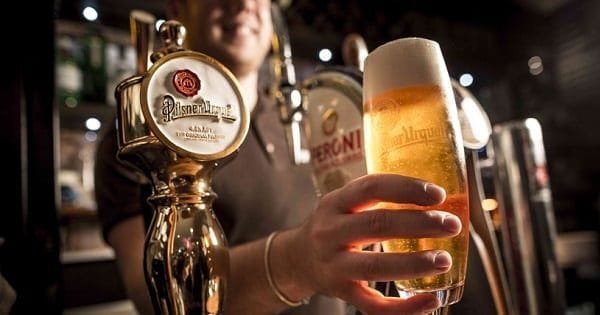
Until then, beers were cloudy and dark, to the point that no one even dared to serve them in transparent glasses.
The history of Pilsner Urquell
The origin of Pilsner Urquell dates back to the mid-19th century in the Czech city of Plzeň (Pilsen), when in 1838, following a series of citizen protests that included spilling barrels due to the low quality of the beers brewed in the city, neighbors and businessmen decided to form an association known as the Bürgerliches Brauhaus (Citizens’ Brewery).
Their goal was to find a way to produce higher quality beer using a method that would allow them to maintain a standard over time.
The first major decision of this new association was to hire a young architect named Martin Stelzer to design the factory where the beer that bears the city’s name is still brewed today.
Stelzer, after traveling across Europe in search of the latest innovations in brewery design, chose a location on the outskirts of the city, on the banks of the Radbuza River.
This location had the necessary qualities for the project: a sandstone rock subsoil easy to excavate for the construction of tunnels for cold storage, surrounded by aquifers that would provide quality soft water.
But ultimately, the key to the birth of the first Pilsner—from Pilsen, the name that all beers that imitated it and continue to imitate it to this day would acquire—was the hiring of brewmaster Joseph Groll, the true creator of this quintessential golden beverage.
Joseph Groll: The father of Pilsner Urquell
Josef Groll was a Bavarian brewmaster born in 1813 in the town of Vilshofen, northeast of Munich.
Groll was the son of a successful local brewer, and from a very young age, he dedicated himself to the family business, quickly becoming recognized for his talent in brewing.
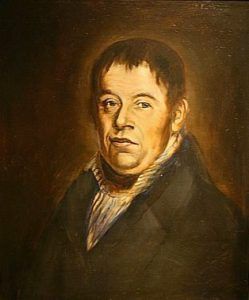
Trained in Germany and Austria, he was said to be a rough and grumpy man, whom his own father would call “the rudest man in Bavaria,” but at the same time, he was very hardworking, diligent, and meticulous, someone who liked to control every detail of the brewing process.
Thus, in 1842, at the age of 29, he was recruited by Martin Stelzer to work for one year at the new brewery, with the condition that once it ended, the contract would not be renewed.
How was Pilsner Urquell developed?
The new beer developed by Groll had to be based on three fundamental pillars.
1. Lager yeast
First, Groll managed to smuggle a batch of German yeast for lager fermentation, as German laws prohibited its trade to preserve its commercial advantages.
Legend has it that the yeast known as Pilsner “H” was sold to Groll by a monk who secretly extracted it from a monastery to settle a debt.

Since approximately the 16th century, Bavarian brewers who stored their beers in Alpine caves had realized that low temperatures caused the yeast to settle at the bottom of the vats, becoming more stable, resulting in a paler beer.

This was the origin of bottom-fermented or lager beers (“lagering” literally means cold storing in German) and one of the fundamental secrets that Josef Groll brought to Plzeň.
2. Raw materials
In addition to the quality of the water, which was especially soft, Groll also wanted to take advantage of the exceptional Moravian barley, which to this day is malted at the factory itself to obtain a very pale malt.
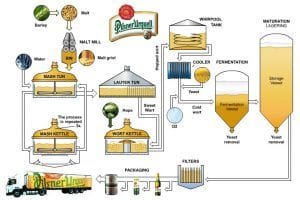
The yeast would work on a local malt variety known as Haná, which would no longer be dried over fire as was customary but with the revolutionary air oven method, which would better preserve its qualities and allow the beer to maintain a light color.
Finally, the mixture would be combined with the magnificent hops from the Saaz region (the German name for the Czech region of Žatec, near Plzeň), which give the beer its characteristic aroma and bitterness.
3. Innovations
In addition to the crucial change in fermentation, other radical changes were introduced, such as the use of copper kettles heated directly by fire, which would slightly caramelize the malt during boiling.
Pilsner Urquell rises to fame
It was on October 5, 1842, when Joseph Groll produced the first batch of the new beer, and it was on November 11, 1842, when he presented it for the first time before the astonished eyes of those present at the St. Martin’s Market in Plzeň.

No one had ever seen a beer with such a beautiful, golden, and brilliant appearance, with its creamy white foam, but above all, with its fine and delicate flavor.
This new beer quickly gained international fame and, within a few years, spread throughout western Bohemia, then conquered Vienna in 1856 and France in 1862.
The arrival of the railroad that same year was a turning point in the company’s growth, which increased exponentially, producing one million hectoliters annually and being present in 34 countries just before World War I broke out.
The origin of the name Pilsner Urquell
After the resounding sales success of the new Pilsner beer, other producers quickly began to imitate it, also proclaiming it as Pilsner beer, even if it was not brewed in that city, to the point where it became a way of referring to a type of beer.
This is why at the end of the 19th century it was necessary to protect the brand from these generic products, and it was decided to add the word “Urquell” to the name, which literally means “from the original source,” a term that bar owners who already served this Pilsner had begun to use to attract customers and which the brewery definitively adopted in 1898.
Frequently Asked Questions (FAQ)
1. Can Pilsner Urquell be found outside the Czech Republic?
Currently, Pilsner Urquell is distributed in more than 50 countries and can be found in specialty stores, premium supermarkets, and bars with international beer menus.
2. What is the difference between a Czech and a German Pilsner?
Czech pilsner, like Urquell, tends to be maltier and less dry than its German counterpart, with a softer, rounder bitterness thanks to Saaz hops.
3. Does it still use traditional brewing methods?
Although modern technology has certainly been incorporated, Urquell maintains the basis of the original process, including the use of wooden barrels.
4. How much ABV does Pilsner Urquell have?
It has an alcohol by volume of 4.4%, making it a light, easy-drinking beer.
5. Why is it important that the water type is soft?
Soft water allows the flavors of malt and hops to express themselves more clearly without adding mineral hardness to the palate.
6. Can the Urquell brewery be visited?
The brewery in Plzeň offers guided tours, tastings, and historical tours, making it one of the most important beer tourist destinations in Europe.