This post is also available in:
 Español
  Português
For the average beer consumer, the difference between Ale and Lager beers usually comes down to appearance, aromas and flavors, where the former tend to be darker and fruitier, while the latter are usually clearer and have cleaner flavors.
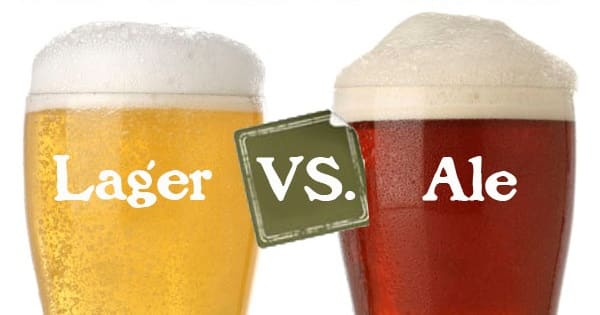
For a brewer, however, the difference between Ale and Lager is a fundamental piece of the entire process — since despite what is commonly believed, it is not the color, flavor or aroma, the varieties of hops or malt used, or even the hardness of the water that differentiates both types of beer.
Yeasts and Fermentation Temperatures
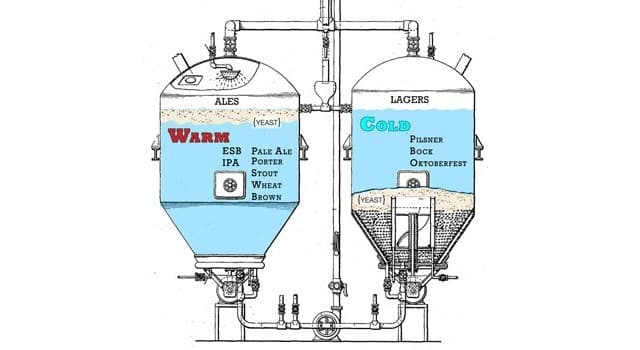
In short, Ale and Lager beers use completely different types of yeast during fermentation.
This means that many of the associated conditions — such as the different optimal fermentation temperatures or the different characteristic aromas and flavors — derive in chain from this fundamental difference.
Now, unlike Ale beers, Lager beers are relatively new on the brewing scene and first emerged in German breweries at the end of the 15th century, later spreading across Europe — with one of their most famous stopping points being the city of Plzeň, the birthplace of Pilsner Urquell.
At that time, Bavarian brewers used cellars, caves and warehouses to “store” their beer (Lagern in German), as in these cool, stable-temperature locations beer could mature undisturbed — and was subsequently called “Lagerbier.”
This is how all those beers commonly thought of as typical varieties from certain countries — Corona, Heineken, Tsing Tao, Sapporo, Kingfisher or Budweiser, to name a few — actually derive from these original Lagers.
The Discovery of Beer Yeast
Robert Hooke originally described cells in 1665 by observing a thin cork slice, thereby inspiring the work of Anton van Leeuwenhoek, considered the father of microbiology, whose studies in optics allowed him to observe them for the first time in 1680, giving rise to microscopy.
But it was not until 1857 that Louis Pasteur analyzed and understood the process of alcoholic fermentation, proposing that Saccharomyces cerevisiae yeasts were responsible for this process in beer.
After this, several more decades had to pass before, in 1904, Danish mycologist Emil Christian Hansen isolated the first Lager yeast, Saccharomyces pastorianus, while working at the Carlsberg brewery in Denmark.

The genome of the Lager yeast had many similarities to that of the Ale yeast, including identical genetic sequences, yet behaved in a completely different manner.
This fundamental difference is that Lager yeast works best at cold temperatures — temperatures that would cause an Ale yeast to enter a state of dormancy.
Furthermore, unlike Ale yeast, Lager yeasts have never been found in the wild in Europe, and human intervention has always been required to ensure their propagation.
Finally, Ale yeast typically lives as a diploid organism, while Lager yeast is what biologists call “allotetraploid” — meaning it has four copies of its genome, which in turn is composed of the genomes of two different species.
What Is the Origin of Lager Yeasts?
The questions that immediately arise are where Lager yeasts come from and why they only appear at the end of the 15th century, thousands of years after humans discovered how to brew beer with Ale yeasts.
The answer came in 2011, with the publication of the study “Microbial Domestication and the Determination of the Wild Genetic Heritage of Lager Yeasts.”
In it, researchers analyzed the genomes of six distinct yeasts: Saccharomyces pastorianus, Saccharomyces cerevisiae, two contaminating Saccharomyces species commonly found in breweries, Saccharomyces bayanus, Saccharomyces uvarum, and two wild strains.

Scientists already knew from previous studies that Saccharomyces grow in oak forests across Europe, and after collecting samples from around the world, two cold-tolerant yeast strains were isolated in the forests of Patagonia in South America.
After analyzing the genomes of the cold-resistant strains, researchers discovered they were members of a completely new Saccharomyces species, which they named Saccharomyces eubayanus.
The scientists also determined in this study that the contaminating strain found in Europe is not, as previously thought, actually a species unto itself, but rather a hybrid and domesticated strain of this Patagonian yeast.
The “eu” in “eubayanus” indicates that the Patagonian strain is the pure progenitor species — something of a thunderbolt in yeast taxonomy: two species go in, one comes out.
A follow-up study from November 2012 indicated that many different strains of Saccharomyces eubayanus exist in South America, reinforcing the argument that the variety is native to that continent.
Characteristics of Ale and Lager
Once researchers compared the genomes of Saccharomyces cerevisiae, Saccharomyces eubayanus and Saccharomyces pastorianus, it became evident that Saccharomyces pastorianus is a hybrid between the Saccharomyces cerevisiae and Saccharomyces eubayanus strains — essentially the allotetraploid lager yeast.
Two sets of chromosomes belong to ale yeast and two belong to this wild Patagonian species.
The Patagonian species is what gives Lager yeast its interesting cold-resistant and sulfite-metabolizing characteristics — traits that manifest in the distinctive flavor and character of a Lager beer.
These beers ferment and are then cold-stored for a period of weeks or months at temperatures around 5 to 7°C.
This prolonged, low-temperature fermentation produces beers that taste cleaner and lack the fruity esters characteristic of Ale beers.
Furthermore, due to sulfite metabolism, Lager beers typically smell strongly of rotten eggs during fermentation (this is normal), and a very (very) slight DMS character in the finished beer (formed from SMM present in the malt) is considered acceptable.
Differences Between Ale and Lager
The above explains why lager beers were only known a few centuries ago, as the arrival of Europeans in the Americas and the establishment of transatlantic trade occurred at the same time.
Although no one truly knows how the Saccharomyces eubayanus strain could have made its way to Europe, this may have happened via carriers such as fruit flies or the use of native timber.
Researchers speculate that the journey took place during the early years of transatlantic trade, ultimately ending up in the cold fermentation vats of Bavarian breweries in Germany.
The Birth of Lager Yeast
There, Saccharomyces eubayanus would have fused with Saccharomyces cerevisiae to form a hybrid strain, which then evolved within the Bavarian brewing environment.
The low temperatures and alcohol content would then have ensured the elimination of any unfit mutations, giving rise to a new brewing strain called Saccharomyces pastorianus — the modern lager yeast.
This strain, in turn, through local trade or even early corporate espionage, traveled to breweries across continental Europe and beyond; and just like Ale yeast, every time Saccharomyces pastorianus arrived in a new environment, it quickly adapted to its surroundings, giving rise to the various Lager strains available today.
Recommended
- “The Beer Hunter,” the series by Michael Jackson and Discovery Channel
- Non-alcoholic beer: production differences and health benefits