This post is also available in:
 Español
 Português
 Français
Beer carbonation is the amount of carbon dioxide dissolved in it, and it is governed by a law formulated in 1803. The more CO₂ pressure there is over the beer and the colder it is, the more gas it can hold, and that gas decides the foam, the bite on the tongue and the way the aromas reach you.
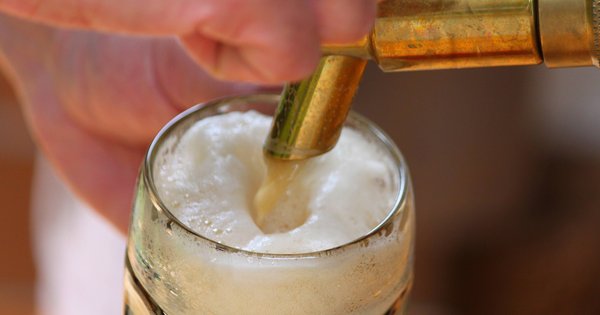
That relationship was described by the English chemist William Henry, and today it rules everything from the bottle cap to the regulator on a keg. That is why a British ale, a weissbier and a Czech pilsner can feel so different in the glass.

What Does Henry’s Law Say?
Henry read his experiments before the Royal Society in December 1802 and published them the following year in the Philosophical Transactions. He measured how much gas water absorbed at different temperatures and pressures, and saw that the dissolved amount grew in proportion to the pressure of the gas.
Put simply, at a constant temperature, doubling the CO₂ pressure over the beer doubles the gas that can stay dissolved. Cold pushes in the same direction, because a cold liquid holds more gas than a warm one.
The gas itself was already known. In the 17th century, Jan Baptista van Helmont had identified it as something different from ordinary air.
What Are Volumes of CO₂?
Carbonation is measured in volumes. One volume equals one liter of CO₂, measured at 0 °C and atmospheric pressure, dissolved in one liter of beer.
Converting it to grams is simple, because one mole of CO₂ weighs 44.01 g and takes up 22.414 L under those conditions.
[math]1\ \text{vol} = \dfrac{44.01\ \text{g}}{22.414\ \text{L}}[/math]
[math]1\ \text{vol} \approx 1.96\ \text{g/L}[/math]
Many lagers carry between 2.5 and 2.7 volumes, about 5 grams of gas per liter. At 2.5 volumes, every glass of beer holds two and a half glasses of gas waiting to get out.
Why Does Each Style Have a Different Level of Carbonation?
Because the gas changes what you perceive. Dissolved CO₂ forms carbonic acid, and in mice the bite of the gas is detected through the same tongue cells that sense sourness, with help from an enzyme called carbonic anhydrase 4.
Plenty of gas lightens the body, boosts the sense of freshness and carries the aromas up to the nose. Little gas leaves a rounder, softer beer, which is exactly what British styles are after.
The usual ranges run from 1.5 volumes in British ales to more than 5 in some German weizens. Between one end and the other there is more than three times as much gas.
This carbonation chart shows the reference levels by style family, with their equivalent in grams per liter.
| Style | CO₂ volumes | Grams per liter |
|---|---|---|
| British ales | 1.5 to 2.2 | 2.9 to 4.3 |
| American ales | 2.2 to 3.0 | 4.3 to 5.9 |
| European lagers | 2.4 to 2.6 | 4.7 to 5.1 |
| American lagers | 2.5 to 2.8 | 4.9 to 5.5 |
| Belgian ales | 2.0 to 4.5 | 3.9 to 8.8 |
| German weizens | 2.8 to 5.1 | 5.5 to 10.0 |
What Happens to the Gas in a Keg of Beer?
At the bar, CO₂ does two jobs at once. It pushes the beer up to the tap and keeps dissolved the gas the beer already carries, as long as the pressure is set to match the temperature of the keg.
Henry’s law makes it possible to calculate. The concentration of dissolved CO₂ equals Henry’s law constant times the pressure of the gas.
[math]c = H \times p[/math]
At 4 °C the constant for CO₂ in water is about 6.1 × 10⁻⁴ mol per cubic meter per pascal. With the regulator at 1 bar, the absolute pressure over the beer is about 201,300 Pa.

[math]c = 6.1 \times 10^{-4} \times 201\,300[/math]
[math]c \approx 123\ \text{mol/m}^3 \approx 5.4\ \text{g/L}[/math]
That equals 2.75 volumes, lager territory. At the same pressure with the keg at 20 °C, the constant drops to 3.9 × 10⁻⁴ and equilibrium falls to 1.75 volumes, a whole volume less.
The calculation uses the constant for pure water and works as an approximation. The equilibrium charts that draught technicians rely on give 2.48 volumes for a beer at 3.3 °C with 11 psi, about 0.76 bar, and the same formula gives 2.47.
That is why a warm keg keeps losing gas day after day and a pressure set too high ends up overcarbonating the beer. The visible symptom is the same in both cases, a tap that pours more foam than it should or a flat beer.
Serving temperature is not a matter of taste. Each style has its recommended temperature, and the keg pressure has to follow it.
Why Do a Cask Ale and a Czech Pilsner Feel So Different?
British cask ale does not rely on pressurized gas to reach the glass. It finishes fermenting in its cask, keeps little CO₂ and is served with a handpump that draws it up by suction, so it arrives in the glass soft and with few bubbles.
In the Czech Republic, control lies at the tap. Czech taps regulate the flow and the amount of foam, and they give rise to pours such as the hladinka, the šnyt and the mlíko, which change the ratio of beer to foam with the same lager.
Both traditions show that the gas is served too. The same beer can feel different depending on the pressure, the temperature and the tap that bring it to the glass.
Frequently Asked Questions (FAQ)
1. What Is Beer Carbonation?
It is the amount of carbon dioxide dissolved in the beer. It is measured in volumes, where one volume equals one liter of CO₂ per liter of beer, about 1.96 grams per liter. Many lagers carry between 2.5 and 2.7 volumes.
2. What Does Henry’s Law Say and What Does It Have to Do With Beer?
It says that, at a constant temperature, the amount of gas that dissolves in a liquid is proportional to the pressure of that gas above it. In beer it explains why a sealed bottle keeps its gas, why it fizzes when you open it and why a keg needs more pressure the warmer it is.
3. How Many Volumes of CO₂ Does Each Beer Style Have?
British ales range from 1.5 to 2.2 volumes, European lagers from 2.4 to 2.6 and German weizens from 2.8 to 5.1. Belgian ales have the widest range, from 2.0 to 4.5.
4. Why Does Warm Beer Lose Its Gas?
Because a warmer liquid holds less CO₂. At the same pressure of 1 bar, a beer at 4 °C reaches equilibrium at about 2.75 volumes and at 20 °C at about 1.75.
5. Why Does the Gas in Beer Prickle on the Tongue?
Because dissolved CO₂ forms carbonic acid. In mice, that bite is detected by the tongue cells that sense sourness, with help from the enzyme carbonic anhydrase 4, which is why carbonation also changes the perceived acidity.
References
Henry, W. (1803). Experiments on the quantity of gases absorbed by water, at different temperatures, and under different pressures. Philosophical Transactions of the Royal Society of London, 93, 29-42 and 274-276. doi.org/10.1098/rstl.1803.0004
Burkholder, J. B., Sander, S. P., Abbatt, J., Barker, J. R., Cappa, C., Crounse, J. D., Dibble, T. S., Huie, R. E., Kolb, C. E., Kurylo, M. J., Orkin, V. L., Percival, C. J., Wilmouth, D. M. and Wine, P. H. (2019). Chemical Kinetics and Photochemical Data for Use in Atmospheric Studies, Evaluation No. 19. JPL Publication 19-5, Jet Propulsion Laboratory. Henry’s law constant of CO₂ in water of 3.4 × 10⁻⁴ mol/(m³·Pa) at 298.15 K, as listed in the Sander (2023) compilation. henrys-law.org
Chandrashekar, J., Yarmolinsky, D., von Buchholtz, L., Oka, Y., Sly, W., Ryba, N. J. P. and Zuker, C. S. (2009). The taste of carbonation. Science, 326, 443-445. doi.org/10.1126/science.1174601
Brew Your Own. Carbonation Priming Chart. Carbonation levels by style. byo.com
Craft Brewers Conference (2022). Draught Beer Quality Workshop. Demystifying Dispense Gap. CO₂ equilibrium chart by pressure and temperature. craftbrewersconference.com

Recommended
- What Are the Bubbles in Beer? Home Experiments to Explain How They Form
- The History of Nitro Beers: Science and Future