This post is also available in:
 Español
 Português
 Français
It could be said that saison beers were an early form of “fuel” on pre-industrialized farms, a crucial component for the success of the harvest season in the old country houses of the French-speaking region of Wallonia, in Belgium, of course.
Today, Saisons represent much more than a historical relic. They are a living testimony to how practical necessity can give rise to a lasting cultural expression.

For the modern consumer, understanding Saison means understanding a brewing approach that prioritizes the expression of terroir, creative flexibility, and the search for balance between complexity and drinkability.
This philosophy resonates deeply in the current craft beer revolution, where authenticity and connection to origin are rising values.
Since drinking water was often not available in these rural areas, the development of a safe beverage was essential for the subsistence of the farms and their workers.
Origins of Saison Beer
Farmers brewed Saison in autumn so it would ferment in winter, tempering unwanted fermentation byproducts along the way and keeping insects at bay, so they would be ready for consumption once summer began.
The availability of this beer was particularly critical during these hot months, since seasonal workers, “les saisonniers,” literally survived thanks to its consumption, which could reach 5 liters per day, while tending to agricultural crops.
To better contextualize Saison within the European brewing landscape, it is useful to compare it with other farmhouse styles.
French Bière de Garde, for example, shares the rural and seasonal origin, but is distinguished by a more malty, less spicy profile and a more moderate carbonation, reflecting the preferences of northern France.
On the other hand, Grisette, also from the Hainaut region in Belgium, was traditionally lighter and intended for miners rather than farmers, with a more neutral and refreshing character.
These subtle distinctions underscore how working conditions, local resources, and cultural traditions shaped unique styles within the same family of seasonal beers.

These farmhouse beers, Farmhouse Ale as they are commonly known in the USA, but not in Europe, where this definition refers rather to a family of seasonal beers, initially had an alcohol content of around 3.0% ABV, which allowed quenching the thirst of “les saisonniers” throughout the day without alcohol preventing the continuity of work.
Each farm developed its own recipe, so these original Saisons could vary enormously from one another; however, there were some similarities; they often contained a fair dose of hops to help prevent spoilage and many used local herbs and spices.
On the other hand, some farmers combined the latest production with aged versions or fruit lambics in order to add acidity.
Yeast Reuse
A peculiarity also emerged in many of them, since farmers with fewer resources reused the same yeast every year, even to this day, so many consider Saisons not as a well-defined style, but rather as a collection of refreshing summer beers.
Over time, many of these small farms and country houses became small breweries, which is why production and recipes were slightly altered, now producing more alcoholic versions, no longer made to be consumed during field work, and introducing new spices and other “exotic” ingredients such as beet and cane sugar.
The Birth of the Modern Saison
With the industrialization of agriculture after World War II, the work of “les saisonniers” was greatly diminished on Walloon farms.
On the other hand, the invention of refrigeration and increasingly widespread drinking water networks mitigated the need for these summer beers, leading to the near disappearance of Saison production in the 1950s, with only a few small craft breweries continuing this tradition.

It was only from the 1980s that the popularity, production, and appreciation of Saisons revived. “Saison Dupont,” in fact, brewed by Brasserie Dupont for the first time in 1920 and named “best beer of the year” in 2005, is considered the “model” Saison par excellence.
It was also thanks to it and the ever-visionary Michael Jackson, who literally saved it from disappearing, that dozens of American and worldwide breweries have experimented and attempted to develop this rustic approach to brewing.

What to Expect from a Saison Beer?
Modern saisons are among the most complex beers in existence, of ale fermentation, generally unfiltered, bottle-conditioned and sometimes using dry hopping.
They are often brewed with pilsner malt and occasionally using candy sugar typical of higher-gravity Belgian beers.
The hops used are generally noble, Saaz, Styrian and East Kent Goldings most of the time, reinforcing the characteristic dryness of the style.
The yeast strain is temperamental, highly attenuative, developing a strong, spicy, dry and sometimes sour flavor.
There is no single recipe; it is a very difficult style to define (an anti-style for some), which can even include delicate touches of herbs and spices.
| Parameter | Range |
| Original Gravity (°Plato) | 1.040 – 1.080 (10 – 19.3 °P) |
| Final Gravity (°Plato) | 1.008 – 1.014 (2 – 3.5 °P) |
| Alcohol by Volume (ABV) | 5.0% – 9.3% |
| Bitterness (IBU) | 20 – 40 |
| Color (SRM) | 3 – 20 (6 – 40 EBC) |
Enjoying a Saison at its maximum potential requires attention to two practical aspects: serving temperature and pairing. The ideal temperature ranges between 6 and 10°C. Too cold a serving can hide its aromatic complexity, while excessive temperature can exaggerate alcohol and phenols.
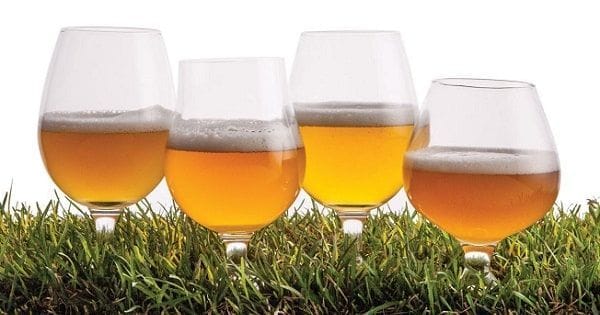
As for glassware, a tulip glass or a Belgian-style glass concentrates the aromas and allows appreciating the effervescence and foam retention, key characteristics of the style.
At the table, the versatility of Saison is one of its greatest virtues. Its moderate acidity, high carbonation and dry finish make it an exceptional companion for dishes that other beers could overwhelm.
It works wonderfully with grilled seafood, especially steamed mussels with herbs, a classic in Belgium. It also complements poultry dishes with creamy or mustard-based sauces, where the beer cuts the fat without competing in intensity.
For cheeses, look for soft, washed-rind options like a Herve or a Limburger, where the beer cleanses the palate between bites. Even in pastry, a Saison with citrus notes can enhance desserts based on white fruits or yogurt.
General Characteristics of the Style
It is a family of refreshing Belgian beers, highly attenuated, hoppy and quite bitter, with a very dry finish and high carbonation.
They are characterized by a fruity, spicy and sometimes phenolic fermentation profile, combined with the use of grains and sometimes spices to increase their complexity, with various variations in terms of intensity and appearance.
Beyond the iconic Saison Dupont, the current landscape of quality producers is broad and diverse. In Belgium, breweries like Brasserie de Blaugies, with its organic approaches and use of local ingredients, or Fantôme, known for its artisanal and almost unpredictable approach, push the limits of the style.
Outside Belgium, the American interpretation has been particularly influential. Breweries like Hill Farmstead in Vermont or The Alchemist have adopted the Saison philosophy, often combining it with aggressive dry hopping techniques to create highly appreciated aromatic hybrids.
This globalization of the style has generated a dynamic market where innovation coexists with tradition, offering the consumer a range of options from the most orthodox to the experimental.
From a commercial perspective, the Saison style presents a strategic opportunity for breweries seeking to differentiate themselves.
Its historical narrative, its brewing flexibility and its complex but accessible flavor profile make it a product with strong potential to attract both enthusiasts and curious consumers looking for something beyond standard IPAs or Lagers.
The key to capitalizing on this opportunity lies in authentically communicating the style’s history and maintaining a balance between creativity and drinkability that defines the best Saisons.
Frequently Asked Questions (FAQ)
1. Is Saison always a high-alcohol beer?
Not necessarily. While modern versions usually range between 5 and 9% ABV, historical Saisons were notably lighter, around 3% ABV, designed for hydration during the workday. Today there are “table beer” or session interpretations that recover that philosophy of low alcohol and high refreshment.
2. Why do some Saisons have a sour or acidic character?
This can be due to two main factors. First, the use of wild yeasts or lactic acid bacteria, a traditional practice on some farms to add complexity and preservation. Second, the high attenuation of Saison yeasts, which ferment almost all available sugars, resulting in an extremely dry finish that can be perceived as a clean acidity, distinct from bacterial acidity.
3. Is it a suitable style for those starting out in craft beer?
Absolutely. Its balanced profile, without extreme dominance of bitterness, sweetness or alcohol, makes it an excellent gateway. The aromatic complexity invites sensory exploration, while its refreshing character makes it accessible and versatile for different consumption occasions.