This post is also available in:
 Español
  Português
The Spanish Association of Sommellerie and Beer Culture (ASYCCE) has established the Mediterranean Lager as the country’s first officially native style, with a technical description including sensory parameters, an ad hoc beer prototype, and a roadmap aimed at international recognition.
The formal identification comes at a time when the concept of “Spanish Lager” has been generating volume in the British market for years, one of the most competitive and barometric markets in the world for imported lagers.
The problem is that a good part of those “Spanish lagers” are not made in Spain. Madrí Excepcional, the most successful on-trade launch in Britain in recent years, comes out of Molson Coors’ facilities in North Yorkshire. Cruzcampo is bottled in Manchester. San Miguel was brewed for years in Northampton.

According to Estrella Galicia, 80% of the so-called “world lagers” on British supermarket shelves are made in the United Kingdom.
The paradox is that the market already identifies it, but the productive benefit stays at another latitude. ASYCCE responds to this with a proposal that goes beyond marketing: establishing the technical parameters that allow any brewery to replicate the style with verifiable criteria.
What exactly is a Mediterranean Lager?
The association’s definition is precise in its identifying traits. A Mediterranean Lager is very pale, bright, and highly attenuated. Drinkability and freshness are its fundamental values, not secondary attributes.
The aromatic profile is built on subtle and elegant citrus notes, coming from hops or the incorporation of local fruits such as lemon or mandarin. The body is light.
The most singular trait, and the one that best anchors the style to a specific territory, is the mineral or saline touch that defines the finish. The association describes it as the evocation of coastal influence:
The experience of opening a beer after coming out of a swim in the sea.
That mouthfeel is not accidental, as it is the differentiating trait that distinguishes the style from any generic continental lager.
The technical work has been carried out by a working group created in early 2026 within ASYCCE, with the participation of beer sommeliers, R&D experts in brewing, and the vision of Mateo Sanz, master brewer and international tasting judge, founder of Cervezas SanFrutos together with his brother Adrián.
The prototype that materialized the definition
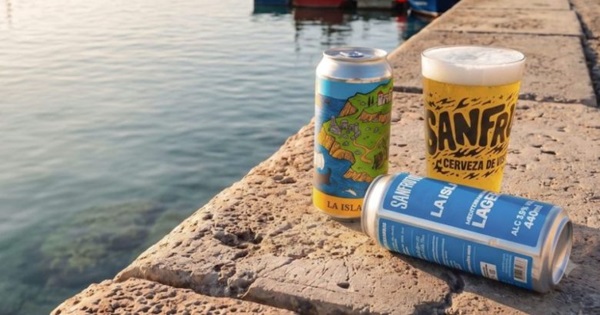
The working group did not stop at abstract description. The tangible result is La Isla, a beer from Cervezas San Frutos specifically designed to embody the style. 3.9% alcohol, 44 cl can format, “elegant, light and very refreshing” in its own descriptor. Citrus and floral notes on the nose. The mineral aftertaste that articulates the coastal identity of the style.
The prototype serves a dual function: demonstrating that the technical description is reproducible and providing a concrete reference against which other breweries can compare their own interpretations. It is not the only exponent of the style, but it is the one that officially defines it.
The breweries that were already making it before it had a name
ASYCCE explicitly recognizes that the style was not born in the working group, but in national brewing practice. The breweries identified as precursors are Garage Beer Co. (Barcelona), La Pirata (Lleida), Althaia (Altea, Alicante) and Yakka (Yecla, Murcia).
Four breweries that, intuitively, had been brewing bottom-fermented beers adapted to the Mediterranean climate, with local ingredients and a sensory profile oriented towards the coastal consumer.
Althaia, from Altea, even had a registered reference as “Mediterranean Lager” before the formal codification. The style existed as a shared concept within the Spanish craft segment without anyone having drawn the technical boundaries that would make it reproducible and defensible against third parties.
The dual strategic objective of codification
ASYCCE has been clear about the two objectives it pursues with this initiative. The first is internal: organizing local identity by creating a recognizable technical framework for brewers, tasting judges, and consumers.

The second is external: providing small breweries with a presentation letter with institutional endorsement to open international markets.
The potential in the United Kingdom is evident. “World lagers” have gone from representing 19% of on-trade value in Britain before the pandemic to 29% today. Volume is growing at 10.3% annually.
The British consumer is already actively seeking the sensory profile described by the Mediterranean Lager; the problem is that they are often buying it in versions brewed hundreds of kilometers from the Spanish coast.
ASYCCE’s codification does not automatically solve that problem, but it creates the necessary technical infrastructure for Spanish breweries to compete with a verifiable authenticity argument.
Heineken has argued that “authenticity should be defined by taste and quality rather than geographic location.” ASYCCE proposes exactly the opposite: that origin be a constitutive part of the style.
Competition, expansion, and global recognition
The official presentation of the style took place in its natural environment, on the Mediterranean Sea, in a tasting in the form of a journey through La Manga del Mar Menor.
The event was exclusive to professionals from the brewing and gastronomic sectors. The four proto-styles from the pioneering breweries and La Isla were tasted, paired with regional cuisine.
The roadmap includes organizing a specific competition for the style, with the declared ambition that the Mediterranean Lager be formally recognized globally.
ASYCCE will assume the role of validating, providing technical support, prescribing, and disseminating the style so that breweries across the country can appropriate it and use it as a spearhead for export.
If the process prospers, Spain will have built in a few years what other countries took decades to achieve: a recognizable style, with technical descriptors, an institution that endorses it, and an international market that already demands exactly that.
Frequently Asked Questions (FAQ)
1. What is the Mediterranean Lager?
The Mediterranean Lager is Spain’s first native beer style, codified in 2026 by the Spanish Association of Sommellerie and Beer Culture (ASYCCE). It is defined as a very pale, bright, and highly attenuated lager, with subtle citrus aromas, light body, and a characteristic mineral or saline touch that evokes Mediterranean coastal influence.
2. Who codified the Mediterranean Lager?
ASYCCE, with the participation of beer sommeliers, R&D experts in brewing, and master brewer and international judge Mateo Sanz, founder of Cervezas SanFrutos. The work was developed in a working group created in early 2026 and has as its reference prototype the beer La Isla, from Cervezas SanFrutos.
Which breweries were already making this style?
ASYCCE identifies as precursors Garage Beer Co. (Barcelona), La Pirata (Lleida), Althaia (Altea, Alicante) and Yakka (Yecla, Murcia). Althaia even registered a reference with the name “Mediterranean Lager” before the association’s formal codification.
Why is it important for Spain to have a native style?
Because the international market, especially the British one, already consumes beer with the sensory profile of the Mediterranean Lager in large volumes, but a significant part of that demand is satisfied by versions brewed outside Spain. Technical codification provides Spanish breweries with a verifiable authenticity argument to compete in those markets.

You may also be interested in
- Saison, the style born from work that conquered the world
- History of IPA: how a style built a global identity