This post is also available in:
 Español
  Português
Beer is typically analyzed mainly from the aspects of flavor, aroma, and appearance; however, there is a sensory dimension that is decisive for the consumer experience, which is mouthfeel.
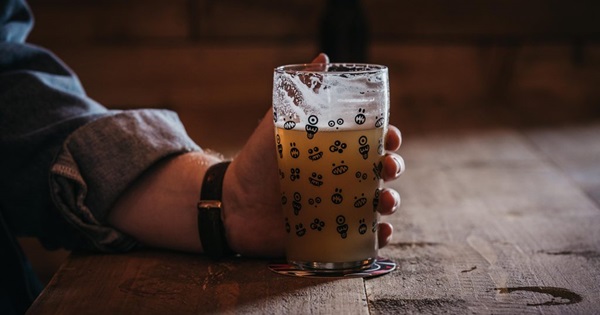
This refers to the tactile, thermal, and chemical perceptions that a beer provokes in the oral cavity. Although for a long time it has been a little-explored variable, recent research underscores its importance for proper product acceptance, especially in segments such as non-alcoholic or low-alcohol beers.
What Do We Understand by Mouthfeel?
Mouthfeel can be defined as the set of perceptions that do not come directly from taste (sweet, sour, bitter, salty, umami) nor solely from smell, but from the physical, thermal, or chemical interaction of the beverage with the mouth, tongue, palate, and throat.
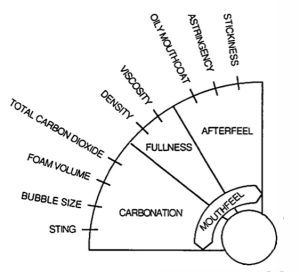
According to Wolinska-Kennard et al., this includes sensations such as carbonation, smoothness, viscosity, astringency, alcohol warmth, or thermal coolness.
Specifically in beer, mouthfeel encompasses sensory terms like body (fullness), dryness, viscosity, effervescence, persistence, or alcoholic warmth.
Since these perceptions play a role in shaping preference for a product, their measurement and detailed description are increasingly relevant for brewers.
Neurophysiological Foundations
To understand how mouthfeel is generated, it is necessary to review the sensory mechanisms involved.
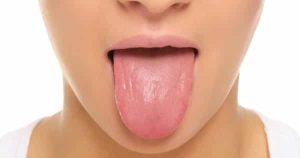
The sensation is not limited to the gustatory or olfactory nerve but incorporates the trigeminal nerve (responsible for tactile, thermal, and irritative sensations) and mechanosensory receptors, thermoreceptors, and chemoreceptors.
These receptors respond to chemical, thermal, or mechanical stimuli and are responsible for translating the physical into concrete sensations:
- TRPV1 detects heat and capsaicin (as in chili peppers), generating sensations of heat or burning.
- TRPM8 is activated by low temperatures and menthol, causing a sensation of freshness.
- TRPA1 reacts to irritants like mustard or wasabi, producing tingling or prickling.
- ASICs (Acid-Sensing Ion Channels) respond to acidity, contributing to the sour or sharp sensation.
- ENaC (Epithelial Sodium Channels) mediate the perception of saltiness.
- Tactile Mechanoreceptors register texture, pressure, and viscosity, key to the sensation of body.
Together, these systems form a biological language of gustatory touch, where each stimulus provides a layer of information that the brain integrates with taste and smell to form the complete beer experience.
How is Mouthfeel Developed?
The design of the beer, from the selection of ingredients to fermentation and maturation, directly influences mouthfeel.
Ingredients and Mashing
The choice of malts, the use of unmalted cereals, the content of dextrins, beta-glucans, or arabinoxylans affects the perceived viscosity and body.
Furthermore, the wort structure (degree of malt modification, grain size, mashing temperature) affects the profile of polysaccharides and peptides that will influence the final texture.
1. Water Chemistry
Water hardness, mineral content, and ionic balance impact tactile perception. A higher proportion of sulfates, for example, can increase dryness and accentuate bitterness, which modifies mouthfeel independently of flavor.
2. Fermentation, Alcohol, and Carbonation
Alcohol content adds warmth and weight in the mouth, while carbonation contributes to tingling and a light sensation. The choice of yeast, fermentation temperature, and maturation condition these factors.
3. Maturation and Storage
Proper maturation can soften aggressive textures, stabilize foam, and adjust the interaction between the beer and saliva.
In non-alcoholic or low-alcohol beers, mouthfeel is often perceived as “lighter” or “watery” as they lack the same structural support that alcohol provides.
Thus, every decision in the brewing process contributes to the final tactile profile of the beer.
The Need for a Sensory Lexicon
In the realm of beer, the description of mouthfeel suffers from a lack of precise common language. Traditionally, terms like “body,” “smoothness,” “dryness” have been used, but without accepted standardization.
Research such as that by Wolinska-Kennard highlights the lack of correlation between specific compounds and tactile sensations, making the deliberate formulation of mouthfeel profiles difficult.
The goal of developing a sensory lexicon tailored to the beer world is to provide the industry with a tool capable of describing, comparing, communicating, and controlling mouthfeel across sensory panels, laboratories, and even consumers.
The proposal for this type of lexicon should consider descriptors such as “body,” “perceived effervescence,” “tactile smoothness,” “tactile persistence,” “residual dryness,” “alcoholic warmth,” among others.
By having these terms well-defined and with sensory references, brewers can link them to process variables and ingredients, facilitating the intentional design of sensory profiles.
Challenges and Future Perspectives
Although progress is being made, significant challenges remain. One of these is the correlation between instrumental measurements (rheology, tribology, particle size, salivary analysis) and actual human perception.
Research in other fermented beverages like wine has made progress, such as detecting relationships between instrumental viscosity and sensory evaluation of viscosity.
In beer, more research is needed linking compounds like polysaccharides, alcohol, CO₂, proteins, and polyphenols to specific mouthfeel sensations.
Likewise, the growing interest in non-alcoholic or low-alcohol beers makes texture, body, and mouthfeel key factors for differentiation and quality.
The future involves integrating sensory analysis, chemistry, processing, and panel training tools so that mouthfeel ceases to be a “silent ingredient” and becomes a beer design parameter as important as aroma or color.
Examples and Practical Application
For the mouthfeel lexicon to be truly useful, it is not enough to define terms: it is necessary to observe how they manifest in different styles and tasting contexts.
1. Body
“Body” describes the perceived density and the sensation of weight or volume that the beer leaves in the mouth.

In an Imperial Stout, the body is usually high, with a dense, oily texture that coats the palate, resulting from a high content of dextrins, proteins, and alcohol.
In contrast, a Pilsner-type lager offers a light, dry body with quick dissipation and low viscosity, resulting from clean fermentation and a soft water mineral profile.
Body is closely related to wort viscosity and fermentative attenuation, variables that the brewer can control through mashing temperature or the use of caramel malts and adjuncts rich in polysaccharides.
2. Smoothness and Viscosity
Tactile smoothness refers to the absence of harshness or oral roughness. A Witbier with oats or wheat tends to have a creamy, silky texture due to its content of suspended proteins and non-fermentable polysaccharides.
In contrast, a dry, heavily hopped IPA may show a rougher texture, with some astringency derived from hop polyphenols.
Perceived viscosity can also be modified through filtration techniques, cold crashing, or the use of nitrogen, which generates finer bubbles and a velvety sensation, as in many Irish stouts.
3. Carbonation and Liveliness
Carbonation affects the sensation of freshness, lightness, and effervescence. A Belgian Strong Golden Ale usually presents high carbonation, with fine bubbles that stimulate the palate and enhance the dry finish.
Conversely, a Porter or Milk Stout maintains moderate to low carbonation, which favors the sensation of body and smoothness.
From a technical standpoint, carbonation pressure and serving temperature determine the persistence and aggressiveness of the gas.
Excess CO₂ can increase the perception of acidity or bitterness, while low carbonation can flatten the sensory experience.
4. Astringency and Dryness
Astringency describes the constriction of mucous membranes and the dry sensation left by the beer after swallowing. It is usually associated with the presence of tannins or polyphenols from hops or roasted malt.
In a Dry Stout, this light astringency adds structure and cleanliness; in an unbalanced IPA, however, it can be perceived as a defect.
The sensation of dryness, on the other hand, can derive from both astringency and high fermentative attenuation or the use of sulfates in the water.
A “dry” beer is not necessarily astringent, but both contribute to the perception of a “clean finish” in the mouth. Dryness is a perception of the absence of residual sweetness, while astringency is a tactile sensation of mucous membrane constriction; they can coexist but have different origins.
5. Alcoholic Warmth
Alcoholic warmth comes from the interaction of ethanol with heat-sensitive trigeminal receptors (TRPV1).
In a Barleywine or a Quadrupel, alcoholic warmth adds roundness and complexity, while in a lower-density beer it can be sharp or unbalanced.
The sensation of warmth is influenced by both alcohol content and the presence of secondary compounds (fusels, esters), fermentation temperature, and maturation time.
6. Tactile Persistence
Tactile persistence describes how long the physical sensation of the beer remains in the mouth after swallowing.
In styles like Imperial Stout, Wee Heavy, or Doppelbock, this persistence is intense, with a sensation of viscosity that prolongs the tactile perception of body.
In drier styles, like Pale Ale or Saison, tactile persistence is minimal, which contributes to a more effervescent and refreshing impression.
This attribute can be modified by the balance between residual sugars, high molecular weight proteins, and lipid content.
Thermal and Trigeminal Sensations
In addition to alcohol warmth, there are sensations of freshness or prickling associated with volatile compounds, acidity, or carbonation.
Beers with natural minty notes (gruit, aromatic herbs, ginger) or with high lactic acidity, such as Berliner Weisse, can produce coolness or tingling on the tongue and gums.
Controlling these perceptions involves adjusting the final pH, CO₂ level, and secondary volatile compounds from the fermentation process.
Sensory Integration and Professional Application
The development of a mouthfeel lexicon allows brewers, judges, and sensory panels to establish a coherent description methodology, linking perceptions to concrete technical decisions.
Frequently Asked Questions (FAQ)
1. What is the exact difference between beer “body” and its “viscosity”?
Although often used interchangeably, technically they are not the same. Body is a subjective sensory perception of fullness and weight on the palate, influenced by proteins and alcohol. Viscosity, on the other hand, is a physical property of the liquid (resistance to flow) determined mainly by the concentration of beta-glucans and dextrins. A beer can have a lot of body due to its alcoholic warmth without necessarily being viscous or “thick”.
2. Why do non-alcoholic craft beers often feel “watery”?
The “watery” sensation or lack of structure is due to the absence of ethanol, which adds density and a surface tension different from water. Furthermore, by limiting fermentation to keep alcohol low, there is usually a lower amount of glycerol and yeast by-products that normally contribute to the richness and mouth-coating characteristic of traditional beers.
3. How does the type of gas (CO2 vs. Nitrogen) influence the texture of beer?
The difference lies in bubble size and solubility. Carbon dioxide (CO2) produces larger bubbles that cause a “prickling” or trigeminal tingling (effervescence). Nitrogen (N2), being much less soluble, creates tiny bubbles that do not irritate tactile receptors in the same way, resulting in that creamy, silky, almost milky texture typical of Irish Stouts.
4. What is the relationship between water hardness and palate dryness?
Mineral balance is key. High levels of sulfates accentuate the perception of dryness and make hop bitterness feel more “crisp” and short. Conversely, chlorides tend to enhance malt fullness and smoothness, giving a rounder, sweeter mouthfeel, independent of actual residual sugar.
5. Is astringency the same as bitterness?
No. Bitterness is a basic taste detected by taste buds (chemical receptors). Astringency is a tactile sensation (trigeminal) of dryness, roughness, or constriction on the gums and tongue. It is caused by the reaction of polyphenols (tannins) with proteins in saliva, which removes the mouth’s natural lubrication; it is a physical sensation, not a flavor.
References
Wolinska, K., Kennard, C., & Smart, K. (2021). Mouthfeel in beer: A review of sensory perception, analytical methods and product design. Journal of the Institute of Brewing, 127(3), 229–242. https://www.researchgate.net
We Recommend
- Why Do Some People Get Drunk Faster Than Others?
- Why You Should Never Serve or Drink Your Beer in a Frozen Glass