This post is also available in:
 Español
  Português
Pierre Celis was the man who put the small Belgian village of Hoegaarden on the world beer map when in the 1960s he revived a beer style made with wheat and the addition of spices and fruit known as Witbier (white beer).

The Witbier style descends from those medieval beers brewed with a mixture of herbs and spices known as “Gruit,” and takes its name from the hazy (white at low temperatures) appearance given by the suspended wheat proteins and yeasts.
The earliest records of its production date back to the 15th century in the Belgian region of Flemish Brabant, where the rich, dark soil is ideal for growing barley, oats, and wheat.
In those years, the small town of Hoegaarden already had a brewers’ guild that by the 17th century counted almost 30 active breweries throughout the town.
The special character of the white beers of Brabant came not only from the use of wheat and oats alongside barley malt, but also from the spices and exotic fruits brought to the Low Countries by Dutch merchants.
For centuries, Hoegaarden was considered the epicenter of this beer style, but it was in the 20th century that breweries began to close, unable to compete with the mass-marketed industrial lagers.
Pierre Celis, the milkman
Pierre Celis was born on March 21, 1925, in the family home located beside the main square of Hoegaarden. He grew up working on his father’s farm and, as an adult, became a milkman, part of the family business of collecting milk from producers, bottling it, and making butter and cheese that they distributed throughout the town.

It was during his student years that Pierre Celis also helped out at the brewery of his neighbor Louis Tomsin, owner of Brouwerij Tomsin, which in 1955 would become the last brewery to produce the Witbier style in Hoegaarden, ending a tradition that had spanned at least 500 years.
The revival of the Witbier style
Nearly 10 years after the closure of the Tomsin brewery, one night in 1965, Celis was drinking in a bar with some friends when they began to reminisce about the many local beers that had disappeared.
It was then that Celis, helped by Marcel Thomas, a retired director from the Loriers brewery, decided to brew a batch of the lost white beer in his wife Juliette’s copper tub.
Recalling the process and ingredients from his teenage years at the brewery, and finding grains and hops readily available, he added to his recipe ground coriander seeds, Curaçao orange peel, and a third “secret” ingredient that was probably cumin seeds.
Celis ultimately decided to honor his hometown with this beer and named it Hoegaarden.
The result of this first experiment was so positive that Celis decided he would try to commercially develop a brewery whose goal would be to brew a white wheat beer in small batches, enough to supply the local trade.
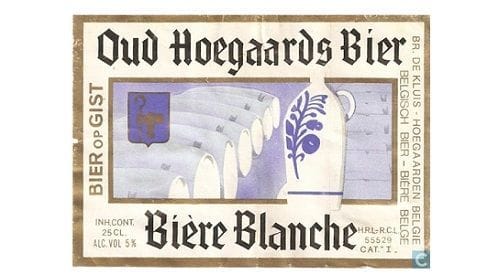
A year later, on July 1, 1966, Celis obtained his first license as a beer producer, founding Brouwerij Celis and officially launching his beer named Oud Hoegaarden.
Little by little, Celis’s Witbier began to be sought after in neighboring towns and production grew to the point of having to seek financing to increase output and meet rising demand.
In 1979, with a loan from his father, Celis purchased the recently closed lemonade factory in Hoegaarden, so that with two facilities running at full capacity he could meet demand for the product. In 1980 he renamed the brewery Brouwerij de Kluis (“The Cloister” or “The Hermitage”).
It was at this time that the brewery’s now-iconic logo was created, based on two shields containing a mashing paddle and a bishop’s crozier held by a hand.
Rapidly after this, the reborn Witbier style began to break into the important Antwerp market and then into the Netherlands, France, and Great Britain, proving very popular among university students who considered it a more natural beer.
Around this time Celis also began using the distinctive six-sided crystal glass in which Hoegaarden continues to be served, having come across an Italian prototype in a shop in town by chance.
Destruction of the Kluis brewery
By 1985, production had grown rapidly to 300,000 hectoliters per year and Celis had just begun exporting his Witbier to the United States a couple of years earlier (renamed Hoegaarden Witbier), when a fire completely destroyed the brewery building, which was not insured for that type of accident.

Devastated and with no financial options, Celis decided to turn to the Stella Artois brewery in Leuven for help, and they offered to invest in exchange for a 60% stake in the business.

It was then that, according to Celis, “the bankers took over.” They wanted him to produce white beer and other beers that had been introduced to the market through a process known as “high-gravity brewing,” which consisted of producing a single very alcoholic beer and then diluting it with water to create different styles.
In this new scenario, Celis had almost no say in the direction of the new brewery, which led him, at the age of 65, to sell his remaining stake.
Later, in 1988, the Artois brewery merged with the Piedboeuf brewery in Jupille, near Liège, to give birth to Interbrew, now part of the brewing giant AB InBev.
Searching for new horizons in the USA
With the capital obtained from the sale of the Kluis brewery and given the recognized interest that Hoegaarden had generated in the United States, Pierre Celis decided in 1992 to emigrate with his family and start a new microbrewery called Celis Brewery in Austin, Texas.

According to his daughter Christine, for this new venture Pierre had to carry his yeast in vials hidden inside his own socks.
For the development of this new project, Celis decided to seek the support of local investors, and not long after he managed to bring the first product of the new brewery to market. Its name: Celis White.
His brewing experience quickly earned him recognition at the Great American Beer Festival in the wheat beer category.
At the same time, Celis White received praise as a world-class beer from the late beer writer Michael Jackson.

He later added other beer styles to the Celis Brewery portfolio that were also met with great acclaim.
Even so, the beers Celis brought to the United States were somewhat ahead of their time, and by 1995 financial problems were not long in coming. The original investors decided to pull out of the business, so Celis found himself needing a new investor: Miller Brewing Company.
At first, the entry of this new partner encouraged Celis to continue his American adventure, but Miller quickly began interfering with the recipes, reducing the quality of ingredients in order to maximize profits. Sales soon collapsed and Celis once again decided to step away from the business, selling his remaining stake.
By 2002, Miller Brewing Company decided to sell the Celis brand to Michigan Brewing Company, who continued producing its products until their closure in 2012 but were never able to replicate the quality of the original beers brewed by Celis Brewery, even after hiring Pierre himself as a consultant.
Pierre Celis returns to Belgium
At the start of the new millennium, Celis decided to return to his native Belgium, and one of the first things he discovered was that Interbrew was planning to close his former brewery and transfer production to the Jupille facility.
The news caused outrage throughout Dutch-speaking Belgium (Jupille is located in the French-speaking region) and for a time there were massive protests across the town, with most shops and homes displaying a sign bearing the slogan “Hoegaarden is brewed in Hoegaarden.”

The beer brewed in Jupille was very poorly received, and the now-rebranded InBev brewery decided to return to Hoegaarden and reopen the brewery in 2007.
Celis, by then around 80 years old, continued to develop collaborations, such as the one with St. Bernardus Brewery in the village of Watou. In North America he also joined forces with Real Ale Brewery in Blanco, Texas, to launch a new wheat beer.
Finally, the indefatigable Pierre Celis died on April 9, 2011, at the age of 86, leaving behind one of the great legacies in the history of modern craft beer.
Almost a year after Pierre Celis passed away, in 2012, his family finally managed to recover the rights to the Celis name in the United States, after the assets of Michigan Brewing were auctioned off following its closure.
A new generation looking to the future
Today, it is the Belgian brewery Van Steenberge that holds the rights to brew Celis White in its native Belgium.

Meanwhile, his daughter Christine and granddaughter Dakota have reopened the Celis Brewery in the United States, recreating Pierre’s original Austin brewery and raising funds to recover the original brewing equipment he used in 1966, which will be displayed in a museum adjacent to the new facilities.
To close this story, Christine was able to recover the original yeast strain her father used in Hoegaarden, which had been stored in Belgium for preservation and propagation, obtaining enough supply for the opening of the renewed Celis Brewery 3.0.
Recommended
- What Is pH and How Does It Affect the Beer Brewing Process?
- The 10 Best Beer and French Food Pairings to Try