This post is also available in:
 Español
  Português
The history of the St. Bernardus brewery is strongly linked to two Trappist abbeys. It was first in 1904, due to the anti-clerical policies of the time in France, that the monks of Catsberg Abbey (Mont des Cats) decided to move a few kilometers north to Belgium and settle on a small farm in the town of Watou.
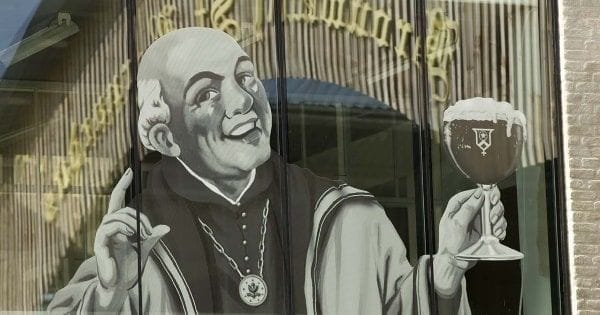
As is customary in the Cistercian Order, the monks decided at that time to begin working to generate income for their subsistence and to carry out charitable works, so for this they transformed the farm into a cheese factory, which they called “Refuge Notre Dame de St. Bernard.”
Years later, when the monks were finally able to return to France in 1934, the rights to produce cheese in Watou were acquired by Evarist Deconinck.
The arrival of Westvleteren Abbey
More than a decade later, in 1946, the Trappist monks of St. Sixtus Abbey in Westvleteren, located 10 km from the St. Bernardus cheese factory, found themselves needing to undertake a series of restoration tasks at the abbey.
Because of this, the monks decided to limit their beer brewing only for personal consumption and for three cafes near the Abbey (In De Vrede among them), so they decided to sell Evariste Deconinck a license for commercial brewing to finance the works.
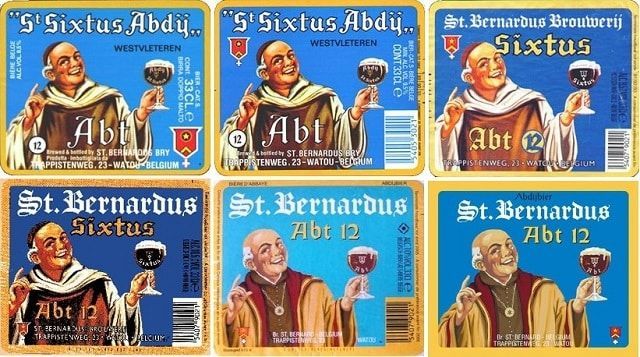
Deconinck built a new building next to the cheese factory that allowed him to brew the beer which they called “Sixtus of Watou,” which was usually labeled as “St. Sixtus Abbey – Westvleteren.”
The now St. Bernardus Brewery began brewing the same beers brewed at the abbey, always under the command of Evariste Deconinck, who partnered with the then Polish-born master brewer of St. Sixtus, Mathieu Szafranski, who brought with him the original knowledge, recipes, and yeast strain used by the monks.
Later, in 1959, Evariste Deconinck decided to sell the cheese factory and concentrate his efforts solely on the brewery, which, in the early 60s, negotiated a new license with the monastery for another 30 years.
Authentic Trappist Product (ATP)
It was during the 1980s that the Trappist monasteries saw how some private producers of commercial beers took advantage of the fame of monastic products, selling beers under the name “Abbey” with very uneven quality.

At that time they decided to create a protected designation of origin that would protect their products and their quality standards under the name “Authentic Trappist Product” which currently recognizes 12 abbeys that produce Trappist beers in Belgium, the Netherlands, Austria, Italy, the USA, and England for the use of this seal in beer brewing.
Since the beers brewed at the St. Bernardus brewery could not be considered authentic “Trappist”, the monks of St. Sixtus had to revoke their licensing agreement with the St. Bernardus brewery, which stopped brewing their beers under the Westvleteren name as of 1992.
St. Bernardus beers
It was for this reason that, already in the late 1980s, St. Bernardus decided to begin brewing beers under its own name, which, although they were not Trappist (because they are not brewed in an abbey, among other reasons) and no longer had any link with the monks of Westvleteren, continued to use the same original recipes.
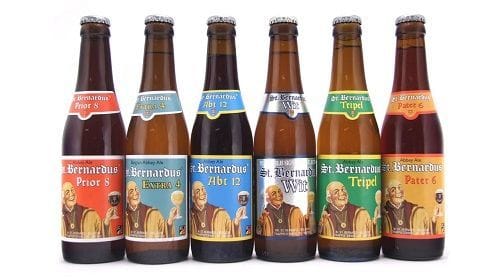
Currently, its portfolio has eight products, the first three brewed with the original Westvleteren recipes and their alcohol content in relation to the monastic order, “Pater 6,” “Prior 8,” and “Abt 12.”

1. St. Bernardus Pater 6
Pater 6 is a Dubbel that presents a dark brown color with ruby highlights; with a balanced flavor, it stands out for notes of caramel and dried fruits, complemented by a touch of spices; it has an alcohol content of 6.7% ABV.
2. St. Bernardus Prior 8
Prior 8 is also a Dubbel, although more robust, with a more complex flavor profile, dark amber in color and aromas that include caramelized malt and fruits like raisins and plums, with a light bitterness balancing its sweetness, achieving an ideal experience for those seeking full-bodied beers with nuances in an alcohol content of 8.0% ABV.
3. St. Bernardus Abt 12
Abt 12 is a Quadrupel that has earned a place as one of the best beers in the world. Dark brown in color with characteristic creamy foam, its nose offers aromas of black fruits, chocolate, and caramel, with a dense, honeyed mouthfeel in a long, warm finish thanks to its 10% ABV.
4. St. Bernardus Tripel
St. Bernardus Tripel was the first self-created beer after the termination of the license with Westvleteren Abbey. Brilliant golden with abundant foam, its floral and spicy aromas stand out, along with touches of fruits like pear and apple, creating a refreshing and slightly sweet experience at an alcohol content of 8.0% ABV.
5. St. Bernardus Witbier
St. Bernardus Witbier was originally devised and brewed in collaboration with the legendary Pierre Celis, who years earlier had revived the style with Hoegaarden, a pale yellow and hazy beer recognized for its citrus and spice aromas, light and refreshing, ideal for hot days, with an alcohol content of 5.5% ABV.
6. St. Bernardus Christmas Ale
St. Bernardus Christmas Ale is a seasonal beer brewed especially for the Christmas season, deep amber in color with complex notes of fruits and spices that make it a perfect alternative to celebrate, with an alcohol content of 10% ABV.
7. St. Bernardus Extra 4
In 2014, the brewery relaunched St. Bernardus Extra 4, a beer that had not been brewed for almost 50 years and is part of the original recipes of Westvleteren Abbey, characterized by its freshness and smoothness, with a slightly fruity and spicy profile, with an alcohol content of 4.8% ABV.
8. St. Bernardus Watou Tripel
Finally, St. Bernardus Watou Tripel is a softer variation of its original version, offering a more fruity and spicy flavor, with a perfect balance between sweetness and bitterness; it has earned its own place in the brewery’s portfolio, with an alcohol content of 7.5% ABV.
Frequently Asked Questions (FAQ)
1. What is the difference between a Trappist beer and an Abbey beer?
The distinction lies in the Authentic Trappist Product (ATP) certification. To be “Trappist”, the beer must be produced within the walls of a Cistercian Order abbey, under the supervision of the monks, and for non-profit purposes (subsistence and charity). St. Bernardus is a commercial Abbey Beer, because although it has monastic roots and uses original Westvleteren recipes, it is brewed in a private, secular-run facility outside the monastery.
2. Does St. Bernardus still use the original Westvleteren yeast?
Yes. This is one of the points most valued by enthusiasts. While St. Sixtus Abbey (Westvleteren) changed its yeast strain to Westmalle’s when it resumed internal production in 1992, St. Bernardus has continuously preserved and propagated the original strain that master brewer Mathieu Szafranski brought with him in 1946. This means that, technically, St. Bernardus’s fermentation profile is closer to historical Westvleteren than the beer actually produced in the abbey today.
3. What do the numbers 6, 8, and 12 mean on St. Bernardus labels?
These numbers do not directly represent the alcohol by volume (ABV), but rather inherit the old Belgian system of density degrees (Belgian Degrees Scale). Historically, they indicated the sugar concentration in the wort before fermentation. 6 (Pater): A light Dubbel. 8 (Prior): A fuller-bodied Dubbel. 12 (Abt): A high-density Quadrupel. This system served as a simple way for monks to classify the intensity of the beer.
4. Why is St. Bernardus Abt 12 considered a clone of Westvleteren XII?
It is called this because from 1946 until 1992, St. Bernardus was the official producer of St. Sixtus Abbey’s beer for commercial sale. Abt 12 is brewed exactly with the same recipe, ingredients, and proportions as the mythical post-war era Westvleteren XII. The only significant difference today, aside from the yeast, is the water used, as St. Bernardus extracts water from deep wells in Watou.
5. What role did Pierre Celis play in the creation of St. Bernardus Witbier?
Pierre Celis, the man who saved the Witbier style (Belgian white beer) by founding Hoegaarden, collaborated with St. Bernardus to create their wheat version. After the sale of Hoegaarden to a large corporation, Celis brought his expert knowledge to St. Bernardus to ensure the house’s Witbier maintained the original artisanal character, using bitter orange peel and coriander in a traditional high-quality process.
Recommended
- Mexican Sendechó: The rebirth of an ancestral beer with malted corn
- ImpacTaste and the future of food innovation with beer bagasse