This post is also available in:
 Español
  Português
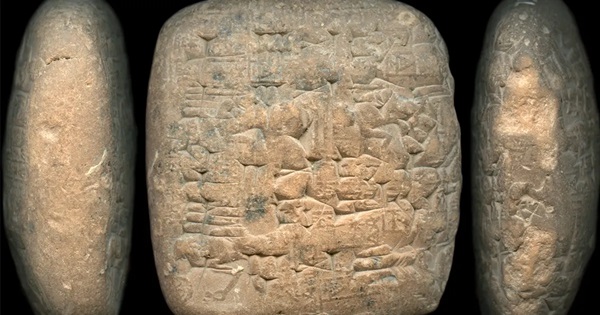
A clay tablet from the Ur III period decoded in Copenhagen records the distribution of more than 120 liters of beer over two consecutive days in ancient Mesopotamia. The NMC 7962 tablet, preserved at the National Museum of Denmark, is the first known administrative document to formally establish a distinction between higher-quality beer and ordinary beer, more than four thousand years ago.
What does the NMC 7962 tablet record?
The find comes from the Hidden Treasures project, a collaboration between the University of Copenhagen and the National Museum of Denmark aimed at analyzing and digitizing cuneiform texts held in collections that had not been systematically studied.

The tablet had previously been published by the Danish Sumerologist Thorkild Jacobsen, but was re-examined during the digitization process and its significance was more fully appreciated.
Troels Pank Arbøll, associate professor of Assyriology at the University of Copenhagen and lead researcher on the analysis, explains that documents of this type are typical Ur III administrative records — tablets that served to document deliveries made by institutions of the period.
The NMC 7962 records two days of distribution. On the first day: 16 liters of good beer and 55 liters of ordinary beer. On the second: 12 liters of good beer and 40 liters of ordinary beer.
In total, more than 120 liters — a figure that corresponds to no domestic consumption or private celebration, but to the logistics of an institution with significant resources.
The document bears the cylinder seal of the provincial governor, which not only certifies that it passed through official administrative channels, but places the transaction at the highest level of the Mesopotamian bureaucratic apparatus.
The recipient of the record, or of the beer itself, remains unknown, but the seal makes clear that this distribution was a matter of state.
The distinction between good beer and ordinary beer
The most revealing aspect of the tablet is not the volume but the classification. The fact that a government administration of the 21st century BC had formal terms for distinguishing beer quality, applied them in an official document, and managed them through a registration system implies that the Mesopotamian beer market was considerably more sophisticated than previous records had allowed us to document.
The differentiation of quality in the production and distribution of goods is not a modern or medieval innovation. The NMC 7962 tablet demonstrates that it has more than four millennia of documented administrative history.
“It was an integral part of urban life.” That is how Arbøll describes the role of beer in Mesopotamian civilization.
The statement is not rhetorical; from the invention of writing, at the end of the fourth millennium BC, until the decline of cuneiform civilization, beer appears in the archives as naturally as grain, livestock, or labor.
It was an essential commodity whose distribution required exactly the same bureaucratic apparatus as any other economic resource.
Ur III documents recording beer are not exceptional; what is exceptional is that the NMC 7962 has survived with enough legibility to reveal its internal detail.
Women in the Mesopotamian production chain
The administrative record of the NMC 7962 does not mention who brewed the beer it distributes. But the historical evidence on beer production in the Ur III period is relatively clear: brewing was a female activity.
Mesopotamian women controlled domestic beer production, and in the institutional context, female brewers could be specialized workers within the large palatial or temple complexes that managed the economy of the period.
The Hymn to Ninkasi, the Sumerian poem of 1800 BC dedicated to the goddess of beer, is not only a religious text: it is also a technical description of the brewing process that confirms the role of women as the primary makers of the beverage.

The combination of the administrative record of the NMC 7962 with the iconographic and literary evidence of the period builds a coherent picture. Mesopotamian beer was produced by women, managed by the administration, and consumed collectively in institutional contexts.
Ingredients, texture, and the reed system
Arbøll describes the basic ingredients of Mesopotamian beer: barley as a base, with regional and period variations that could incorporate emmer wheat or date syrup.
The result was a drink completely different from any modern beer: cloudy, unfiltered, with grain sediment in suspension.
The technical solution adopted by drinkers of the period, documented in texts and iconographic representations, was a long hollow reed that acted as a straw and allowed them to drink the liquid above the grain deposit.
Representations of two people drinking from the same vessel through long reeds are among the most recognizable images in Mesopotamian art and reflect an everyday practice, not an exceptional ritual.
The structure of the drink — fermented from a cereal bread called bappir, mixed with water and aromatic ingredients — was stable enough to persist for millennia without fundamental changes in its production technology.
What changed was the scale, the institutional organization, and, as the NMC 7962 demonstrates, the sophistication of classification and distribution systems.
Recreating a beer from 4,000 years ago
Academic interest in Mesopotamian beer has not remained theoretical. The University of Chicago has been one of the most active centers in the effort to reconstruct ancient recipes from available texts.
Experimental versions point to a low-alcohol, spontaneous-fermentation beer with acidic and herbal notes far removed from the profiles we associate with any contemporary lager or ale.
The exercise has value beyond gastronomic curiosity: it allows researchers to calibrate the reading of administrative documents like the NMC 7962. If researchers can reproduce an approximate profile of the drink the receipt describes, the category “good beer” acquires technical content — not merely a distinction of price or institutional origin, but potentially a reflection of real differences in ingredients, process, or fermentation time.
The Hymn to Ninkasi, translated by Miguel Civil of the University of Chicago from two clay tablets, had already provided the first verifiable recipe in brewing history. The NMC 7962 now adds the first formal quality classification.
The Hidden Treasures project underlines that museum archives continue to hold thousands of unstudied objects.
Each deciphered tablet expands the map of what we know about the economies of the ancient world, and the NMC 7962 does so in a concrete way — putting names, volumes, and an official seal on the beer drunk by the inhabitants of Mesopotamia more than four thousand years ago.
Frequently asked questions
What is the NMC 7962 cuneiform tablet?
The NMC 7962 is a clay tablet from the Ur III period (approximately 2112–2004 BC) preserved at the National Museum of Denmark. It records the delivery of more than 120 liters of beer over two consecutive days and explicitly distinguishes between higher-quality beer and ordinary beer. It was decoded by researchers at the University of Copenhagen as part of the Hidden Treasures project.
How much beer does the Mesopotamian receipt record?
The tablet records two consecutive deliveries: on the first day, 16 liters of good beer and 55 liters of ordinary beer; on the second, 12 liters of good beer and 40 liters of ordinary beer. The total exceeds 120 liters, a quantity that indicates institutional distribution, not domestic consumption.
What was beer made from in ancient Mesopotamia?
Mesopotamian beer was made primarily from barley, though recipes could include emmer wheat or date syrup. It was a cloudy, unfiltered drink, which is why drinkers used long hollow reeds as straws to avoid the grain sediment at the bottom of the vessel.
What is the Hidden Treasures project?
Hidden Treasures is a collaboration between the University of Copenhagen and the National Museum of Denmark to analyze, catalog, and digitize cuneiform texts held in museum collections that had not been systematically studied. The NMC 7962 tablet was one of its most significant finds.

Recommended
- The psychedelic effects of kykeon in the Eleusinian Mysteries
- The importance of women in the history of beer