This post is also available in:
 Español
 Português
 Français
The PFAS concentration of a beer resembles that of the tap water in the city where it is brewed. That is the conclusion of the first study to measure these compounds in beer with the official method of the U.S. environmental agency, published in 2025 in Environmental Science & Technology, which found PFAS in 95% of the samples analyzed.
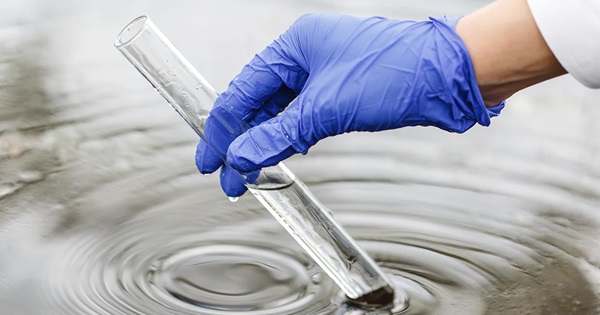
A Czech pilot study published in 2026 shows the other side of the picture. In 21 beers brewed with water that contained hardly any PFAS, none were quantified in the final product.

Between the two studies a simple rule emerges. Beer does not generate PFAS, it inherits them from the water, and that is why the map of drinking water contamination is also, in this sense, the map of beer.
What Are PFAS and Why Are They Called Forever Chemicals?
PFAS, per- and polyfluoroalkyl substances, are a large family of synthetic compounds built on carbon-fluorine bonds, among the most stable in chemistry.
That stability makes them useful in non-stick coatings, waterproof textiles, packaging and firefighting foams, and it also makes them almost indestructible in the environment and in the body.
In September 2020 the European Food Safety Authority set a tolerable weekly intake of 4.4 nanograms per kilogram of body weight for the sum of four of them, PFOA, PFOS, PFNA and PFHxS. The critical effect used to set it was the reduced response of the immune system to vaccines.
According to the same agency, PFAS appear mainly in drinking water, fish, fruit and eggs, and children are the most exposed group. Beer was not on that list because nobody had measured it systematically.
How Many Beers Contained PFAS in the U.S. Study?
The team led by Jennifer Hoponick Redmon, of the RTI International institute, bought 23 types of canned beer in North Carolina stores in August 2021. The beers came from 17 counties, 9 states and 3 countries, the United States, Mexico and the Netherlands.
They adapted EPA Method 533, designed for drinking water, to beer and analyzed 94 aliquots in two phases. In the second phase they measured five cans from the same pack for each beer.
In that second phase, 71 of the 75 aliquots contained some PFAS, 95%, as did 13 of the 15 beers, 87%. PFOS appeared in 84% of the aliquots, PFBS in 53% and PFOA in 36%.
The concentrations are low in absolute terms. The sum of PFAS had a median of 6.782 nanograms per liter and a maximum of 40.077, and PFOA a median of 4.095 with a maximum of 8.374.
The table sets the study values against the limit the EPA set for drinking water in 2024.
| Analyte | Median in beer (ng/L) | Maximum in beer (ng/L) | EPA drinking water limit (ng/L) |
|---|---|---|---|
| Sum of PFAS | 6.782 | 40.077 | No combined limit |
| PFOA | 4.095 | 8.374 | 4.0 |
| PFOS | 0.901 | 8.343 | 4.0 |
Why Does Beer Copy the Water of Its City?
Because water makes up more than 90% of beer and up to 7 liters can be used for every liter produced. Conventional municipal treatment, according to the authors, is almost ineffective against PFAS, so whatever is in the tap reaches the mash tun.
The researchers compared their results with the public PFAS data for the tap water of each county. The correlation was 0.82 for the sum of PFAS, 0.90 for PFOA and 0.71 for PFBS.
PFOS was the exception, with a negative correlation of 0.09. It appeared in almost every beer regardless of the water, which points to other inputs, such as ingredients or equipment.
The map confirms the relationship. Chatham County, in the upper Cape Fear River basin in North Carolina, gave the highest average in the sample at 33.946 nanograms per liter, and neighboring Alamance 21.536.
In the lower basin of the same river, near Wilmington, the beers showed HFPO-DA, the compound known as GenX that a chemical plant discharged into the river for years, and the same compound was present in the raw water. In Michigan, Kalamazoo County gave the highest PFOA, with an average of 6.618.
Small breweries were more likely to test positive than the large national and international brands. A macro brewery blends water sources, invests in its own treatment and dilutes the effect of any single water utility.
Did Any Beer Exceed the Legal Limits?
No country has PFAS limits for beer, so the comparison is made with those for drinking water. Using the average of the five cans, 3 beers exceeded the EPA limit for PFOA, two from the upper Cape Fear and one from Michigan, and 1 exceeded the PFOS limit, in the lower Cape Fear.
That is 4 of 15 beers, slightly more than one in four. The EPA set those limits of 4 nanograms per liter for PFOA and PFOS in April 2024, with a compliance deadline in 2029.
In May 2026 the EPA itself proposed to rescind the limits for four other PFAS and to extend the PFOA and PFOS deadline to 2031 for systems that request it. At the time of writing it was still a proposal under consultation.
In the European Union, Directive 2020/2184 sets 100 nanograms per liter for the sum of 20 PFAS in drinking water, mandatory since January 12, 2026. Not even the most contaminated beer in the American study would reach that value.
[math] \dfrac{40.077}{100} = 0.40 [/math]
The maximum measured in beer equals 40% of the European limit for water. Germany will go further and apply 20 nanograms per liter to the sum of PFOA, PFNA, PFHxS and PFOS from 2028.

What Did the Czech Study Find?
In 2026, Darina Dvořáková and her team analyzed the raw water of 17 Czech breweries and 21 beers brewed with it, screening for 32 PFAS. Most of the waters contained PFAS, at a few nanograms per liter, far below the European limit.
In none of the 21 beers were PFAS quantified above the method limit. The authors conclude that, with clean water, transfer to the final product was not demonstrated and that no added contamination from other raw materials or from the process appeared either.
Read together with the American study, the picture is consistent. Where the water is clean, the beer comes out clean, and where the water carries PFAS, the beer reflects them almost one to one.
Is Drinking Beer With PFAS a Risk?
The levels measured are small compared with the European intake reference. For a person weighing 70 kilograms, the EFSA tolerable weekly intake for the four main PFAS equals 308 nanograms.
[math] 70 \times 4.4 = 308 [/math]
A half liter of beer with the study medians for PFOA and PFOS, about 5 nanograms per liter combined, contributes about 2.5 nanograms.
[math] 0.5 \times 5.0 = 2.5 [/math]
That is less than 1% of the tolerable weekly intake per beer, using the medians of the positive samples. The calculation is illustrative, because the EFSA sets the threshold for the whole diet, and water, fish and eggs weigh far more than beer.
The problem with PFAS is not a single beer, it is the accumulation over decades, since the body takes years to eliminate them. That is why the authors frame the finding as a signal about water, not as an alert about the drink.
What Can a Brewery Do?
The first step is to check the annual report of its water utility or to test its own water. The study estimates that around 18% of breweries in the United States are in zip codes whose tap water has detectable PFAS according to the 2024 federal monitoring program.
If PFAS are present, the authors recommend installing activated carbon or reverse osmosis at the water intake, as part of the water adjustments a brewery already makes for flavor reasons.
Activated carbon and anion exchange work well with long-chain PFAS and less well with short-chain ones, and reverse osmosis removes both at a higher cost.
For the consumer, the practical takeaway is origin. A beer brewed in an area with contaminated water will tend to have more PFAS than the same beer produced at another plant, just as happens with microplastics, where the packaging mattered more than the water.
Frequently Asked Questions (FAQ)
1. What are PFAS?
They are a family of synthetic compounds with very stable carbon-fluorine bonds, used in non-stick coatings, waterproof textiles, packaging and firefighting foams. They do not break down in the environment or in the body, which is why they are called forever chemicals, and the EFSA sets a tolerable weekly intake of 4.4 nanograms per kilogram of body weight for the four main ones.
2. Does beer contain PFAS?
It depends on the water used to brew it. In the United States, a 2025 study found them in 95% of the samples and in 87% of the beers, with a median of 6.782 nanograms per liter for the sum of PFAS. In the Czech Republic, a 2026 pilot study quantified none in 21 beers made with clean water.
3. Why does beer contain the same PFAS as the city’s water?
Because water makes up more than 90% of beer and conventional municipal treatment removes hardly any PFAS. The correlation between the county’s tap water and the beer was 0.82 for the sum of PFAS and 0.90 for PFOA.
4. Did any beer exceed the EPA limits?
Yes, 4 of the 15 beers in the second phase exceeded the limit of 4 nanograms per liter using the average of five cans, 3 for PFOA and 1 for PFOS. These are drinking water limits, because no limits exist for beer. None reached the 100 nanograms per liter of the European standard for the sum of 20 PFAS.
5. How can a brewery avoid PFAS?
By reviewing the reports of its water utility or testing its water and, if PFAS are present, filtering with activated carbon or reverse osmosis before mashing. Carbon works better with long-chain PFAS, and reverse osmosis also removes short-chain ones.
References
Hoponick Redmon, J., DeLuca, N. M., Thorp, E., Liyanapatirana, C., Allen, L. and Kondash, A. J. (2025). Hold My Beer: The Linkage between Municipal Water and Brewing Location on PFAS in Popular Beverages. Environmental Science & Technology, 59(17), 8368-8379. doi.org/10.1021/acs.est.4c11265
Dvořáková, D., Pernica, M., Svobodová, V., Pulkrábová, J. and Bělaková, S. (2026). PFAS in the Brewing Chain: Occurrence in Raw Water and Beer. A Pilot Study. Kvasný průmysl, 72, 1207-1214. doi.org/10.18832/kp2026.72.1207
European Food Safety Authority (2020). PFAS in food: EFSA assesses risks and sets tolerable intake. Press release of 17 September 2020. efsa.europa.eu
European Parliament and Council (2020). Directive (EU) 2020/2184 on the quality of water intended for human consumption, Annex I Part B and Article 25. eur-lex.europa.eu
United States Environmental Protection Agency (2024). Per- and Polyfluoroalkyl Substances (PFAS), National Primary Drinking Water Regulation. epa.gov
Jones Day (2026). EPA Proposes to Rescind Certain PFAS Drinking Water Standards and Extend Compliance Deadlines for PFOA and PFOS. Note of 20 May 2026. jonesday.com

Recommended
- How Many Microplastics Are in Your Beer, and Why Is It Worse in Bottles Than in Cans?
- How Do You Adjust Water Characteristics to Brew a Better Beer?