This post is also available in:
 Español
  Português
  Français
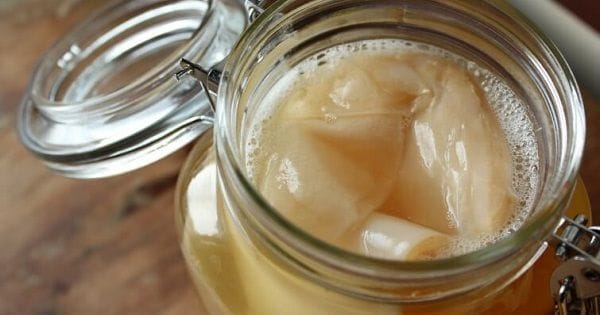
Yes, kombucha contains alcohol. It is a fermented drink, and during fermentation the yeasts produce ethanol, which the bacteria in the culture then turn into acetic acid.
Kombuchas sold as non-alcoholic drinks usually keep some of that ethanol. In published studies, most samples come in below 2%, with peaks close to 3.6%, and the figure is not fixed because fermentation keeps going inside the bottle.
Why does kombucha contain alcohol?
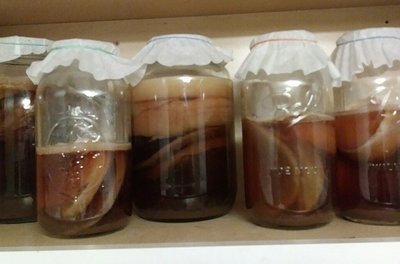
Kombucha is made by fermenting sweetened tea with a SCOBY, a colony of yeasts and acetic acid bacteria that floats on top of the liquid. The full process is in our guide on what kombucha is and how to make it at home.
The yeasts break sucrose down into glucose and fructose and ferment those sugars into ethanol and carbon dioxide. The acetic acid bacteria then oxidize much of that ethanol into acetic acid, which gives the drink the vinegary edge that is part of kombucha’s aromas and flavors.
Both reactions run at the same time, so the alcohol left over depends on the balance between them. That balance shifts with time, temperature, and access to oxygen, which acetic acid bacteria need to oxidize ethanol.
A study from the University of Burgundy found that ethanol builds up more in a closed vessel than in an open one. The authors put this down to the lack of oxygen, which they did not actually measure.
Why does the alcohol go up inside the bottle?
Unpasteurized bottled kombucha keeps live yeasts and some of its sugar, so fermentation does not stop when the cap goes on. With little oxygen and a bit of warmth, the ethanol climbs again.
Researchers at the University of Texas at Arlington stored sealed bottles of a commercial brand at 22 °C (72 °F) and measured a clear increase after seven days, reaching 1.57% at two weeks. In the refrigerator the alcohol also rose, more slowly, and then leveled off.
Some producers also run a second fermentation in the bottle with fruit or juice to build carbonation and flavor. The Australian regulator listed the carbonation method and added flavorings among the factors that affect the final alcohol content.
The U.S. tax authority, the TTB, warns producers that refrigerating the product is not enough to guarantee the alcohol will not rise. The reason is that the producer cannot control whether the bottle stays cold after it leaves the facility.
How much alcohol is in commercial kombucha?
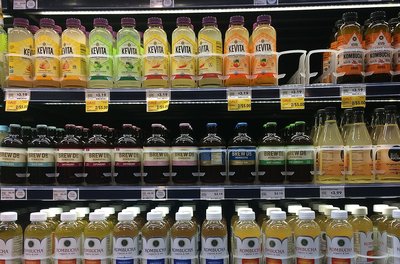
Lab analyses find kombuchas ranging from almost undetectable alcohol to just over 3.5%. In several studies, most samples exceed the 0.5% that the United States, Brazil, and Australian labeling rules use as a limit.
In the Texas study, the 18 commercial kombuchas tested contained between 1.12% and 2% alcohol, all above the U.S. limit. In British Columbia, Canada, an analysis of 684 samples found an average of 0.77% and a maximum of 3.62%, and 31.5% exceeded the provincial limit of 1%.
In Australia, 64.8% of the 132 kombuchas sampled by health authorities in 2017 and 2018 exceeded 0.5%, and almost one in four went over 1.15%. In Brazil, a follow-up of 12 brands found that 92% exceeded 0.5% before the specific regulation took effect, and a year later two out of three did not comply with it.
Not every brand fares badly. A Cornell University study of 47 samples from six brands measured values between 0.04% and 1.3%, and only two of those brands were clearly above 0.5%.
These are the main published studies on commercial kombucha.
| Study | Location | Samples | Alcohol measured | Result |
| Talebi et al., 2017 | United States | 18 | 1.12% to 2.00% | All above 0.5% |
| ISFR and FSANZ, 2019 | Australia | 132 | Not reported | 64.8% above 0.5% and 22.9% above 1.15% |
| Jang et al., 2021 | Canada | 684 | Up to 3.62% | Average of 0.77% |
| Rossini and Bogsan, 2023 | Brazil | 12 brands | Up to 3.56% | 92% above 0.5% |
| Sogin and Worobo, 2024 | United States | 47 | 0.04% to 1.3% | 2 of 6 brands above 0.5% |
How much alcohol is in a bottle of kombucha compared with a beer?
Studies sometimes express alcohol as a percentage by volume and sometimes in grams per liter. To convert grams per liter to a percentage, divide by 7.89, which is the density of ethanol, 0.789 g/ml, multiplied by 10.
As reported in the Texas team’s study, Greenwalt and colleagues measured 14 g/L of ethanol when they extended a lab fermentation past its optimal point. Converted to a percentage, the calculation works out like this.
[math]\text{ABV} = \dfrac{\text{ethanol in g/L}}{0.789 \times 10}[/math]
[math]\text{ABV} = \dfrac{14}{7.89}[/math]
[math]\text{ABV} \approx 1.77\%[/math]
For a kombucha at 1.5%, a 330 ml bottle contains about 3.9 g of ethanol. A 330 ml beer at 5% contains about 13 g, so that kombucha equals a little under a third of a regular beer.
[math]\text{ethanol} = 330 \times 0.015 \times 0.789[/math]
[math]\text{ethanol} \approx 3.9 \text{ g}[/math]
That amount does not make kombucha a drink comparable to beer. It does put it above any Spanish alcohol-free beer, which by law must stay below 1%.
What does the law say about alcohol in kombucha?
In the United States, any kombucha that reaches 0.5% alcohol at any point, including after bottling, falls under the rules for alcoholic beverages. The TTB calls it hard kombucha from that threshold up, and kombucha made only with sugar, tea, SCOBY, and water is usually classified as beer.
In June 2010, Whole Foods pulled kombuchas from several manufacturers off its shelves over suspicions that they exceeded 0.5% alcohol.
We have not found a specific European regulation for kombucha. Regulation 1169/2011 only requires the alcohol content to be stated on drinks above 1.2%, so a kombucha at 1% can be sold without any mention of alcohol on the label.
Nor have we found a specific Spanish regulation for kombucha. The only legal definition of alcohol-free we have found, below 1%, belongs to the beer quality standard and does not extend to other drinks.
The 2018 UK labeling guidance reserves the term alcohol free for dealcoholized drinks with a maximum of 0.05%, and the term low alcohol for those up to 1.2%. Canada requires alcohol to be declared from 1.1%, and Australia and New Zealand from 0.5%, with a maximum of 1.15% for fermented drinks sold as soft drinks.
Brazil went further and passed a specific regulation in 2019. It sets a maximum of 0.5% for non-alcoholic kombucha and a range of 0.6% to 8% for alcoholic kombucha.
Does homemade kombucha have more alcohol?
Alcohol is rarely measured at home. A fermentation left to run long in a closed vessel, warmth, and second fermentations in tightly sealed bottles all tend to push it up.
We have not found studies with representative samples of homemade kombucha. The closest reference is the tightly controlled lab trials compiled by the Texas team, which reached 9.1 g/L after 24 days and about 14 g/L, close to 1.8%, when fermentation was extended.
The scientific literature cites values between 0% and 3%, and the British Columbia study measured up to 3.62%. There, kombucha from the province’s producers and restaurants had higher averages than kombucha from other retail outlets, and that is craft production, not homemade.
Given enough oxygen and time, the ethanol eventually drops because the acetic acid bacteria consume it. In that same trial by Sievers and colleagues, ethanol fell to 0.7 g/L at 62 days.
Who should avoid kombucha because of its alcohol?
As the calculation above shows, a single bottle can provide several grams of ethanol. That amount matters most for anyone who needs to avoid alcohol completely.
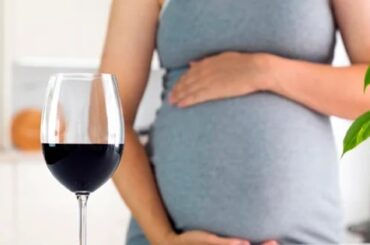
For pregnancy, the U.S. CDC notes that no safe amount of alcohol is known, and Health Canada expressly lists kombucha among the fermented drinks that may contain ethanol. It is the same issue raised during pregnancy by wine and beer sold as alcohol-free.
Health authorities in New South Wales and Ireland also mention minors, breastfeeding women, and people who are about to drive, and New South Wales adds people taking prescription medication. We have not found an official recommendation on kombucha for people in recovery from an alcohol problem. They would do well to treat it as a drink that may contain alcohol.
Health Canada advises keeping these drinks cold to slow fermentation and throwing out any that are past their best by date. The Irish regulator notes that in unpasteurized drinks, fermentation can continue during storage.
Frequently asked questions (FAQ)
1. Does all kombucha contain alcohol?
Fermentation produces alcohol and nearly every kombucha tested contains some, with a few commercial samples where none was detected. In published studies, most come in below 2%, with peaks close to 3.6%.
2. How much alcohol does kombucha have compared with beer?
A 330 ml bottle of kombucha at 1.5% alcohol contains about 3.9 g of ethanol. A regular beer of the same size at 5% contains about 13 g, a little more than three times as much.
3. Does homemade kombucha have more alcohol than store-bought kombucha?
It is not known, because there are no representative studies of homemade kombucha and alcohol is rarely measured at home. Lab trials with long fermentations reached close to 1.8%, a figure similar to that of many commercial kombuchas.
4. Can pregnant women drink kombucha?
The CDC states that no safe amount of alcohol during pregnancy is known. Health Canada recommends avoiding alcohol during pregnancy and lists kombucha among the drinks that may contain ethanol.
5. What is hard kombucha?
In the United States, any kombucha with 0.5% alcohol or more is hard kombucha and is governed by the rules for alcoholic beverages. In Brazil, the regulation allows up to 8% in alcoholic kombucha.
Bibliography
- Alcohol and Tobacco Tax and Trade Bureau. (2019). Kombucha: General requirements. U.S. Department of the Treasury. https://www.ttb.gov/regulated-commodities/beverage-alcohol/kombucha/general-requirements
- Alcohol and Tobacco Tax and Trade Bureau. (n.d.). Kombucha general FAQs. U.S. Department of the Treasury. Retrieved October 12, 2026. https://www.ttb.gov/regulated-commodities/beverage-alcohol/kombucha/kombucha-general
- Australian Beverages Council. (2019). Fermented drinks and alcohol. https://www.australianbeverages.org/wp-content/uploads/2019/08/Fermented-drinks-and-alcohol_FINAL.pdf
- Brasil. Ministério da Agricultura, Pecuária e Abastecimento. (2019). Instrução Normativa n.º 41, de 17 de setembro de 2019. Diário Oficial da União. https://kombuchabrewers.org/brazil/
- Centers for Disease Control and Prevention. (2026). About alcohol use during pregnancy. https://www.cdc.gov/alcohol-pregnancy/about/index.html
- Department of Health and Social Care. (2018). Low alcohol descriptors guidance. GOV.UK. https://assets.publishing.service.gov.uk/media/5c10f47f40f0b60c1ec239cc/low-alcohol-descriptors-guidance.pdf
- Food Safety Authority of Ireland. (2021). Survey of plant-based fermented beverages available on the Irish market. FSAI. https://www.fsai.ie/publications/survey-of-plant-based-fermented-beverages-availabl
- Food Safety Authority of Ireland. (2021, September 23). Food safety guidance published for unpasteurised fermented non-alcoholic beverages. FSAI. https://www.fsai.ie/news-and-alerts/latest-news/food-safety-guidance-published-for-unpasteurised-f
- Food Standards Australia New Zealand. (2025). Labelling of alcoholic beverages. https://www.foodstandards.gov.au/consumer/labelling/Labelling-of-alcoholic-beverages
- Health Canada. (2020). Ethanol in non-alcoholic fermented beverages. Government of Canada. https://www.canada.ca/en/health-canada/services/publications/food-nutrition/ethanol-non-alcoholic-fermented-beverages.html
- Implementation Subcommittee for Food Regulation. (2019). Coordinated survey of alcohol content and labelling of fermented soft drinks. Summary. Food Standards Australia New Zealand. https://www.foodstandards.gov.au/sites/default/files/science-data/surveillance/Documents/Summary%20Coordinated%20survey%20of%20alcohol%20content%20and%20labelling%20of%20fermented%20soft%20drinks.pdf
- Jang, S. S., McIntyre, L., Chan, M., Brown, P. N., Finley, J., & Chen, S. X. (2021). Ethanol concentration of kombucha teas in British Columbia, Canada. Journal of Food Protection, 84(11), 1878-1883. https://doi.org/10.4315/JFP-21-130
- NSW Health. (2019). Fermented drinks and alcohol. https://www.health.nsw.gov.au/aod/resources/Pages/fermented-drinks-and-alcohol.aspx
- Real Decreto 678/2016, de 16 de diciembre, por el que se aprueba la norma de calidad de la cerveza y de las bebidas de malta. Boletín Oficial del Estado, 304. https://www.boe.es/eli/es/rd/2016/12/16/678/con/20161217
- Reglamento (UE) n.º 1169/2011 del Parlamento Europeo y del Consejo, de 25 de octubre de 2011, sobre la información alimentaria facilitada al consumidor. Diario Oficial de la Unión Europea, L 304, 18-63. https://eur-lex.europa.eu/legal-content/ES/TXT/HTML/?uri=CELEX:32011R1169
- Rossini, D., & Bogsan, C. (2023). Is it possible to brew non-alcoholic kombucha? Brazilian scenario after restrictive legislation. Fermentation, 9(9), 810. https://doi.org/10.3390/fermentation9090810
- Sogin, J. H., & Worobo, R. W. (2024). Primary metabolites and microbial diversity in commercial kombucha products. Fermentation, 10(8), 385. https://doi.org/10.3390/fermentation10080385
- SupplySide SJ. (2010, June 23). Whole Foods pulls kombucha. https://www.supplysidesj.com/digestive-health/whole-foods-pulls-kombucha
- Talebi, M., Frink, L. A., Patil, R. A., & Armstrong, D. W. (2017). Examination of the varied and changing ethanol content of commercial kombucha products. Food Analytical Methods, 10(12), 4062-4067. https://doi.org/10.1007/s12161-017-0980-5
- Tran, T., Grandvalet, C., Verdier, F., Martin, A., Alexandre, H., & Tourdot-Maréchal, R. (2020). Microbial dynamics between yeasts and acetic acid bacteria in kombucha: Impacts on the chemical composition of the beverage. Foods, 9(7), 963. https://doi.org/10.3390/foods9070963
- Wang, B., Rutherfurd-Markwick, K., Zhang, X.-X., & Mutukumira, A. N. (2022). Kombucha: Production and microbiological research. Foods, 11(21), 3456. https://doi.org/10.3390/foods11213456
- Webster, M. (2022, April 1). Hard kombucha: An overview of TTB federal regulatory requirements [Presentation]. KombuchaKon 2022. https://www.ttb.gov/images/pdfs/kombuchakon-2022-presentation.pdf

Recommended
- What Is Kombucha and How to Make It Step by Step in Your Own Home?
- Kombucha Aromas and Flavors: An Introduction to Its Sensory Analysis