This post is also available in:
 Español
  Português
  Français
In mouth and throat cancer, drinking and smoking at the same time does not add up two risks; it multiplies them. In a pooled analysis of 17 studies on head and neck cancer, people who smoked more than 20 cigarettes and had 3 or more drinks a day had odds of developing it 14 times higher than those who did neither (Hashibe et al., 2009).
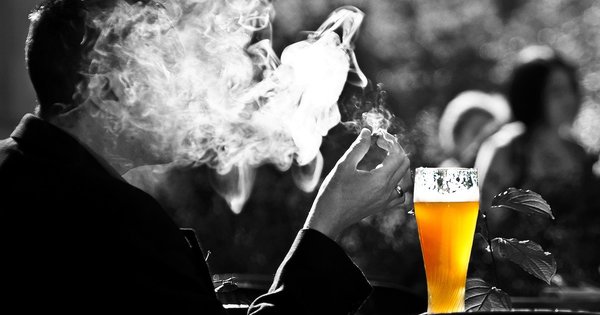
The combination also changes how using them feels, because alcohol increases the urge to smoke and nicotine masks part of the feeling of being drunk. This guide brings together what the evidence says about cancer, the brain and how to quit both.

What Happens to Your Body When You Drink and Smoke at the Same Time?
The combined damage has been studied mainly in the mouth, throat and esophagus, the tissues that come into contact with both the smoke and the drink. The US National Cancer Institute warns that people who use alcohol and tobacco have much higher risks of mouth and throat cancer, and that the harms of the two substances multiply (NCI, 2025).
According to the NCI, researchers propose that in the mouth and throat, alcohol makes it easier for tissues to absorb the toxic substances in smoke. In addition, the body converts ethanol into acetaldehyde, a compound that can damage DNA and proteins.
Why Does the Cancer Risk Multiply?
The INHANCE consortium pooled 17 studies with 11,221 head and neck cancer cases and 16,168 controls. It found a joint effect greater than the multiplication of the two separate risks (Hashibe et al., 2009).
If the two risks simply multiplied, someone who smokes heavily and drinks heavily would have a ratio close to 8. The observed value is almost 1.8 times that figure.
[math]4.15 \times 1.91 \approx 7.93[/math]
[math]\dfrac{14.23}{7.93} \approx 1.79[/math]
Other studies reach the same conclusion. A meta-analysis of 24 studies estimated a relative risk of 35.24 for head and neck cancer with heavy alcohol and tobacco use, and observed that the synergy grows as consumption increases (Jun et al., 2024).
In esophageal squamous cell carcinoma, drinking and smoking at the same time was associated with an odds ratio of 3.28 compared with people who used neither substance (Prabhu et al., 2014).
The table shows the odds ratios (OR) from that analysis, compared with people who never smoked or drank.
| Daily consumption | Odds ratio (OR) | 95% confidence interval |
|---|---|---|
| Neither smokes nor drinks | 1.00 | Reference |
| Drinks only, 3 or more drinks | 1.91 | 1.27 to 2.87 |
| Smokes only, more than 20 cigarettes | 4.15 | 2.44 to 7.07 |
| 1 to 20 cigarettes and 3 or more drinks | 9.92 | 6.36 to 15.46 |
| More than 20 cigarettes and 3 or more drinks | 14.23 | 8.30 to 24.40 |
How Does Alcohol Amplify Tobacco’s Toxins?
Acetaldehyde is the central piece. In 2009, the International Agency for Research on Cancer classified acetaldehyde associated with alcohol consumption as carcinogenic to humans, as reported by the US National Toxicology Program.
In a study of 7 smokers and 6 nonsmokers, the smokers showed twice as much acetaldehyde in their saliva after drinking, and when they smoked while drinking, their total exposure to acetaldehyde in saliva was about 7 times that of the nonsmokers (Salaspuro and Salaspuro, 2004). That is why the mouth of someone who drinks and smokes is exposed to two sources of the same toxin.
Why Do People Who Drink Want to Smoke More?
Alcohol and nicotine activate the same reward pathway in the brain, the one that releases dopamine and that explains how alcohol alters the reward system. A 2017 review also describes cross-tolerance between the two substances (Adams, 2017).
The same review explains that nicotine reduces the sedative effects and the feeling of being drunk, that alcohol enhances the reward from nicotine and that the urge to smoke increases after drinking. Each substance drives greater use of the other.
The link also shows up in the numbers. In a US national survey of 43,093 adults, 66.3% of men and 59.7% of women with alcohol dependence had used tobacco in the past year, according to data from 2001 and 2002 (Falk et al., 2006).
Among those who had never drunk alcohol, the share who used tobacco was 12.7% in men and 8.0% in women. Alcohol dependence comes in different degrees, and knowing the types of alcoholism helps put each case in context.
Does It Also Affect the Heart and the Liver?
The multiplying effect is well documented in head and neck cancer and in esophageal cancer. The sources reviewed for this guide do not measure that synergy in the heart.
In the liver, an analysis of 14 cohorts with more than 1.5 million people found no interaction between smoking and drinking in liver cancer risk, unlike two earlier studies in which more of the cases had hepatitis B or C, something the authors say could explain the difference (Petrick et al., 2018). Smoking at the start of the study was, on its own, associated with more liver cancer.
How Many People Drink and Smoke in Mexico and Spain?
In Mexico, the 2025 National Survey on Drug, Alcohol and Tobacco Use found that 46.1% of people aged 12 to 65 drank alcohol in the past year and that 15.1% smoked tobacco in the past month (ENCODAT 2025). Both figures fell compared with 2016, when they stood at 49.1% and 17.6%.
In Spain, the EDADES 2024 survey found that 63.5% of people aged 15 to 64 drank alcohol in the past month and that 25.8% smoked daily during that period (EDADES 2024). A total of 39.0% reported having used two or more substances in the past 12 months, and alcohol appears in at least 93.5% of those who used exactly two.
Neither survey publishes in its summaries how many people drink and smoke at the same time. Data on alcohol use among teenagers show that drinking begins before the age of majority.
Should You Quit Alcohol and Tobacco at the Same Time?
The evidence indicates that quitting smoking does not put alcohol abstinence at risk. A meta-analysis of 19 trials found that people who received help to quit smoking during addiction treatment were 25% more likely to stay off alcohol and drugs in the long term (Prochaska et al., 2004).
A later Cochrane review found no differences in abstinence from alcohol and other drugs, and confirmed that these interventions do increase tobacco cessation (Apollonio et al., 2016). The effect appeared when the help included medication, alone or with counseling, and counseling alone was not enough.
If you would rather start with drinking, you can check how to stop drinking beer based on what works in studies. Quitting alcohol abruptly after heavy, prolonged drinking can cause potentially serious withdrawal, so it is advisable to do it under medical supervision.
Where Can You Get Help in Mexico and Spain?
In Mexico, the Línea de la Vida helpline answers at 800 911 2000, free of charge, 24 hours a day, 365 days a year. It offers information on substance use and brief interventions, including for quitting smoking (CONASAMA, 2025).
In Spain, the Plan Nacional sobre Drogas maintains a search tool for addiction treatment centers, and the Ministry of Health brings together resources to quit smoking in each autonomous community.
Frequently Asked Questions (FAQ)
1. Is it more dangerous to drink and smoke at the same time than to do them separately?
Yes. In head and neck cancer, the joint risk exceeds the multiplication of the two separate risks, and people who smoked more than 20 cigarettes and had 3 or more drinks a day had an odds ratio of 14.23 (Hashibe et al., 2009).
2. Why do you want to smoke more when you drink alcohol?
Because alcohol and nicotine activate the same reward pathway in the brain. Alcohol enhances the reward from nicotine, and the urge to smoke increases after drinking (Adams, 2017).
3. Which cancers become more likely when you combine alcohol and tobacco?
Mainly cancers of the mouth, pharynx, larynx and esophagus, the tissues exposed to both smoke and drink at the same time. For liver cancer, an analysis of 14 cohorts found no interaction between the two (Petrick et al., 2018).
4. Can you quit alcohol and tobacco at the same time?
Yes. Getting help to quit smoking during addiction treatment does not undermine abstinence from alcohol, according to a meta-analysis that found people were 25% more likely to stay off alcohol and drugs in the long term, and a Cochrane review that found no differences (Prochaska et al., 2004; Apollonio et al., 2016).
5. Where can you get help to stop drinking and smoking in Mexico?
At the Línea de la Vida, at 800 911 2000, a free service that is available 24 hours a day and also helps people quit smoking.

Recommended
- How Do You Stop Drinking Beer? What Science Says Works and the Mistake That Can Be Dangerous
- What Are the Types of Alcoholism and How Severe Can It Be? What Science Says and How It Is Diagnosed