This post is also available in:
 Español
  Português
  Français
In a nutshell, kombucha is a fermented tea, also known as Manchurian mushroom, tea mushroom, or Chinese mushroom.
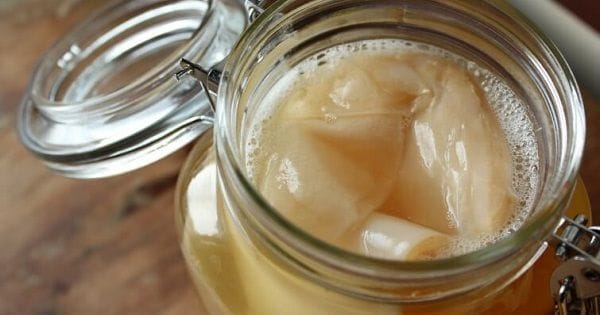
In kombucha, a bacterial culture called SCOBY (Symbiotic Culture of Bacteria and Yeast), sometimes called “the mother,” consumes sugar through a fermentation process, much like yeast in beer.

Origins of kombucha
While the origins of kombucha are still unknown, the general consensus indicates that it would have originated in Manchuria, in northeastern China, where writings have been found mentioning the tea mushroom during the Tsin dynasty, around 206 BC.
From there, it would have spread to neighboring countries such as Russia in the early 19th century, where it became very popular, and later crossed to Japan, Europe, and then the Americas.
What is the SCOBY?
The scientific name of the SCOBY is “Medusomyces gisevi” and it is composed of a colony of microorganisms formed mainly by strains of Bacterium xylinum, Gluconobacter oxydans, and yeast-like fungi of the Ascomycete genus, such as Saccharomycodes ludwigii, Saccharomyces cerevisiae, Schizosaccharomyces pombe, Pichia fermentans, and Zygosaccharomyces bailii.
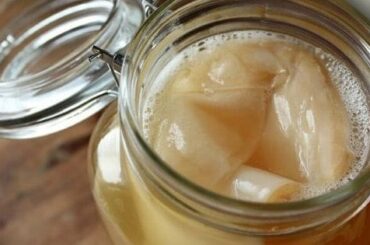
These fungi and bacteria convert sugar (sucrose) into glucose, fructose, and subsequently into ethyl alcohol, carbon dioxide (CO2), and acetic acid, all while coexisting in a mutually beneficial symbiosis, forming on the liquid’s surface a gelatinous, jellyfish-like body.
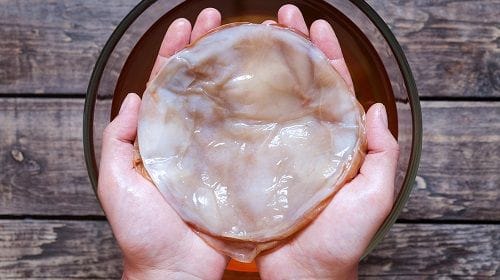
If the SCOBY receives continuous feeding, this fermentation process has no end, which is why kombucha is called the “mushroom of immortality.”
The result of the process is a fermented, semi-sweet tea with a very low alcohol level, typically below 1% ABV.
Kombucha can also be carbonated, making it a bubbly elixir that, combined with other ingredients like fruits or spices, can open up endless possibilities of aromas and flavors.
Etymology of the word kombucha
The etymology of the word kombucha is still uncertain, but it may be a mistaken adoption into English of the Japanese term for seaweed tea (昆布 茶), which refers to a completely different beverage—an edible kelp from the Laminariaceae family.
This confusion likely originated from the presence of the SCOBY floating on the surface. The correct term for fermented tea (mushroom tea) in Japanese is kōcha kinoko (紅茶キノコ).
Other less accepted theories indicate that kombucha comes from the Russian term “kombuja” (комбуха: ‘large seaweed’), always related to the same association.
How to make kombucha at home?
Homemade kombucha is one of the most accessible fermented beverages to make at home step by step, without specialized equipment and with ingredients found in any supermarket.
Although it is known for its supposed probiotic benefits, there is still no scientific consensus on the magnitude of its health effects.
What is clear is that the fermentation process that transforms sweet tea into kombucha is reproducible and predictable when the proper proportions and times are followed.
Homemade kombucha recipe
1. Materials
- Organic cheesecloth
- Bottles
- pH meter (optional)
- ppm meter (optional)
- 2-3 gallon kettle (7 to 12 liters)
- StarSan sanitizer
- Kitchen thermometer
- 1-gallon wide-mouth jar (3.8 liters)
- Funnel
- Strainer
- Tongs
2. Ingredients
Homemade kombucha only needs four basic ingredients. Filtered water and unflavored black tea form the base; white sugar feeds the fermentation, and the active SCOBY with its starter liquid is the culture that transforms the tea into kombucha.
- Organic black tea
- Organic sugar
- SCOBY
- Filtered water
The following table shows the proportions according to batch volume, so you can adapt the recipe step by step to the amount you want to prepare.
| Ingredient | 1 liter | 2 liters | 1 gallon (3.8 L) |
|---|---|---|---|
| Filtered water | 1 liter | 2 liters | 3.8 liters |
| Black tea (tea bags) | 2 tea bags | 4 tea bags | 8 tea bags |
| White sugar | 50 g (¼ cup) | 100 g (½ cup) | 200 g (1 cup) |
| SCOBY | 1 SCOBY | 1 SCOBY | 1 SCOBY |
| Starter liquid | 100 ml | 200 ml | 380 ml |
3. Prepare the tea
Start with filtered water. A homemade water filter should be sufficient, but it is important not to use water that is too rich in minerals, as it will alter the final flavor of the kombucha.
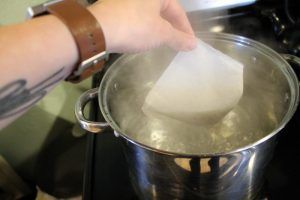
Place 1 gallon (3.8 liters) of filtered water in the kettle and bring to a boil; remove from heat, add the tea bags, and let steep for 4 minutes.
It is very important not to exceed the amount of tea because the kombucha could turn out very bitter.
4. Add the sugar
After steeping the tea, add 1 cup (200 g) of sugar and stir until dissolved. Cover the sweetened tea with a cheesecloth and let it cool to room temperature.


While this may take several hours, you can speed up the process by placing the pot over ice. As the tea cools, thoroughly sanitize the 1-gallon / 3.8-liter jar with StarSan.
5. Add the SCOBY
If you get a mother SCOBY (bacterial culture) from a friend or buy it at a store, make sure it stays at room temperature and never exceeds 32°C.
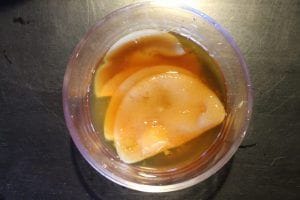
This is why adding your SCOBY to room-temperature tea is crucial; otherwise, you could damage the bacteria and hinder fermentation.
The SCOBY should come submerged in a tea starter, which keeps the SCOBY comfortable in its environment so it doesn’t get stressed when moved to another tea.
Check the temperature of the sweetened tea with a sanitized kitchen thermometer. Remember that the temperature should not exceed 32°C.
When it has cooled enough, pour the sweetened tea into the sanitized wide-mouth jar.
Wash your hands thoroughly with soap and water. Remove the SCOBY from its container and place it in the sweetened tea in the jar. Also pour in the rest of the starter tea.
Cover the jar with a piece of organic cheesecloth and secure it so it stays in place. Place the mixture in a dark place for 1 to 2 weeks.
Don’t worry if your SCOBY falls to the bottom of the jar at first; it will eventually rise to the top to create a new SCOBY.
6. Remove the SCOBY
After 7 to 14 days, the kombucha should have a sweet-sour smell, and the SCOBY should have formed a larger “mother” SCOBY covering the entire surface area of the liquid at the top of the jar.

With completely clean hands, remove the SCOBY and place it submerged in a jar of kombucha for future use.
7. Bottle the kombucha
For bottling, you will need approximately 4-liter bottles. Sanitize the bottles, caps, funnel, and strainer.

When bottling the kombucha, you are transferring it to a secondary fermentation. Allow the kombucha to ferment for another 7 to 10 days in the refrigerator to adjust its carbonation.
If you prefer a less bubbly and carbonated kombucha, simply adjust the time of this stage.
8. Check the pH of the kombucha
The pH of the kombucha should be between 2.5 and 3.5. Test your kombucha to see if it falls within this range.
If the pH is too high, you can consider letting it ferment a little longer before bottling. If it is too low, go ahead and bottle it.
Frequently Asked Questions (FAQ)
1. How long does it take for kombucha to ferment at home?
The first fermentation takes between 7 and 14 days at room temperature (between 20 and 27 °C). The colder the room, the slower the fermentation. The result is a flat kombucha; if you want carbonation, you need a second fermentation in a sealed bottle for an additional 2 to 4 days.
2. What ingredients do I need to make homemade kombucha from scratch?
The basic ingredients are filtered water, black or green tea (unflavored), white sugar, and an active SCOBY with its starter liquid. Any other ingredients, such as fruit or ginger, are added only during the second fermentation, never the first.
3. Where can I get a SCOBY to start making kombucha?
The most common way is to get it from someone who already makes kombucha at home, as the SCOBY reproduces with each batch. You can also buy it dehydrated at natural food stores or online; in that case, you will need to rehydrate it before use following the manufacturer’s instructions.
4. How much alcohol does homemade kombucha contain?
Homemade kombucha typically contains less than 1% ABV, making it a very low-alcohol beverage, similar to kefir or sourdough bread. If the second fermentation is prolonged too much or the temperature is very high, the alcohol content may rise slightly, but it rarely exceeds 3% ABV under normal home conditions.
5. How do I know if my kombucha is ready to bottle?
The most reliable indicator is pH: a ready kombucha has a pH between 2.5 and 3.5. You can also go by taste: it should be acidic but balanced, with no pronounced sweetness. If it tastes very sweet, it needs more days of fermentation; if it is excessively vinegary, it has fermented too long and can be used as a starter for the next batch.

We Recommend
- Beer-battered calamari recipe, ingredients, and step-by-step
- How to prepare beer-braised pork ribs, recipe and step-by-step