
This post is also available in:
 Español
  Português
  Français
A crisp beer is a dry, clean and fresh beer, with sharp bitterness or acidity and a finish that leaves no sweetness behind in the mouth. The word has nothing to do with crunch, even though crisp is also what we call a good apple or a cracker.
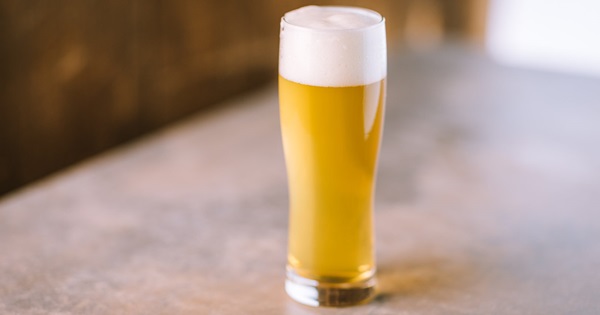
The term shows up on cans, spec sheets and reviews, from industrial lagers to ciders. It is everyday tasting vocabulary in English, and outside the world of beer judges every source explains it differently.

For some, crisp means dry. For others, bitter, highly carbonated or simply cold, and all of them are partly right.
Does crisp mean crunchy?
Not when we talk about beer. The Cambridge Dictionary groups the meanings of the adjective crisp into three families, things that are hard and break easily, things that are clear and sharp, and things that are cold, dry and fresh.
The first gives us a crisp apple or a bag of crisps. The second describes a very clear sound or image, and the third the air on a cold, dry morning.
When a beer is described as crisp, the word combines the last two families, clarity and dry freshness. Nobody means the beer crunches, but that its flavors finish clean, with no sweet residue, and that it leaves the mouth refreshed.
That is also why the word trips up translators. In Spanish, Portuguese or French, the first equivalent that comes to mind is crunchy, and in a tasting note the right choices are words closer to clean, fresh, lively or dry.
What exactly does a crisp beer describe?
The BJCP style guidelines, one of the most widely used references in the beer world, define the term in their glossary as a rapid, abrupt change in the mouthfeel of beer from smoothness to sharpness, leading into a dry finish. They add that it is usually a positive term.
In practice, that turn toward a dry finish usually comes from several traits at once, such as sharp bitterness or acidity, lively carbonation, good attenuation and no sweetness lingering in the mouth. Not all of them are needed, because some make up for others.
The 2021 edition of the guidelines uses crisp and its derivatives 42 times, almost always as praise. It very often appears next to dry, and also next to clean and refreshing.
The sensation is part of a beer’s flavor, which blends taste, aroma and tactile stimuli such as the prickle of carbonation. It is also closely tied to drinkability, because a clean finish invites the next sip.
Is crisp the same as dry?
Not quite. The guidelines show it with two very similar German styles. According to the BJCP, German Pils has a drier, crisper finish than a Munich Helles, which in turn is described with a soft and dry finish, not crisp and biting.
Yet the guidelines’ own numbers do not show a more fermented Pils. It is enough to calculate the apparent attenuation, an estimate of the extract the yeast consumed, called apparent because alcohol, lighter than water, lowers the final gravity reading.
[math]AA = \dfrac{OG – FG}{OG – 1}[/math]
For German Pils, with an average original gravity of 1.047 and a final gravity of 1.0105, the result is this.
[math]AA_{\text{Pils}} = \dfrac{1.047 – 1.0105}{1.047 – 1} = \dfrac{0.0365}{0.047}[/math]
[math]AA_{\text{Pils}} \approx 0.777 = 77.7\%[/math]
For Munich Helles, with 1.046 and 1.009, the figure comes out higher.
[math]AA_{\text{Helles}} = \dfrac{1.046 – 1.009}{1.046 – 1} = \dfrac{0.037}{0.046}[/math]
[math]AA_{\text{Helles}} \approx 0.804 = 80.4\%[/math]
Using the midpoints of the ranges, Helles is even slightly more attenuated, and the final gravity ranges of the two styles overlap. The dryness perceived in a Pils does not come from the extract alone, and its relative bitterness also matters, measured with the BU:GU ratio, the quotient between bitterness units and gravity points.
With the guidelines’ midpoints, Pils has a ratio of 0.66 and Helles 0.41. The sharp bitterness of the Pils cuts the smoothness at the end of the sip, which is exactly the turn the glossary describes.
Bitterness is one route to crispness, not the only one. The American lagers in the table have even less relative bitterness and the guidelines still describe them as crisp, probably because they compensate with very high attenuation and plenty of carbonation.
The table compares five pale lagers and ales using the midpoints of the BJCP 2021 guidelines and the descriptor they use for each. These are calculations on ranges, not measurements of specific beers, so they are useful to compare styles rather than brands.
| Style | OG | FG | Apparent attenuation | IBU | BU:GU | How does the BJCP describe it? |
| German Pils | 1.047 | 1.0105 | 77.7% | 31 | 0.66 | Dry, crisp finish |
| Kölsch | 1.047 | 1.009 | 80.9% | 24 | 0.51 | Slightly crisp, not sharp |
| Munich Helles | 1.046 | 1.009 | 80.4% | 19 | 0.41 | Soft and dry, not crisp |
| American Lager | 1.045 | 1.007 | 84.4% | 13 | 0.29 | Crisp, dry finish |
| American Light Lager | 1.034 | 1.003 | 91.2% | 10 | 0.29 | Crisp, dry finish |
What makes a beer taste crisp?
Carbonation is one of the clearest pieces. For American lagers, the BJCP notes that high carbonation may accentuate the crispness of the dry finish.
Carbonation does more than tingle on the tongue. A study in mice published in Science in 2009 showed that carbon dioxide is detected partly through sour-sensing taste cells, thanks to an enzyme, carbonic anhydrase 4, that turns it into acid on the surface of the tongue (Chandrashekar et al., 2009).
That small acidic stimulus could add sharpness to every sip, and it fits what the guidelines observe in highly carbonated lagers. A lager that has lost its carbonation usually tastes flatter and sweeter.
Temperature matters too. The TRPM5 channel, involved in the perception of sweet, umami and bitter tastes, responds less as temperature drops, according to a study in mice published in Nature in 2005 (Talavera et al., 2005).
That could explain why a very cold beer seems less sweet and therefore drier. Cold may also mute part of the bitterness, so serving a beer ice cold does not make it crisper without limit.
Water is the last ingredient. A high sulfate to chloride ratio pushes a beer toward a drier, more bitter profile, and a low one toward a rounder, maltier profile, as John Palmer and Colin Kaminski explain in their book Water, devoted to water adjustments for brewing.
In a blind test by the Brülosophy website, 14 of 22 tasters told apart two IPAs that differed only in their water (p = 0.003), one with a sulfate to chloride ratio of 150 to 50 and the other with the reverse.
Overall, the version with more sulfate was perceived as crisp, dry, hoppy and more bitter, and the one with more chloride as smoother.
Which beers are usually described as crisp?
The BJCP reserves the word mainly for pale, well attenuated lagers. German Pils has the most mentions, five, followed by the historical Polish Piwo Grodziskie, with four, and by Australian Sparkling Ale and Pre-Prohibition Lager, with three each.
It also appears in unexpected styles, such as Witbier, refreshingly crisp with a dry finish, or Belgian Golden Strong Ale, which is usually paler, lighter-bodied, crisper and drier than a Tripel. In sour beers, such as Berliner Weisse or Straight Sour Beer, the guidelines speak of crisp acidity.
At the other end sits Munich Helles, with a soft finish that is not crisp, and halfway Kölsch, slightly crisp and not sharp or biting. Sweet stouts, malty wheat beers and any style with residual sweetness fall outside the term.
How can you tell whether a beer is crisp when tasting it?
The most reliable test is to pay attention to what happens after you swallow, more than to the first sip. A crisp beer leaves the mouth clean within a few seconds, with no sweetness or pasty feeling, and makes you want another sip.
It is best tasted cold and freshly poured, because as it warms it loses carbonation and sweetness gains presence. A beer that seemed crisp in the first minutes may stop being so halfway through the glass.
A useful trick in any beer tasting is to compare two styles side by side, for example a pils and a helles, or a pale lager and a wheat beer. Tasting them one after the other, the difference between a finish that cuts off clean and one that stays round in the mouth becomes obvious.
To describe it in a tasting note, the best approach is to name what produces the sensation. A dry and bitter finish, like that of a pils, is not the same as a dry and acidic one, like that of a Berliner Weisse, or a dry and highly carbonated one, like that of a light lager.
And in cider?
In cider the word is used the same way, and the sharpness comes mainly from the acidity of the apple. A crisp cider is dry, with lively acidity and a clean finish, and a sweet cider rarely deserves the adjective, whether or not it carries it on the label.
The best known case is Angry Orchard Crisp Apple, which Untappd classifies, curiously, as a sweet cider. Strongbow Original Dry, by contrast, is listed there as a dry cider, closer to what the term promises.
Frequently asked questions (FAQ)
1. How should I translate “crisp” in a tasting note?
The most accurate approach is to describe the sensation with words such as clean, fresh, lively, dry and clean finish or clean bitterness, and for a cider or a sour beer, lively acidity. In Spanish, Portuguese or French it is best to avoid the words for crunchy, which only describe the texture of food.
2. Are crisp and crispy the same thing?
According to VinePair magazine, crispy applies mainly to lagers such as pilsners, with light bitterness and a refreshing finish, and its popularity gave rise to the informal expression crispy boi. Crisp is the tasting term, and it describes a dry, clean and fresh finish that can also appear in styles that are not lagers.
3. Can an IPA be crisp?
Yes, and the BJCP notes that IPAs with a dry, crisp finish, at most medium body and high perceived bitterness fit better as American IPA than as Hazy IPA. Hop bitterness and good attenuation can give a crisp finish even in very aromatic beers.
4. Why does a beer stop tasting crisp as it warms up?
Carbon dioxide dissolves less well in a warmer liquid and escapes sooner, and with less carbonation part of the acidic stimulus that brings freshness is lost. In addition, according to a study in mice, cold dampens the perception of sweetness, so as the beer warms it may seem sweeter and less dry.
5. Is clean the same as crisp?
No, because clean describes a beer without distracting fermentation aromas, such as fruity esters or yeast notes. Crisp describes the sensation of the finish, dry, sharp and fresh, and the BJCP often uses both words together, as in German Pils, crisp, clean and refreshing.

Recommended
- What Is Beer Attenuation? The Percentage That Decides Whether Your Beer Will Be Dry or Sweet
- What Is the Difference Between Taste and Flavor in Beer?