This post is also available in:
 Español
  Português
  Français
A blind tasting is one where you don’t know which beer you’re tasting, or its brand, price, or label. It lets you judge what is in the glass, not what you expect to find in it.
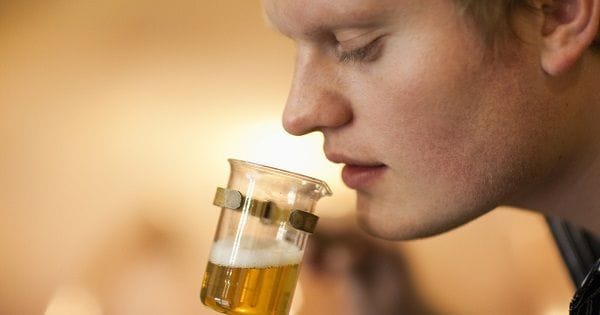

It may seem like an excessive precaution. Several experiments show that the information surrounding a beer changes what we think we taste.
Does your favorite beer taste better when you see the label?
In 1964, Ralph Allison and Kenneth Uhl published a classic study on the subject in the Journal of Marketing Research. They asked a few hundred volunteers to rate five brands of lager beer, with the bottles both labeled and unlabeled.
With the label in view, participants rated their preferred brand higher, and without it they showed virtually no preference for any of them, according to the review of the study published in Money.
The study became a marketing classic because it pointed to something uncomfortable. Much of the loyalty to a beer brand seemed to depend more on the label than on the taste.
The beer with balsamic vinegar
In 2006, Leonard Lee, Shane Frederick, and Dan Ariely took the idea to a bar. They offered patrons a regular beer and another with a few drops of balsamic vinegar, which they called “MIT brew,” and published the results in Psychological Science.
One group tried both beers blind, another learned about the secret ingredient before tasting, and a third found out right after tasting, before choosing.
Disclosure of the secret ingredient significantly reduced preference only when the disclosure preceded tasting, suggesting that disclosure affected preferences by influencing the experience itself.
Learning about the vinegar after tasting did not significantly reduce preference. Learning about it beforehand did, which suggests that the expectation altered what patrons experienced as they drank.
What else changes what we think we taste?
Packaging matters too. In 2016, Barnett, Velasco, and Spence served the same beer from a bottle and from a can at a science festival in Edinburgh, and published the results in Beverages.
With the packaging in view, the beer served from the bottle was rated higher. In the blind test, with 29 participants, there was no preference for either one.
Price works in a similar way, at least with wine. Plassmann and colleagues found in 2008 that raising the price of a wine increased how pleasant participants found it, as well as activity in a brain region associated with pleasure.
The effect of color was more limited in a study with beer. In 2017, Carvalho, Moors, Wagemans, and Spence published a study with beers of different appearance in Frontiers in Psychology.
The differing visual appearance of the beers led to clear differences in expected taste/flavor. However, after tasting, no differences in flavor ratings were observed.
With wine, by contrast, an experiment by Morrot, Brochet, and Dubourdieu from 2001 led a panel of 54 tasters to describe the aroma of a white wine dyed red, with an odorless colorant, as that of a red wine. Music has an influence as well, and in a 2016 study the tasting experience was rated more enjoyable with music than in silence.
| Study | What was changed? | Result |
|---|---|---|
| Allison and Uhl (1964) | Brand label | With the label, the preferred brand was rated higher, according to reviews of the study |
| Lee, Frederick, and Ariely (2006) | Knowing the beer contained vinegar | Preference dropped only when known before tasting |
| Barnett, Velasco, and Spence (2016) | Bottle or can | With the packaging in view, the bottle won; tasted blind, neither was preferred |
| Carvalho and colleagues (2017) | Beer color | It changed the expected taste, not the ratings after tasting |
Why do competitions judge blind?
Competitions keep judges from knowing who made each beer. The BJCP rules make this clear.
Blind tasting must be used. Judges must not be given the identity of the brewer or entrant.
It is one of the few mandatory rules for competitions sanctioned by the program, which also certifies BJCP beer judges.

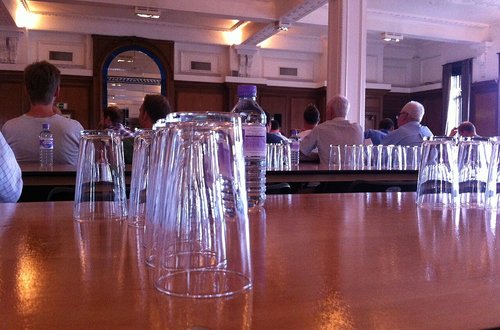
How can you tell whether someone can really distinguish two beers?
To check whether two beers can be told apart, the triangle test is used, as described in the ISO 4120 standard. Each taster receives three glasses, two with the same beer and one with a different beer, and has to pick out the odd one.
Someone guessing without perceiving any difference will be right one time in three.
[math]p = \dfrac{1}{3}[/math]
That is why it isn’t enough for most tasters to get it right. You have to calculate the probability of getting at least k correct answers by pure chance among n tasters, using the binomial distribution.
[math]P(X \geq k) = \sum_{i=k}^{n} \binom{n}{i} p^{i} (1-p)^{n-i}[/math]
With 12 tasters, the probability of getting 8 or more correct answers by chance is about 2%, and the probability of getting 7 or more is nearly 7%.
[math]P(X \geq 8) \approx 0.019[/math]
[math]P(X \geq 7) \approx 0.066[/math]
So with 12 tasters, you need 8 correct answers to conclude that there is a difference at a 5% significance level. The FAO table lists these minimums for other panel sizes.
| Tasters | Minimum correct answers at 5% | Minimum correct answers at 1% |
|---|---|---|
| 12 | 8 | 9 |
| 24 | 13 | 15 |
| 30 | 15 | 17 |
How to set up a blind tasting at home
All it takes is someone who isn’t tasting to serve the beers and write down which one goes in each glass. The glasses should be identical, with the same amount of beer at the same temperature, and identified only by a number or a letter.
If the beers are very different in color, you can use opaque glasses so their appearance gives nothing away. The rest of the preparation is the same as when you host a beer tasting at home.
Frequently asked questions (FAQ)
1. What is a blind beer tasting?
It is a tasting in which the taster doesn’t know which beer is in the glass, or its brand, price, or packaging. It lets you judge the beer for what it is, not for what you expect from it.
2. Why does the label change what we think we taste?
Because information creates an expectation that can shape the experience itself. In the 2006 study of beer with balsamic vinegar, learning about the ingredient before tasting significantly lowered preference, and learning about it afterward did not.
3. Does your favorite beer taste better with the label in view?
In Allison and Uhl’s 1964 study, participants rated their preferred brand higher with the label in view, and without it they showed virtually no preference for any of them, according to reviews of the study.
4. How many correct answers do you need in a triangle test?
It depends on the number of tasters. With 12 you need 8 correct answers, with 24 you need 13, and with 30 you need 15 to conclude that there is a difference at a 5% significance level, according to the FAO table.
5. Do beer competition judges taste blind?
Yes. BJCP rules state that blind tasting must be used and that judges must not know the identity of the brewer or entrant.
Recommended
- What Is the ISO 4120 Standard and How Is It Used to Detect Sensory Differences in Beer?
- Are You a Supertaster? Why Some People Are Hypersensitive to Bitter Taste