
This post is also available in:
 Español
  Português
  Français
A juicy IPA is one whose aroma and flavor recall tropical fruit juice without containing any fruit. The term has no formal definition, and the BJCP guidelines put it in quotation marks.
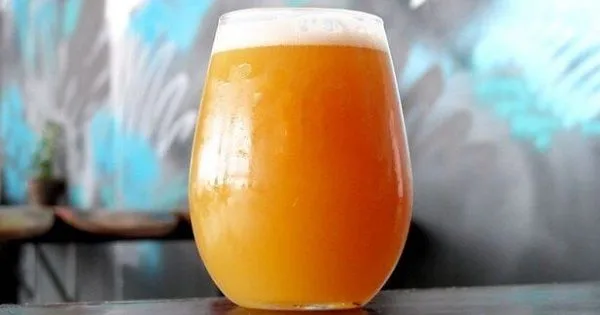

Juicy describes aroma and flavor, and hazy describes appearance. Many beers are both at once, which is where the confusion comes from.
What does the BJCP say about juicy?
The 2021 BJCP style guidelines describe the Hazy IPA as an American IPA with intense fruity aromas and flavors, a smooth body, and often a pronounced haze. The word juicy appears only once, in the style comments.
An emphasis on late hopping, especially dry-hopping, with hops with tropical fruit qualities lends the ‘juicy’ character for which this style is known.
The same guidelines leave out of the style any heavy examples that resemble a milkshake or a fruit smoothie.
Are juicy and hazy the same thing?
No. The Brewers Association 2026 style guidelines call the category “Juicy or Hazy India Pale Ale” and keep the two terms separate.
The term ‘juicy’ is frequently used to describe flavor and aroma attributes often present in these beers which result from late, often very large, additions of hops. A juicy character is not required, however.
The guidelines add that hazy describes the appearance of many of these beers and that some versions show hardly any haze. An IPA can be juicy and almost clear, or hazy with a pine and resin profile.
Where does the juice flavor come from?
The juicy character comes mainly from hop aroma compounds that are perceptible in tiny amounts. The most potent are three thiols, sulfur compounds that give notes of passion fruit, black currant, and grapefruit.
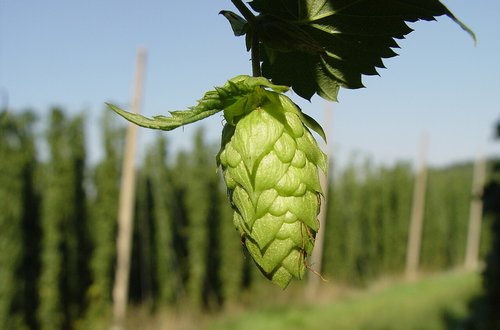
According to the review by Klimczak and colleagues (2023), 4MMP can be detected in beer at 1.5 nanograms per liter, 3MHA at about 4, and 3MH at 55. A nanogram is one billionth of a gram.
In 2008, Kishimoto and colleagues proposed 4MMP as the main contributor to the fruity aroma of beers brewed with certain American hops. In their analysis, the highest content appeared in Simcoe, followed by Summit, Apollo, Topaz, and Cascade.
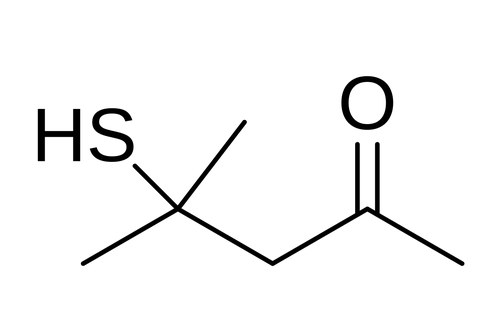
To estimate how much each compound contributes, its concentration in the beer is divided by its threshold. That ratio is called the odor activity value (OAV), and from 1 upward the compound is usually perceived on its own. Below 1 it can also contribute if it adds up with other similar compounds.
[math]\text{OAV} = \dfrac{C}{T}[/math]
Using the concentrations that the same review reports in beers made with dry hopping, 4MMP sits well above its threshold.
[math]\dfrac{31}{1.5} \approx 21[/math]

[math]\dfrac{40}{1.5} \approx 27[/math]
| Thiol | Descriptor | Threshold (ng/L) | In dry-hopped beers (ng/L) | Odor activity value |
|---|---|---|---|---|
| 4MMP | Black currant, passion fruit | 1.5 | 31 to 40 | 21 to 27 |
| 3MHA | Passion fruit, grapefruit | 4 | 4 to 10 | 1 to 2.5 |
| 3MH | Rhubarb, grapefruit | 55 | 29 to 475 | 0.5 to 8.6 |
Hop terpenes round out the picture with floral and citrus notes. According to the same review, linalool can be detected from about 8 micrograms per liter, geraniol between 4 and 40, and citronellol between 8 and 40, depending on the source.
Yeast does its part too
Some of the aroma comes not from the hops as they are added but from what the yeast does with them. Yeast converts geraniol into citronellol. In 2010, working with lager yeast, Takoi and his team observed that geraniol dropped during the first three days of fermentation and citronellol rose gradually throughout the entire fermentation.
The same study found an additive effect among linalool, geraniol, and citronellol, so just 5 micrograms per liter of geraniol and of citronellol were enough to be noticed, a level below their thresholds.
Something similar happens with some thiols. 3MH, for example, is present in hops and wort mostly bound to cysteine or to glutathione, the same compound that appears in kokumi, and yeast releases it through an enzyme encoded by the IRC7 gene, according to the review by Svedlund and colleagues (2022).
The same review notes that during wort fermentation, yeast converts only between 0.1% and 0.5% of these precursors. 4MMP, by contrast, is almost entirely free from the start, according to Kishimoto’s study.
Releasing more thiols doesn’t guarantee a tropical aroma either, because in 2023 Molitor and colleagues observed that beers made with yeasts carrying the complete IRC7 gene were more strongly associated with sweaty, vegetal, or overripe fruit notes.
Does haze add flavor?
According to the BJCP, the haze in a Hazy IPA comes from the interaction between polyphenols from dry hopping and grain proteins, not from yeast in suspension. The Brewers Association takes a broader view and attributes haze to starch, yeast, hops, proteins, or other compounds.
We have not found published studies that compare the same beer, hazy and clarified, in a sensory panel. It has not been shown that a hazy IPA tastes more like juice, and the Brewers Association itself accepts juicy versions that are almost clear.
Frequently Asked Questions (FAQ)
1. What does it mean for an IPA to be juicy?
It means its aroma and flavor recall tropical fruit juice, such as passion fruit or grapefruit, without the beer containing any fruit. The term has no formal definition. The BJCP uses it in quotation marks and attributes it to late hopping and dry hopping with hops that have a tropical profile.
2. What is the difference between a juicy IPA and a hazy IPA?
Juicy describes aroma and flavor, and hazy describes the cloudy appearance. The Brewers Association groups both in the same category and makes clear that a juicy character is not required and that some versions show hardly any haze.
3. Which compounds create the juice flavor?
Mainly hop thiols such as 4MMP, 3MHA, and 3MH, which are perceptible at levels of nanograms per liter and recall passion fruit, black currant, and grapefruit. Terpenes such as linalool and geraniol add floral and citrus notes.
4. Does haze make an IPA taste more like juice?
That has not been shown. According to the BJCP, haze comes from the binding of hop polyphenols with grain proteins, and the Brewers Association adds other sources, such as starch or yeast. We have not found studies that compare the same beer, hazy and clarified, in a sensory panel.
5. Which hops are used in juicy IPAs?
Brewers look for hops with a tropical fruit profile. In a 2008 study, the content of 4MMP, one of the compounds most associated with that aroma, was highest in Simcoe, followed by Summit, Apollo, Topaz, and Cascade.

Recommended
- What Is a Hazy IPA (NEIPA)? Style Description According to the BJCP Guidelines
- What Is Kokumi and Why Have You Never Heard of It If It’s in Your Beer?