
This post is also available in:
 Español
 Português
 Français
A funky beer smells and tastes of barnyard, old leather, wet hay or horse blanket, with an earthy background that sometimes edges into sweat or aged cheese. In English tasting vocabulary the word sums up what the yeast Brettanomyces leaves behind after months of work in a barrel or a bottle. It is a cluster of aromas that other languages have never managed to fit into a single word.

The term usually shows up on Lambic, Gueuze and Wild Ale labels, in Orval reviews and in the BJCP style guidelines, which use it 35 times in the 2021 edition, but outside that circle almost nobody defines it, so one drinker reads it as a synonym for sour, another as a fault and a third as a seal of authenticity.

This article follows the origin of the word, the compounds hiding behind each descriptor and why the same aroma is a fault in a Cabernet while a Gueuze is celebrated for it. It also explains how to describe it in a tasting note without hiding behind the catch-all.
Where the Word Funky Comes From
Before it named a musical groove, funk named a smell. According to Etymonline, the word is documented in English since 1620 in the sense of a strong stink, related to the French dialect funkier and the Old French fungier, which in turn descend from the Latin fumigare, to smoke.
In 1784, according to the Oxford English Dictionary, the adjective funky reappears attached to the meaning of musty or mouldy, the smell of a closed cellar or of a cheese forgotten at the back of the pantry.
Around 1900 the slang of early New Orleans jazz took it up as a name for a raw music felt with the body, carrying the connotation of sweat and smell that the word still had.
That is how beer later recovered the original meaning. When a taster writes funky, the word goes back to the stink of 1620, to the animal, mouldy smell of a stable, except that now it is sought on purpose in the glass.
What Does the BJCP Guide Mean When It Says Funky?
The 2021 BJCP style guidelines are one of the most widely used references in homebrew and craft beer competitions, so their glossary sets how judges use the word, with an entry that reads as follows.
Funky is a positive or negative term, depending on the context. If expected or desirable, it can often take on a barnyard, wet hay, slightly earthy, horse blanket or farmyard character. If too intense, unexpected or undesirable, it can take the form of silage, fecal, baby diaper or horse stall qualities.
The same guide defines Brett as an attenuative yeast that develops fruity aromas of pome fruit, tropical fruit or stone fruit, floral notes and often funky complex flavors, with leather, sweat, barnyard and horse blanket as examples. For the BJCP, funky names the “animal” half of what Brettanomyces does, while the fruity half gets other adjectives.
The distribution by style confirms it, because of the 35 times the English edition uses funk, funky or funkiness, almost all fall within the family of wild beers, with Lambic, Gueuze, Brett Beer and Mixed-Fermentation Sour Beer at the top. In the Saison, on the other hand, the guide states that Brettanomyces is not typical and sends those versions to the Brett Beer category.
Yet even within that family there are limits, because a Berliner Weisse with Brett must stay on fruity and floral notes without turning funky. A Straight Sour Beer keeps its funk below the sensory threshold and a Grape Ale does not admit a funky Brett character at all.
Does Funky Mean Sour?
They are not the same thing, however often they meet in the same bottle. The sourness of a lambic comes from lactic acid bacteria, above all Pediococcus, while the funky aromas come from a Brettanomyces yeast that barely acidifies unless oxygen reaches it.
Years ago, when we introduced the yeast Brettanomyces in beer, we already warned that funk had become a vague label for not saying “faulty” and that a truly sour beer needs lactobacilli. The confusion comes from the fact that both things are learned in the same glass, a gueuze, where the sourness arrives first and the funk takes a year or more to develop.
The proof is in the guide itself, where the Brett Beer, a beer finished with that yeast alone, may not be lactic or acetic. Even so, it is expected to show a funk that grows with the years, so funk exists without sourness.
The Chemical Compounds Behind the Funk
The barnyard or Band-Aid descriptor has a chemical name, 4-ethylphenol. Brettanomyces produces it in two steps from the p-coumaric acid of the malt, first with a decarboxylase that turns it into 4-vinylphenol and then with a vinylphenol reductase that reduces it to the final ethylphenol.
The same route leads from ferulic acid to 4-ethylguaiacol, which smells of smoke, clove or smoked bacon and accompanies the ethylphenol at a ratio close to ten to one.
The yeast of a Weizen or a Saison also decarboxylates those acids, except that it stops at the clove-like vinylphenols because it lacks the reductase.
An ethylphenol in a beer almost always gives Brett away, the only microorganism linked to its synthesis in beverages. In wine it is measured in micrograms and kept out, whereas in a lambic it is measured in milligrams and expected.
The sweat and cheese aromas come from short-chain fatty acids. Isovaleric acid, which the Brewers Association describes as cheese, sweaty socks or fish sauce, is born from leucine when Brettanomyces metabolizes it. Its threshold runs from 0.1 to 2.0 mg/L depending on the beer.
The same acid comes from the oxidation of old hops, which is why the association counts it as expected in lambics, which are brewed with aged hops.
The goaty side even has an etymology, because caproic, caprylic and capric acids, with six, eight and ten carbons, owe their names to the Latin caper, goat, after the smell of those animals.
Gueuze accumulates those acids above the usual level of a lager, while their ethyl esters lean toward sweet or sour apples.
Finally there are the mousy aromas, the tetrahydropyridines that Brettanomyces and some lactic acid bacteria form from the lysine in the wort and from ethanol. They leave an aftertaste of stale cracker that can barely be smelled and shows up at the end of the swallow.
An example helps to see how this works and to read the table that follows. In a Brett Beer with 1.2 mg/L of 4-ethylphenol against a threshold of 0.3 mg/L, the odor activity value, which is the ratio between concentration and threshold, comes out at 4.
An isovaleric acid at 0.2 mg/L against a threshold of 0.3 stays below 1 and is not perceived on its own, so a beer can carry several of these compounds while the nose picks out no more than one or two.
[math]OAV = \dfrac{C}{T}[/math]
[math]OAV_{\text{4-EP}} = \dfrac{1.2}{0.3} = 4[/math]
[math]OAV_{\text{isov}} = \dfrac{0.2}{0.3} \approx 0.67[/math]
The table lists the aroma compounds that a six-person panel detected by olfactometry in Lindemans lambics aged 3 to 28 months, with the approximate threshold in beer given by the ASBC database.
They are data from a single brewery and a small panel, so they serve to rank descriptors and not to fix universal figures.
| Compound | Panel descriptor | Approximate threshold (ppm) | Months in which the panel detected it |
| 4-ethylphenol | Musky, barnyard | 0.3 | 9, 12 and 28 |
| Isovaleric acid | Rancid, cheese | 0.3 to 2.0 | 3, 6, 9, 12 and 28 |
| Hexanoic acid | Sweaty | 8 to 10.7 | 3, 6, 9, 12 and 28 |
| Ethyl lactate | Fruit | 25 | 9 and 28 |
| Ethyl acetate | Fruit, solvent | 0.5 to 50 | 9, 12 and 28 |
| Ethyl butyrate | Apple | 0.05 to 0.3 | 3, 6, 12 and 28 |
Why Does Funk Take Months to Appear?
The reason is that Brettanomyces arrives late in the relay. A study carried out at the Cantillon brewery showed that the succession runs from enterobacteria during the first month, to Saccharomyces and Pediococcus damnosus from the second, to Brettanomyces bruxellensis isolated at six months and from then on the dominant yeast.
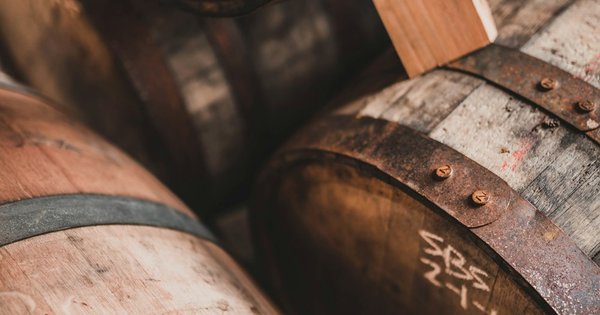
Those microorganisms did not turn up in samples of the air or of the surfaces of the room. The strongest hypothesis places them in the wood of the casks, which had previously held red wine and keep a population of their own in their pores.

On the other side of the Atlantic, in a coolship brewery in the United States, the sequence repeated itself without any inoculation. Brettanomyces dominated the late phase after the first year thanks to a microbiota resident in the brewhouse itself.
Funk is not an ingredient, it is the end of that relay, which lasts longer than the entire fermentation of any lager. In the Lindemans samples the panel did not smell 4-ethylphenol until nine months, when Saccharomyces had already stopped competing for the sugar, while the number of aroma-active compounds it could tell apart rose from seven at three months to seventeen at 28.
The same happens in a bottle of Orval, where the abbey adds wild yeasts, Brettanomyces, during a two to three week conditioning at 15 °C together with hop pellets and then refermentes in the bottle for three to five weeks.
The brewery itself describes a beer that smells of fresh hops with a marked bitterness when young and at six months blends yeast aromas with matured hop notes. Later it drifts toward a slight acidity with hints of yeast and caramel.
When Is Funk a Fault?
It depends on the glass in front of you, because in a Pilsner or an IPA a 4-ethylphenol above its 0.3 ppm threshold is a Brett contamination and belongs squarely among the off-flavors of beer.
It is the kind of accident the Brewers Association asks brewers to avoid by keeping the equipment of clean beers apart from that of mixed fermentation.
In wine the line is even harder. Two decades of enology literature treat the “horse sweat” of Brettanomyces as a cellar plague, with 4-ethylphenol thresholds between 140 and 440 µg/L in reds, so the very molecule that ruins a Cabernet turns a Gueuze into a classic.
Even in a Brett Beer the guide marks what is no longer funk, Band-Aid, fetid, nail polish remover or cheese. The unexpected counts too, because the same horse blanket celebrated in a three-year-old Lambic is penalized in a Berliner Weisse.
A simple rule works at the tasting table, because if the funk lives alongside fruit, clean acidity and a dry finish, it adds complexity. If it smothers everything else or arrives with vinegar and the smell of a horse stall, the beer has gone too far.
How to Describe Funky in a Tasting Note
As with a crisp beer, the mistake is to look for a single word. Funky is not translated, it is broken down, because it gathers at least four families worth naming separately.
There is the animal side (barnyard, leather, horse blanket, farmyard), the damp vegetal side (wet hay, earth, mushrooms), the fatty side (aged cheese, sweat) and the medicinal side (Band-Aid, smoke, clove).
Why write “funky” when you can write “barnyard and leather over an earthy base” and any reader understands it at once?
The English word works as a style label, while in the tasting note the breakdown works better, just as it helps to distinguish taste and flavor when a sensation such as mousiness arrives through the retronasal route.
If you want to train your nose, open a 3 Fonteinen Oude Geuze and an Orval of more than a year on the same afternoon. The first shows the full funk of spontaneous fermentation, barnyard, leather and oak held up by a citric acidity. The second shows the funk of a single yeast added on purpose, drier, earthier and with no lactic acidity.
Anyone brewing at home should remember that Brett is in no hurry to work. A bottle conditioning with Brettanomyces will not show ethylphenols until Saccharomyces has finished its job, so a wait of six to twelve months is part of the recipe.
The next time a label promises funk, leave the bottle in the cellar until the following winter, because what you will smell then is the end of a relay that began in the wood.
Frequently Asked Questions (FAQ)
1. What does it mean when a beer is funky?
That it shows aromas and flavors of barnyard, leather, wet hay, horse blanket or earth, with touches of sweat or cheese, produced above all by the yeast Brettanomyces during a long maturation. The BJCP guide defines it as a positive or negative term depending on the context, desirable in lambic, gueuze or Brett Beer and a fault in clean styles such as a Pils.
2. Is a funky beer the same as a sour beer?
No, they are different things. Sourness is produced by lactic acid bacteria such as Pediococcus and Lactobacillus, while funk is produced by the yeast Brettanomyces, which barely acidifies without oxygen. A Brett Beer can be funky without being sour and a Berliner Weisse can be very sour with no funk at all. In a gueuze the two live together.
3. Which beers are funky?
The spontaneously or mixed-fermented beers of Belgium, such as lambic and gueuze, the Brett Beers and American wild ales finished with Brettanomyces, as well as cellar-aged beers like Orval, which receives Brett during maturation and gains funk over the months. Fruited versions, such as a lambic kriek, keep the funky base under the cherry.
4. Which compounds produce the funky flavor?
4-ethylphenol (barnyard, Band-Aid) and 4-ethylguaiacol (smoke, clove), which Brettanomyces forms from the phenolic acids of the malt, isovaleric and hexanoic acids (cheese, sweat), caprylic and capric acids (goat) with their apple-like esters, and the tetrahydropyridines responsible for the mousy aftertaste.
5. How do you say funky in a tasting note?
There is no single word. The most precise approach is to break it down into concrete descriptors, barnyard, leather, wet hay, farmyard, earthy, sweat or aged cheese, and to say whether it comes with acidity or fruit. “Wild” or “rustic” work as a general label, while “funky” can be kept in quotation marks when talking about the style.
References
Beer Judge Certification Program (2021). Beer Style Guidelines. Glossary, 23D Lambic, 25B Saison, 28A Brett Beer and 28D Straight Sour Beer. https://www.bjcp.org/style/2021/
Liberman, M. (2017, May 23). Funky. Language Log. https://languagelog.ldc.upenn.edu/nll/?p=32835
Spitaels, F. et al. (2014). The microbial diversity of traditional spontaneously fermented lambic beer. PLoS ONE, 9(4), e95384. https://doi.org/10.1371/journal.pone.0095384
Bokulich, N. A., Bamforth, C. W. and Mills, D. A. (2012). Brewhouse-resident microbiota are responsible for multi-stage fermentation of American coolship ale. PLoS ONE, 7(4), e35507. https://doi.org/10.1371/journal.pone.0035507
Witrick, K., Pitts, E. R. and O’Keefe, S. F. (2020). Analysis of lambic beer volatiles during aging using gas chromatography-mass spectrometry (GCMS) and gas chromatography-olfactometry (GCO). Beverages, 6(2), 31. https://doi.org/10.3390/beverages6020031
Chatonnet, P. et al. (1992). The origin of ethylphenols in wines. Journal of the Science of Food and Agriculture, 60(2), 165-178. https://doi.org/10.1002/jsfa.2740600205
Snowdon, E. M., Bowyer, M. C., Grbin, P. R. and Bowyer, P. K. (2006). Mousy off-flavor: A review. Journal of Agricultural and Food Chemistry, 54(18), 6465-6474.
Malfeito-Ferreira, M. (2018). Two decades of “horse sweat” taint and Brettanomyces yeasts in wine: Where do we stand now? Beverages, 4(2), 32. https://doi.org/10.3390/beverages4020032
Nardi, T. (n.d.). Brettanomyces in enology: physiology and mechanisms of spoilage. Infowine. https://www.infowine.com/en/brettanomyces-in-enology-physiology-and-mechanisms-of-spoilage/
Brewers Association (2025). Beer off flavor: Isovaleric acid. https://cdn.brewersassociation.org/wp-content/uploads/2025/07/14095250/BAtech25-Off-Flavor-Isovaleric-201.pdf
Brasserie d’Orval (n.d.). How Orval beer is made. https://www.orval.be/en/page/485-how-orval-beer-is-made

Recommended
- What Does It Mean When a Beer Is “Crisp”? The Tasting Term Everyone Uses and Few Can Define
- What Is Mixed Fermentation? Taxonomy, Strains and Microbial Interaction