
This post is also available in:
 Español
 Português
 Français
By Victor Kling
Beer sommelier
Article updated in October 2026 with the BJCP’s current names, prices and requirements.
The Beer Judge Certification Program (BJCP) is an American program that certifies beer judges around the world to judge at competitions for homebrewers and craft brewers.
Its mission is to promote the judging of beer samples based on the style standards set out in the Beer Style Guidelines, in order to encourage the growth of the sector and drive a steady improvement in the quality of the beers entered.
Getting BJCP certified is important if you want to judge at small and large competitions. Since it is far from easy to obtain, it has also become a credential for many professionals in the beer industry.
To become a BJCP beer judge you first have to pass a 180-question online exam and then, within the following two years, a tasting exam in which you evaluate 6 beers in 90 minutes. A score of 60% on the tasting exam earns the Recognized rank, and 70% plus 5 experience points earns Certified.
The BJCP’s own slogan says it best:
It’s tough, but fair.
Online Entrance Exam (Beer Judge Entrance Examination)
The BJCP certification program is made up of three exams, but most judges only take the first two. To start, you must pass the online entrance exam, the Beer Judge Entrance Examination, on the www.bjcp.org website.
The required content is based on the BJCP Style Guidelines, on topics related to brewing, sensory analysis and service, and also on how the program works (what a judge needs to do, how, and so on).
There are 180 true or false, single choice and multiple choice questions to answer in 60 minutes. The result is pass or fail, with no numerical score, and the exam is available in English, Spanish, Brazilian Portuguese and Simplified Chinese.
Each attempt costs 10 dollars, and there is an option of three attempts for the price of two, that is, 20 dollars. If you fail, you can retake it after at least one day.
The time limit is very short precisely to stop people from looking up answers in sources such as Google or the guidelines themselves.
However, for some questions you won’t find the answer in either place, so it is best to take the exam only after a good amount of study or if you already have plenty of experience as a homebrewer.
The BJCP website also offers a free practice exam so you can see how it works and what to expect.
Once you pass, you become a Provisional Judge and, from that date, you have two years to take the Beer Judging Examination, the practical tasting exam that will certify you at different levels depending on your score.
If you don’t take the tasting exam within those two years, you will have to pass the online exam again.
Those who want to reach the National and Master ranks must also take the Beer Judge Written Proficiency Examination, the written exam, considered the hardest of the three. To sit it you need 80% on the tasting exam and at least 10 judging experience points.
The written exam lasts 90 minutes and has 20 true or false questions and 5 essay questions, according to the BJCP exam structure. Only program members can take it, and it costs 25 dollars.
Beer Judging Examination, the Practical Tasting Exam
To take the tasting exam, check the exam calendar for your region on the BJCP website. There you will find the organizer’s contact details to book a seat, which is usually in high demand.
The exam costs 15 dollars for BJCP members and 40 dollars for non-members.
The tasting exam consists of evaluating 6 beer samples, which may be commercial or homebrewed (chosen by the organizers).
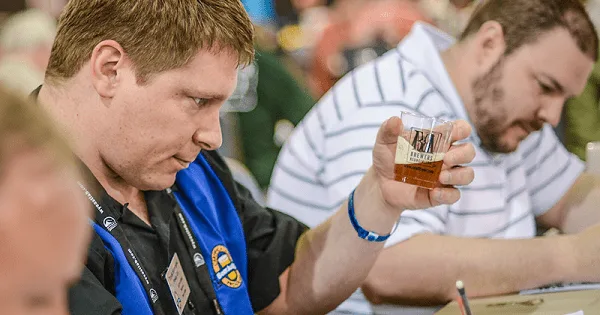
Judging is done on the standard BJCP sheet, the “Beer Scoresheet“. It is not a blind tasting, as is usually the case in sommelier courses and exams. You will judge each beer knowing which style each sample theoretically belongs to.
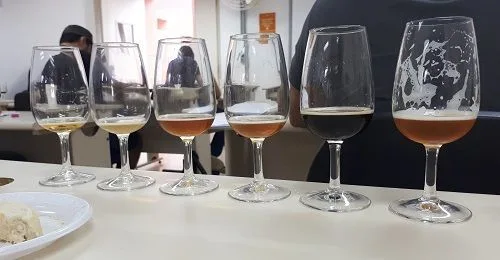
The organizer may announce one style when the beer is actually another. That is the whole point, to judge, for example, a German Pils as if it were a Helles and find the beer’s supposed “faults”, explaining why that Helles is not a classic example of the style.
The beer may also show off-flavors. For example, in a Tasting exam held in February in Brazil, the samples were:
- Homebrewed Czech Premium Pils, with a slight presence of diacetyl and oxidation.
- Schneider Hefeweizen.
- Homebrewed Belgian Pale Ale, infected, with solvent off-flavors and oxidation.
- American IPA from a local brewery, packaged a few days before the exam.
- Baltika Baltic Porter, listed as a style example in the BJCP guidelines.
- La Trappe Belgian Dark Strong Ale or Quadrupel, announced as a Dubbel in the exam, meaning candidates had to judge a Quadrupel sample as if it were a Dubbel.
In total, the exam lasts 90 minutes for 6 samples, an average of 15 minutes to evaluate each beer. In parallel with the exam, in another room, the Proctors (more experienced judges) take the same test.
They have access to the guidelines and talk among themselves. Their final scores cannot diverge much. They have more time to evaluate the samples, since they need to provide twice as much information, precisely because they are building the exam’s answer key.
It is worth remembering that even classic beers and style benchmarks can score low. They may be close to their expiry date, oxidized, and so on.
As a courtesy, many judges don’t score below 13 points, to acknowledge the effort of brewing the beer. It is a widespread custom, although it is not a BJCP rule.
Evaluation Criteria
The tasting exam score is made up of five criteria worth 20 points each, always compared with the scoresheets completed by the proctors.
- Ability to perceive flavors, both positive and negative, in other words on and off, accounting for 20% of the score.
- Level of completeness of the scoresheet, description and detail of the sensory evaluation.
- Descriptive ability, that is, the use of precise adjectives and expressions to convey what you perceive and what is in or out of style.
- Courtesy and advice for the brewer in the overall impression, giving feedback on where to improve, how and why.
- Finally, the accuracy of the score given to each beer, from 0 to 50, which is also worth 20% of the grade and reflects how close your scores were to the average given by the Proctors.
According to the organizers, this is the hardest element for beginners, because when a beer is good, we tend to give it a high score. But what matters here is judging against the core characteristics of the style, that is, how true to style the beers are.
The difference between a sommelier and a judge is that the sommelier is trained to perceive the best qualities in a beer, and the judge to critique, so that homebrewers can improve their beer based on the feedback.
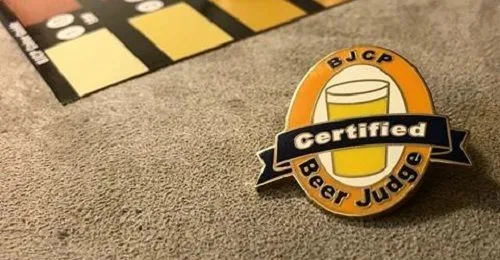
A score of 60% on the tasting exam earns the Recognized rank, and 70% plus 5 experience points earns Certified. Anyone scoring below 60% is an Apprentice for two years.
The National, Master and Grand Master ranks also require the written exam, which carries the same weight as the tasting exam in the average, and more experience points. The table summarizes the current requirements for each rank according to the BJCP.
| Rank | Minimum tasting score | Minimum tasting and written average | Total experience points | Judging points | Other requirement |
|---|---|---|---|---|---|
| Recognized | 60 | Not applicable | 0 | 0 | No |
| Certified | 70 | Not applicable | 5 | 2.5 | No |
| National | 80 | 80 | 20 | 10 | No |
| Master | 80 | 90 | 40 | 20 | No |
| Grand Master | 80 | 90 | 100 | 50 | Service requirement (GMSR) |
After the Exam
The BJCP aims to grade and review exams within eight weeks of their reaching the graders. When this article was written, in 2018, results could take several months.
Normally, when the BJCP receives the exams, it assigns an ID to each registration email.
Sometimes the ID is only issued when the exam result is released. With this ID you can log in and access a restricted area of its website.
There you can review your history of participation in events and judging. In the same place you will have access to the scanned PDF of your tasting exam and your result.
There are private Facebook groups you can usually join once the exam is over, to talk with other BJCP members.
In addition to the 2021 BJCP Style Guidelines, which are the current edition, and the judging forms, the scoresheets, the BJCP website has a range of study resources and supporting documents, such as an excellent off-flavor chart, a spreadsheet with a wide variety of hop types and a best practices manual to help you become an excellent judge.
(*) Victor Kling on Instagram and Medium.
Frequently Asked Questions (FAQ)
1. How much does it cost to become a BJCP judge?
The online entrance exam costs 10 dollars per attempt, or 20 dollars for three attempts. The tasting exam costs 15 dollars for BJCP members and 40 dollars for everyone else, and the written exam, required for the higher ranks, costs 25 dollars and is open to members only.
2. Can you take the BJCP exam in Spanish?
Yes. The BJCP offers its exams in English, Spanish, Brazilian Portuguese and Simplified Chinese, including the 180-question online entrance exam. For the tasting exam, check the calendar for your region and confirm the language with the organizer.
3. How long do I have to take the tasting exam after the online exam?
You have two years from the date you pass the online entrance exam. If you don’t take the tasting exam within that period, you will have to pass the online exam again to regain Provisional Judge status.
4. What judge ranks are there in the BJCP?
The ranks are Recognized, Certified, National, Master and Grand Master. They are awarded based on the tasting exam score, the average with the written exam and accumulated experience points, ranging from 60% with no prior experience for Recognized to 100 experience points and a service requirement for Grand Master.
5. Which style guidelines does the BJCP use today?
The current beer guidelines are the 2021 Beer Style Guidelines, which replaced the 2015 edition. They are the reference used to evaluate the samples and the one worth studying thoroughly before sitting the exam.
Recommended
- Beer Certification Programs: BJCP, Cicerone and Doemens
- Would You Recognize Your Favorite Beer? What a Blind Tasting Without the Label Reveals