
This post is also available in:
 Español
  Português
  Français
The balance ratio, or BU:GU ratio (Bitterness Unit:Gravity Unit), is an original idea from brewing math first presented by beer writer Ray Daniels in his book “Designing Great Beers“, and it lets you estimate the balance between hop bitterness and malt sweetness in a beer.
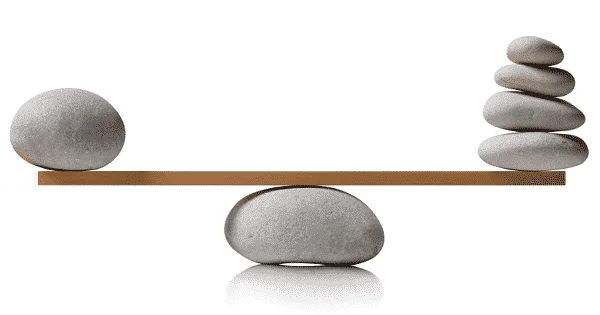

This value is especially useful when defining the ideal characteristics of our next beer, since it lets us design recipes with specific profiles, whether balanced, malty or bitter.
In short, the BU:GU ratio is calculated by dividing a beer’s IBU (International Bitterness Units) by its original gravity (Gravity Units).
Bitterness vs. Sweetness
Hop bitterness is an essential element in achieving balance with malt sweetness, even in the maltiest beer styles.
This interaction is very important for getting the right flavor. Few beers are perfectly balanced; the vast majority lean toward one end of the spectrum or the other.
50 IBU, for example, is quite a lot of bitterness, but it will certainly taste different depending on whether it is a Barley Wine or an English Bitter. With those 50 IBU, a Barley Wine with an original gravity of 1.100 ends up with a BU:GU ratio of 0.5. A beer with a gravity of 1.040 and the same bitterness reaches 1.25.
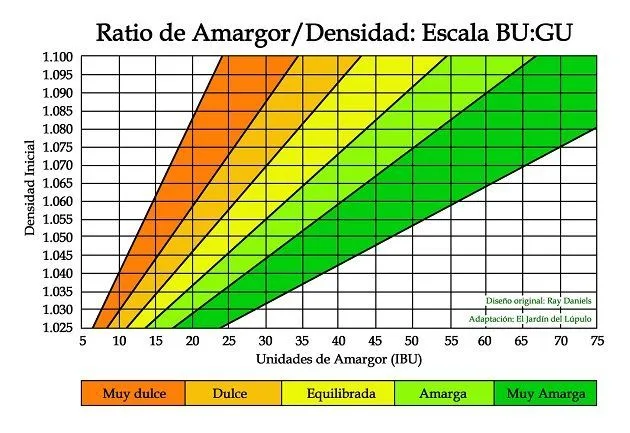
Finally, it is important to keep in mind that the BU:GU ratio, within the calculations of brewing math, only expresses a balance vector between malt sweetness and hop bitterness.
But although these two sensory indicators are the backbone of a beer, many other factors, such as roasted, smoky, fruity and sour characteristics, carbonation or body, can affect the final perception.
How Is the BU:GU Ratio Calculated?
Suppose you plan to brew a beer with an original gravity of 1.050. The gravity units (or points), GU, would therefore be 50 GU (the last two digits of 1.050).
[math]\text{BU:GU} = \dfrac{\text{IBU}}{\text{GU}}[/math]
If you decide that the beer you plan to brew will have 40 IBU, applying the BU:GU formula gives a ratio of 0.80.
[math]\text{BU:GU} = \dfrac{40}{50} = 0.80[/math]
This would place the beer in the dark green zone of the chart, meaning very hoppy.
On the other hand, based on the chart above, for an original gravity of 1.050 a reasonable bitterness range would fall between 15 and 42 IBU, which is the same as a BU:GU ratio between 0.30 and 0.84.
Results and Interpretation
Interpreting the result is simple. When the ratio falls toward the orange zone, we are dealing with malty beers.
A result in the yellow zone of the chart would correspond to a beer with a balance of malt and hops. If the result falls toward the green zones of the chart, these are beers with a bitter profile.

Above 1.0 we are talking about extraordinarily bitter beers, such as Imperial IPAs, which fall outside the range covered by the chart.
For reference, Brad Smith lists average values by style on the BeerSmith blog, with a Weissbier at 0.24, a Märzen at 0.45, an American Pale Ale at 0.71, an English IPA at 0.80 and a Dry Irish Stout at 0.87 (BeerSmith, 2009). The dry stout shows that the ratio does not depend on color or roast.
BU:GU Ratio Values by Style
The table calculates the ratio using the midpoint of the IBU and original gravity ranges for each style in the 2021 BJCP guidelines. These are reference values, since each recipe moves within the range of its style.
| Style | IBU | Original gravity | Approx. BU:GU |
|---|---|---|---|
| Weissbier | 8 to 15 | 1.044 to 1.053 | 0.24 |
| American Lager | 8 to 18 | 1.040 to 1.050 | 0.29 |
| Märzen | 18 to 24 | 1.054 to 1.060 | 0.37 |
| Sweet Stout | 20 to 40 | 1.044 to 1.060 | 0.58 |
| German Pils | 22 to 40 | 1.044 to 1.050 | 0.66 |
| Best Bitter | 25 to 40 | 1.040 to 1.048 | 0.74 |
| American IPA | 40 to 70 | 1.056 to 1.070 | 0.87 |
| Double IPA | 60 to 100 | 1.065 to 1.085 | 1.07 |
The Relative Bitterness Ratio (RBR)
The BU:GU ratio is calculated from the original gravity, so it cannot tell apart two beers that start the same and finish differently. How bitter a beer tastes depends on how much sugar is left unfermented.
To correct this, Ryan Shwayder proposed the Relative Bitterness Ratio, or RBR, on Mad Alchemist, which adjusts BU:GU according to the beer’s apparent degree of fermentation (ADF).
[math]\text{RBR} = \text{BU:GU} \times \left(1 + (\text{ADF} – 0.7655)\right)[/math]
The value 0.7655 is the average apparent attenuation across the BJCP styles (Brewfather). If the beer finishes drier than that average, the RBR goes up. If it finishes sweeter, it goes down.
With a gravity of 1.050 and 25 IBU, the BU:GU is 0.5 in both cases. Attenuated to 80%, the beer gives an RBR of 0.517, while attenuated to 60% it stays at 0.417.
[math]0.5 \times (1 + 0.80 – 0.7655) = 0.517[/math]
[math]0.5 \times (1 + 0.60 – 0.7655) = 0.417[/math]
The difference in balance is noticeable on the palate. That is why the RBR is most useful with highly attenuative yeasts, such as some saison strains, or with low attenuators, such as some English strains.
Frequently Asked Questions (FAQ)
1. What Is the Recommended BU:GU Ratio for an IPA Compared with a Stout?
Although every recipe is unique, the BU:GU ratio varies by style. Using the midpoints from the 2021 BJCP guidelines, an American IPA comes in around 0.87, with a range of 0.57 to 1.25. A Sweet Stout sits around 0.58, with a range of 0.33 to 0.91, aiming for malt sweetness to dominate over the hops. Not all stouts are sweet, and a Dry Irish Stout lands around 0.87 according to BeerSmith.
2. How Does Yeast Attenuation Affect BU:GU Perception?
The BU:GU ratio is calculated from the original gravity, but the actual perception depends on the final gravity. A low attenuating yeast will leave more residual sugars, which can make a beer with a ratio of 0.80 taste less bitter than it looks on paper. If your yeast is highly attenuative, consider lowering the ratio slightly to avoid an overly dry, sharp finish.
3. Does the BU:GU Ratio Apply to Beers with Lactose or Fruit?
The BU:GU ratio is a mathematical guide for malt and hops, but it can be misleading in beers brewed with adjuncts. Lactose adds gravity and unfermentable sweetness that the standard GU calculation does not always distinguish from malt, while fruit acidity can heighten the sensation of bitterness. In these cases, it is best to use the ratio only as a starting point and adjust based on sensory perception.
4. What Is the Difference Between the BU:GU Ratio and RBR?
The BU:GU ratio is Ray Daniels’ classic formula, while the RBR (Relative Bitterness Ratio), proposed by Ryan Shwayder, is a more advanced calculation that adjusts the result according to the beer’s apparent attenuation. It helps correct the limitations of BU:GU when the yeast leaves the beer much drier or sweeter than average, as explained in the section on the Relative Bitterness Ratio.
5. Why Does a Beer Taste Very Bitter If the Ratio Is 0.50?
A balanced ratio (0.50) can come across as excessively bitter if the water profile has a high concentration of sulfates. Sulfates accentuate dryness and hop character. If your BU:GU is right but the flavor is harsh, check the sulfate to chloride ratio in your mash water to soften the perception on the palate.
Bibliography
- Ray Daniels, Designing Great Beers, Brewers Publications, 1996
- BJCP, Beer Style Guidelines 2021
- Brad Smith, Balancing your Beer with the Bitterness Ratio, BeerSmith, 2009
- Brewfather, Relative Bitterness Ratio
- Brewing math, cervezomicon.wordpress.com
- BU:GU scale, eljardindellupulo.blogspot.com
- Randy Mosher, Tasting Beer

Recommended
- What Is IBU in Beer and How to Calculate It? Everything You Need to Know
- Hoppy vs. Bitter: What’s the Difference and How Do They Show Up in Beer?