This post is also available in:
 Español
  Português
The acronym IBU (International Bitterness Units) in beer corresponds to the international measurement unit of bitterness and represents the amount of iso-alpha-acids dissolved in the beer; in other words, each IBU is equivalent to one milligram of iso-alpha-acid per liter of beer.

Each addition of hops during the boil contributes bitterness, to a greater extent if the additions are early, or to a lesser extent if they are in the final stages compared to the same amount.

Early hop additions cause a better isomerization of the resins, but eliminate, due to the time the hops are exposed to the boil, the essential oils that provide aroma and flavor.
On the contrary, hop additions near the end of the boil do not achieve good resin isomerization, but they contribute to flavor and aroma.
Hop Additions for Aroma, Flavor, and Bitterness
When designing a craft beer recipe, you must think about what sensations you want to produce with the different hop additions.
The following image shows a graph of the behavior during the same boil.
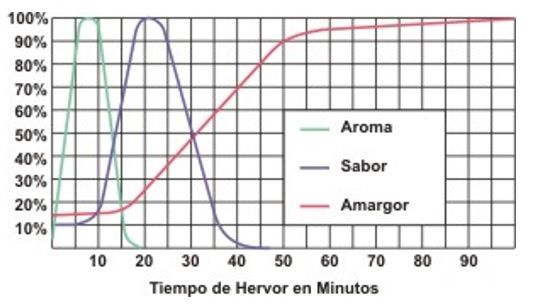
The aroma curve (green) shows that the maximum aroma contribution extracted from the hops occurs at approximately 7 minutes of boil and then declines considerably until it is nullified.
Although this topic is open to debate, as we must consider what happens during the post-whirlpool rest, while our wort is settling at a temperature of over 100°C.
Also, more vigorous fermentations, as in the case of ales, eliminate more aromas than lagers; that is why, to contribute aromas, dry hopping is recommended.
The flavor curve (blue) indicates that the highest transfer of flavors occurs with the wort boiling for 20 minutes, after which the essential oils begin to volatilize.
Finally, the bitterness curve (red) indicates the hop contribution from the beginning and up to around minute 15, where the bitterness delivery is very low.
This then increases rapidly to reach nearly 95% of its contribution by minute 60, after which it continues to increase slowly, as the isomerization of the resins slows down.
How to Calculate the IBU of a Beer
Now it is possible to design the desired profile for the beer and add a personal touch to the formulation. If a beer with a low contribution of hop aroma or flavor is desired, a single addition is made at the start of the boil.
Conversely, if you want to impart a touch of flavor or aroma, additions should be made near the end of the boil, according to the balance defined in your concept.
Calculating IBUs would be very simple if it only depended on the alpha acids in a hop variety and how much of it is added to the beer.

That is to say, given a certain volume of wort, calculating how many liters remain at the end of the boil, and adding a specific amount of hops with a certain percentage of alpha acids by weight; the added alpha acids per liter would be:

Where:
AA/l: Alpha acids per liter
Plu: Hop weight in grams
%AA: % of alpha acids of the added hop
Lm: Liters of wort
From this equation, it is possible to obtain the amount of alpha acids (in milligrams) per liter of wort, if added in a single addition.
If multiple additions are made, the calculation must be done for each type of hop (if using two or more varieties) and each addition.
The sum of all these results would yield the final amount of alpha acids per liter.
However, what we are looking for is the amount of alpha acids that actually isomerize in the wort. To find this result, the calculated alpha acids per liter are multiplied by a coefficient called the utilization percentage.

Techniques to Measure the IBU of a Beer
To determine this utilization percentage, several methods exist, ranging from tables to graphs, such as the Rager method, the Randy Mosher method, or the Glenn Tinseth method.
1. Randy Mosher Method
The Randy Mosher method is a chart consisting of curves that indicate the time the hops will be in contact with the boiling wort; at the bottom is a gravity scale and on the right is the utilization percentage.
2. Glenn Tinseth Method
The Glenn Tinseth method is a table that has the original gravity of the beer at the top and the boil time of the hops on the left; the intersection of both gives the utilization percentage.
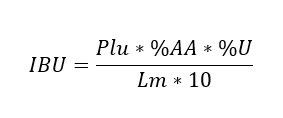
For these two methods, the IBU calculation formula for each addition is as follows:

Where %U is the percentage obtained from the table or chart, usually a one or two-digit number. If it is already expressed as 0.XX, the division by 100 has already been performed, cancelling one of the 100 divisors. If simplified, we get:
3. Rager Method
The Rager method is based on applying a utilization percentage according to the time the hops are exposed to the boil, divided by a correction factor for gravities greater than 1,050; if the gravity is equal to or less than this, this factor will be 1.
The correction factor is calculated using the following equation:

This formula is adapted to how we read gravity, using points without decimals (e.g., 1050 instead of 1.050), where CF is the correction factor we will apply in the formula and OG is the original gravity of our wort (after boiling).

In the table, we can find the different utilization percentages, whether using pellets or whole-leaf hops (flowers).
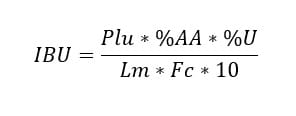
In this case, the formula for calculating IBUs is similar to the previous methods, except that the correction factor for gravities greater than 1,050 is added.
Example of How to Calculate IBUs
To conclude, let’s look at an example: calculate the IBUs of a beer with an OG of 1,060, a volume of 20 liters, with three additions of 15 grams each of Cascade hop pellets (7.2% AA), at 60 minutes for the first, 20 minutes for the second, and 5 minutes for the third.
First, we calculate the correction factor, since the gravity exceeds 1,050, which will be the same for all three additions:
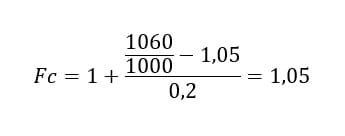
Now let’s calculate how many IBUs were contributed by each addition. We check the table for the utilization percentage: for the first addition, it is 30%; for the second, 19%; and for the third, 6%.
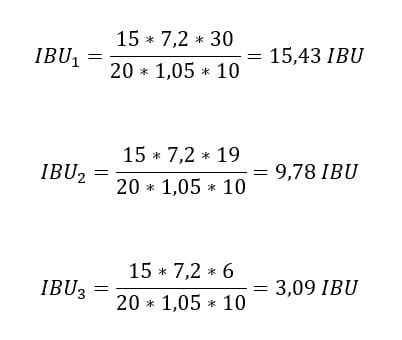
The sum of these three calculations will indicate the bitterness level of our beer, which is 28 IBUs. Notice that depending on when the hops are added, the bitterness contribution decreases, even though the hop amount is identical in all three cases.
If any addition contains two hop varieties, they are calculated independently even if they share the same utilization percentage, as the weight added and the alpha acid percentage will likely differ.
Finally, we can plan our beer, which means thinking about its final profile. First, we need to consider how many liters we get after the boil, at what gravity, and what bitterness level we want to achieve.
Next, we would analyze the addition schedule, determine which varieties to incorporate, and based on this, calculate the necessary grams of each hop (if using more than one variety) per addition using the following equation.
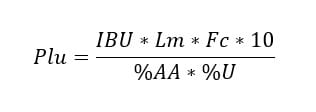
Where IBU is the amount of bitterness we look to obtain in that addition and which will be part of the final total if we do it in several additions, or the total if it is in only one.
With online tools, it is easy to calculate IBUs and determine the bitterness level of a brewed beer. Whether estimating hop additions roughly or precisely calculating the required grams during recipe design, you can easily adjust or recalculate your targets if you stray from your parameters.
Recommended
- Patagonia, varieties and characteristics of the Argentine brewery
- Types of beer by brewing method, origin, and representative styles
Frequently Asked Questions (FAQ)
What does IBU stand for in beer?
IBU stands for International Bitterness Units. It is a scale used to measure the concentration of iso-alpha-acids in beer, which determine its overall bitterness. One IBU is equivalent to one milligram of iso-alpha-acid per liter of beer.
How do hop additions affect beer bitterness and aroma?
Early hop additions (boiled for 60 minutes) maximize bitterness through the isomerization of alpha acids, but volatilize aromatic essential oils. Late additions (boiled for 5 to 20 minutes) preserve flavor and aroma oils but contribute very little bitterness.
What is the difference between Rager and Glenn Tinseth methods?
The Glenn Tinseth and Rager methods are formulas used to calculate a hop utilization percentage based on boil time and wort gravity. The Tinseth method uses a tabular lookup or mathematical function, while the Rager method incorporates a specific gravity correction factor for worts with an original gravity higher than 1.050.