
This post is also available in:
 Español
 Português
 Français
Hop creep is the slow refermentation that a finished beer undergoes when it receives dry hops and live yeast still remains in the tank. Hops bring their own enzymes, which convert dextrins, sugars the yeast could not eat, into glucose and maltose, and fermentation starts up again.
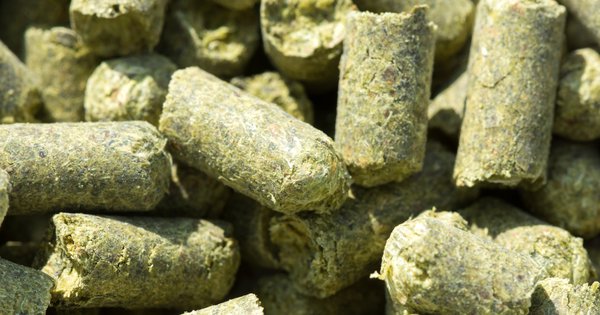
The phenomenon was described rigorously in 2018, when Kirkpatrick and Shellhammer, of Oregon State University, showed that Cascade pellets contain active amyloglucosidase, alpha-amylase, beta-amylase and limit dextrinase. Until then, hops were considered an inert ingredient once fermentation was over.

Since then, research has moved forward with three studies published in 2025 that pin down which varieties, which parts of the cone and which contact conditions worsen or curb the problem. This article sums up what is known today and what a brewer can do with that information.
Why do hops restart fermentation?
When fermentation ends, the beer still holds dextrins, chains of four or more glucose units that brewing yeast cannot assimilate. They account for part of the body and of the final real extract.
When the dry hops arrive, their enzymes break those chains into glucose, maltose and maltotriose. Glucose and maltose are easy food for any strain, so the residual yeast goes back to work.
The enzymes do not live in the lupulin. Wietstock’s team measured in 2025 that the plant material and the strig of the cone have far higher enzymatic activity than the lupulin fraction, in line with the plant or microbial origin that Kirkpatrick and Shellhammer had attributed to these enzymes.
How much alcohol and CO2 does hop creep add?
The reference experiment used a fully attenuated commercial lager, 10 grams per liter of Cascade pellets, one million ale yeast cells per milliliter and a temperature of 20 °C. That is a moderate dry hopping dose by the standards of a modern IPA.
Real extract dropped 1 °P in the first five days and kept falling slowly until it had lost about 2 °P by day 40. Fully fermented, that sugar produced 1.3% more alcohol by volume and an additional 4.75% of CO2.
The speed of the process explains why it goes unnoticed. The first degree Plato is lost at a brisk pace and the second falls almost seven times more slowly, with the beer already in the package.
[math] \dfrac{1}{5} = 0.20 [/math]
[math] \dfrac{1}{35} \approx 0.029 [/math]
The two quotients express degrees Plato lost per day in each stretch of the experiment. For a homebrewer measuring with a hydrometer, those 2 °P amount to watching final gravity drop by roughly 8 gravity points after fermentation had been declared finished.
The summary of the Kirkpatrick and Shellhammer (2018) experiment looks like this.
| Time | Real extract | Cumulative effect |
|---|---|---|
| Day 5 | Down 1 °P | Refermentation under way |
| Day 40 | Down 2 °P | Alcohol +1.3% v/v and CO2 +4.75% v/v |
What happens to diacetyl and the aromas?
The reactivated yeast once again produces precursors of diacetyl, the buttery off-flavor, and in the cold it has no time to reabsorb them. Bruner, Marcus and Fox measured in 2022 how diacetyl changes during the fermentation of dry-hopped beers across twelve Saccharomyces strains.
There is a second, less familiar front. Willemart, Tanriverdi and Collin confirmed in 2025 that hops also contribute esterases that hydrolyze isoamyl acetate, the banana ester typical of many ales.
The longer the contact time, the more glucose released and the less isoamyl acetate left in the beer. Hop creep fattens the alcohol and at the same time thins the ester profile.
Do all hop varieties produce hop creep?
Not with the same intensity. Kirkpatrick and Shellhammer analyzed 30 varieties and found clear differences that followed neither the pedigree nor the genetics of each one.
Jobe, Féchir, Rubottom and Shellhammer refined the figure with 35 fields in Washington and Oregon during the 2020 and 2021 harvests. Cascade showed 60% higher enzymatic activity than Mosaic regardless of region and year.
Soil and field management also had a significant influence, although the authors were unable to isolate which terroir variables explain the difference. Hops of the same variety can behave differently depending on the farm that grew them.
In Germany, Wietstock et al. sorted 16 varieties from three harvests into three activity groups. Pelletizing and storage barely altered the enzymes, so the pellet format offers no protection against the problem.

How is hop creep controlled?
Kilning temperature is the first brake, and it acts before the hops ever reach the brewery. Rubottom’s team tested kilning between 49 and 82 °C on Amarillo and Simcoe and confirmed that the higher the kiln temperature, the lower the enzymatic activity and the lower the overattenuation in the fermenter.
In the brewery, contact time rules. The Belgian study of 2025 showed that longer contact favors alpha-glucosidase and the esterases, so shortening the dry hopping limits both the sugar released and the loss of esters.
Removing the yeast before hopping, chilling the tank to slow enzymes and yeast at once, or pasteurizing after packaging are the usual routes. Each carries an aromatic or economic cost that the brewery weighs.
The beer’s own alcohol is no defense. It took 10% v/v of ethanol to inhibit the amylolytic enzymes of the hops, and even that level did not affect the esterases.
The same work leaves a practical takeaway. A laboratory assay at 50 °C makes it possible to predict in less time how much hop creep a batch of hops will generate, before risking a whole tank.
Which beers are most at risk?
Hop creep affects any beer that receives dry hops with live yeast, whether a pale ale, a dry-hopped lager or pilsner, a saison, a sour or even a hopped cider. The 2018 reference experiment was carried out on a commercial lager.
New England IPA and Hazy IPA concentrate the problem for three reasons. They carry enormous dry hopping doses, they are often hopped with yeast still in suspension and they reach the market within a few weeks.
If refermentation continues inside the can, pressure rises, the real alcohol exceeds the one on the label and gushing appears on opening. Jobe et al. point out that overpressure and package failure are a consumer safety issue, on top of a labeling violation.
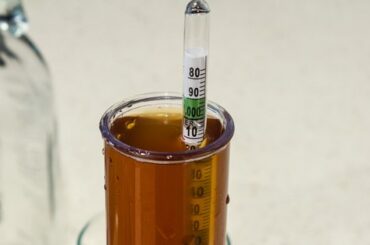
A homebrewer detects it with a gravity reading one week after hopping. If gravity has dropped relative to the end of fermentation, hop creep is under way.
Frequently Asked Questions (FAQ)
1. What is hop creep in beer?
It is the refermentation that occurs when hops added dry release enzymes that break down the dextrins of an already attenuated beer. The resulting glucose and maltose feed the yeast still in suspension, which goes back to producing alcohol and CO2.
2. How much alcohol does hop creep add?
In the 2018 experiment by Kirkpatrick and Shellhammer, with 10 grams per liter of Cascade at 20 °C, the beer lost about 2 °P of real extract in 40 days and gained 1.3% alcohol by volume. With higher dry hopping doses, the effect can be greater.
3. Which hop varieties have more enzymes?
It depends on the variety and the farm. Across 35 fields in Washington and Oregon, Cascade showed 60% more activity than Mosaic. In Germany, 16 varieties fell into three activity groups and pelletizing did not reduce the enzymes.
4. How is hop creep avoided?
Shortening contact time, removing the yeast before dry hopping, chilling the tank and using hops kilned at high temperature reduce the problem. The beer’s alcohol offers no protection; it takes 10% v/v to inhibit the hop amylases.
5. Does hop creep produce diacetyl?
It can. The reactivated yeast once again generates diacetyl precursors and in the cold does not reabsorb them, something that has been observed in dry-hopped fermentations across several Saccharomyces strains.
References
Kirkpatrick, K. R. and Shellhammer, T. H. (2018). Evidence of Dextrin Hydrolyzing Enzymes in Cascade Hops (Humulus lupulus). Journal of Agricultural and Food Chemistry, 66(34), 9121-9126. doi.org/10.1021/acs.jafc.8b03563
Kirkpatrick, K. R. and Shellhammer, T. H. (2018). A Cultivar-Based Screening of Hops for Dextrin Degrading Enzymatic Potential. Journal of the American Society of Brewing Chemists, 76(4), 247-256. doi.org/10.1080/03610470.2018.1546091
Rubottom, L. N., Lafontaine, S. R., Hauser, D. G., Pereira, C. and Shellhammer, T. H. (2022). Hop Kilning Temperature Sensitivity of Dextrin-Reducing Enzymes in Hops. Journal of the American Society of Brewing Chemists, 80(1), 75-83. doi.org/10.1080/03610470.2021.1903290
Bruner, J., Marcus, A. and Fox, G. (2022). Changes in Diacetyl and Amino Acid Concentration during the Fermentation of Dry-Hopped Beer. Journal of the American Society of Brewing Chemists, 81(2), 242-254. doi.org/10.1080/03610470.2022.2078946
Jobe, C. A., Féchir, M., Rubottom, L. N. and Shellhammer, T. H. (2025). The Importance of Variety and Regional Identity on the Dextrin-Reducing Enzymatic Activity of Cascade and Mosaic Hops Grown in Washington and Oregon. Journal of the American Society of Brewing Chemists, 83(1), 39-46. doi.org/10.1080/03610470.2024.2335828
Willemart, G., Tanriverdi, Y. and Collin, S. (2025). Impact of Contact Time, Temperature, and Ethanol Content on Hop Creep-Related Enzymatic Activities in Beer. Journal of the American Society of Brewing Chemists, 83(2), 215-221. doi.org/10.1080/03610470.2024.2432146
Wietstock, P. C., Michalek, D., Treetzen, T. et al. (2025). Diastatic Activity of German Hop Cultivars with Respect to Variety, Crop Year, and Separated Hop Cone Parts. ACS Food Science & Technology, 5(6), 2408-2416. doi.org/10.1021/acsfoodscitech.5c00217

Recommended
- Dry Hopping (Dry Hop): What Is It, What Is It For, and What Are Its Benefits?
- Diacetyl in beer, formation, reduction and control