This post is also available in:
 Español
  Português
When we talk about craft beer, there is an infinite array of aromas and flavors to enjoy, each with its own way of being described; yet the same words are used over and over again far too often.


And one of the most overused terms is “hoppy,” most of the time to point to the bitterness of a beer.
Let’s compare whether this terminology is being used correctly and see how we can improve our vocabulary and broaden our thinking on the subject.
Finally, while much of the discussion tends to revolve around IPAs, these terms apply to many other beer styles as well.
The good and the bad of IPAs
The India Pale Ale (IPA) style has done incredible things for the craft beer industry worldwide.
It is, by far, the most popular style and in many ways has paved the road for the birth of new breweries and beer styles.
But the IPA style has also generated a lot of confusion and misunderstanding. Any beer with a hop-forward profile is often referred to as an IPA sub-style.
In fact, the debate about what an IPA once was and what it has become is still ongoing, but that is a discussion for another time.

For now, let’s compare the two terms most frequently used to describe an IPA: hoppy vs. bitter.
When you hear someone at a bar say they don’t like “hoppy beers,” what they probably mean is that they don’t like very bitter beers.
This misuse of words has even led to the widespread misconception that all craft beer is by default hoppy and therefore bitter.
But the issue is not limited to IPAs, because all beers contain hops; however, it’s impossible to overlook the fact that this is the style most people think of when using these terms.
The fundamentals of hops and beer
The need to clarify the difference between hoppy vs. bitter is by no means a lesson in how to brew beer or the science behind hop usage, but it is important to recognize some key factors.
1. Virtually all beers use hops
Hops are one of the four basic ingredients of beer, so even a beer that doesn’t taste “hoppy” has used hops in its production.
2. Hops provide balance
Without hops, beer would be too sweet. It is that balance between sweetness, bitterness, and their different ratios that most people seek and recognize in a quality beer.
3. Hops add bitterness
Yes, hops provide the bitter element in beer, but the level of bitterness can vary dramatically depending on the type of hop, the quantity used, and how it is used.
4. Hops have much more to offer
Beyond the bitter component, hops possess many additional qualities that contribute aromas, flavors, and even antibacterial properties to beer.
Hoppy vs. bitter
All of this background brings us to the main topic of this article: hoppy vs. bitter. What is the difference? Why should we care?
1. Hoppy
Hops can do incredible things for beer, imparting characteristics that range from piney, earthy, and floral; hops are capable of providing a wide range of flavors, which are usually tied to the geographic region in which they are grown.
In most cases, hops will be used to provide bitterness and balance the sweetness of the malt, or, as in the case of IPAs, often to add a great deal of bitterness.
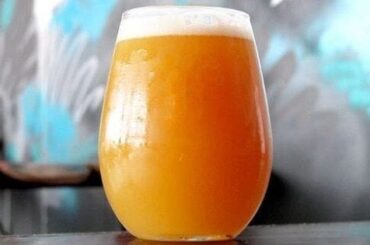
But the two things are not necessarily connected, since, in fact, with the rise of the Hazy IPA, bitterness has never been less related to hops.

This is because brewers are intentionally using techniques that avoid extracting bitterness from the hops, adding them late in the brewing process where hops primarily contribute flavor and aroma.
Modern beers are recognized for exhibiting large amounts of hop flavor while maintaining bitterness so low it is often imperceptible.

So hoppy means you can taste and smell the characteristics of the hops used—whether fruity, earthy, citrusy, floral, or piney, depending on the hop variety—without the beer necessarily being bitter.
2. Bitter
Remember that commercial with the guy puckering his lips and scrunching his face because his beer was too bitter?
Those kinds of ads taught a generation that beer should not be bitter, something that the craft beer movement has helped to correct.
Even so, many people still shy away from beers that exhibit any level of bitterness and, while there is nothing necessarily wrong with that, most find that a moderate bitterness can be quite pleasant.

Beer can and often should be bitter. It is bitterness that balances the sweetness of the grains. However, it is also important to realize that bitterness on its own has a wide spectrum of characteristics.
International Bitterness Units (IBU) are the scale used today to measure beer bitterness, quantifying an acid contributed by hops called isohumulone.
The scale starts at zero and the higher it goes (with a cap of 100), the more isohumulone will be present in the liquid.
But let’s slow down a bit, because just because a beer has a high IBU does not mean it will be bitter.
That’s because we need to consider relative bitterness and perceived bitterness.
Relative bitterness vs. perceived bitterness
While at first glance it might seem that a beer with a higher IBU would be more bitter than one with a lower IBU, that is not always the case.
This is where the magic of beer and brewers comes into play, as the malts used in brewing are the counterpart to bitterness.
So if a beer was brewed using a lot of malt (likely also aiming for a higher ABV), this can balance a higher IBU level.
For example, a beer with 60 IBU and 6% ABV will taste as bitter as a beer with 90 IBU and 9% ABV.
Also, a beer with 40 IBU and 3% ABV will taste more bitter than a beer with 60 IBU and 8% ABV.
The IBU value should always be considered as a relative factor compared to the other elements of the beer.
Simplified, it could look like this:
More malt = Higher ABV = Greater capacity to balance bitterness
This is a very simplified view that does not apply to all beers, but it is a good place to start.
The second factor is perceived bitterness, which is simply the sensation of how bitter the beer actually tastes, which is also affected by each person’s ability to taste and perceive bitterness.
The lesson here is that we cannot judge a beer based solely on the IBU value listed on the label.
A little more understanding of the beer and its style is needed to estimate how bitter it might be, and the only reliable way is to drink it and judge for yourself.
Conclusions
When it comes to craft beer, you will always discover which styles are your favorites, but this should not stop you from continuing to experiment and try different versions of the same style. It is the best way to learn and expand your knowledge of what you enjoy drinking.
When it comes to the topic of hoppy vs. bitter: try to understand the terms first and how they apply to what you are drinking.
All beers contain hops, but what hops do to a beer depending on how they are used can be dramatically different.

Recommended
- What Are the Main Fraud and Scam Risks When Shopping Online?
- What Is Beer Fermentation and What Are Its Different Stages?