This post is also available in:
 Español
  Português
By Evan Rail
The global battle over the name “Budweiser” has been going on for 120 years—long enough to earn its own detailed entry on Wikipedia.
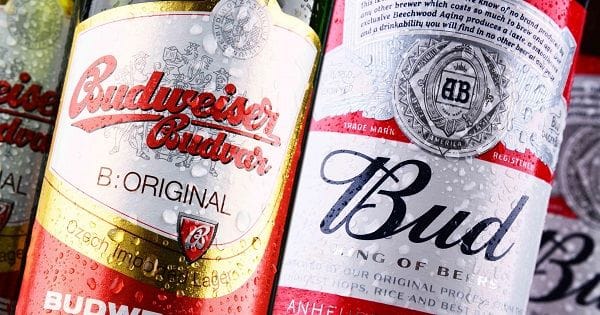
The most widely told version of this dispute says that the original Budweiser comes from the Czech city of České Budějovice, a town in southern Bohemia filled with spire-topped towers that Germans traditionally called “Budweis.”
A brief history of “Budweiser”
According to history, in 1876, a brewery in St. Louis, United States, began producing a beer they called Budweiser, meaning “from Budweis,” in honor of the famous lager from the historic Czech city.
Adolphus Busch, co-founder of Anheuser-Busch, chose the name out of a desire to “brew a beer similar in quality, color, aroma, and flavor to the beer brewed in Budweis.”

That version of history has at least two major gaps, starting with the fact that Budvar, also known as Budweiser Budvar, was founded in 1895, while the American version, Budweiser, dates back to 1876.
If the Czech Budweiser is 19 years younger, you might ask: how can it be the original? Like many stories involving language, ethnicity, and identity in Central Europe, the answer is not straightforward.
To begin with, Budvar has made geography—not chronology—the crux of its argument. The difficulty of pronouncing České Budějovice aside, the city has a brewing history dating back to its founding in 1265.
Budvar has therefore reasonably argued that, as a descendant of a 750-year brewing tradition actually located in the city called Budweis (in German), it should be the authorized brewery to use the name Budweiser, rather than a trademark registered in North America.
Legal disputes between the two Budweisers
The dispute has been ongoing since 1907 and has involved more than 100 court cases worldwide, mainly following World War I.
As a result, Budweiser Budvar holds the rights to the Budweiser name in most of Europe, while AB InBev holds those rights in North America.
Consequently, AB InBev uses the name “Bud” in most of Europe, and Budvar sells its beer in the United States and Canada under the name “Czechvar.”
In other countries, one brewery or the other—or even both—may use the name “Budweiser,” depending on local trademark law.
Samson: the “third party” in the dispute
But there are additional elements in this case, such as the small brewery now known as Samson, also located in České Budějovice and whose origins date back to 1795.
Under the arguments presented, if there were an “original Budweiser,” it should be Samson.

České Budějovice was once a city where both Czech and German were spoken and where everyone got along famously until the end of the 19th century.
Although Germans were a minority in České Budějovice, they enjoyed political power that went well beyond language, including ownership of the Samson brewery and other important local institutions.
The Czechs, for their part, founded Budvar—a locally owned competitor—amid the nationalist fervor of the late 19th century, the same era in which the Czech National Theatre was founded with the aim of hearing opera and plays in their own language, rather than in German.
In recent years, the diminutive Samson has been overlooked in the beer world’s most famous branding battle, while at the same time, the quality of Samson’s beer suffered through successive ownership changes, earning a reputation as a poor-quality beer amid constant speculation about its closure.
Then, in 2014, the inevitable happened: following an initial purchase that included part of its intellectual property, AB InBev fully acquired the Samson brewery, giving the American company a historic foothold within the city of Budweis itself.
This acquisition went almost unnoticed amid the wave of news about AB InBev’s acquisition of SABMiller in 2015, which required SABMiller to divest most of its Central and Eastern European brands, including Pilsner Urquell and other breweries that ultimately ended up being acquired by Japan’s Asahi.
Yet amid this whirlwind of sales, AB InBev decided to hold on to Samson.
And so we arrive at the second decade of the 21st century, with Czech media reporting that AB InBev has invested more than $17 million in Samson since 2014.
For its part, under the management of a new CEO, the Czech state-owned brewery Budvar has not been left behind and has undertaken significant expansions.
It is almost as if a new front had opened in the longest trademark war in the beer world.
In 1996, Samson was brewing at full capacity, exceeding 380,000 barrels per year. Today, its annual production does not exceed 75,000 barrels—and that is accounting for the 10% growth achieved under AB InBev’s ownership.
Dřevikovský attributes those results to investments in technology and sanitation under AB InBev’s ownership.
We have invested a lot of money and our beer is once again recognized as high quality. We have not adjusted recipes. There is not a single change in our recipes. It is just technology. We have our history, our recipe, our traditions, our taste.
The major changes included much more stainless steel, a dozen new giant cylindrical-conical tanks (CCTs) to complement the few Samson already had installed, as well as new filtration and cleaning systems.
Dřevikovský adds:
Two years ago, convincing a pub owner to sell Samson was almost impossible. Now, local points of sale have nearly doubled, as have exports, although the brewery will continue to focus on sales in České Budějovice and the surrounding area.
The old brewery has a lot to offer. They use the same celebrated water source as Budvar—a 274-meter artesian well.
They use a yeast strain similar to Budvar’s. Like Budvar, and in sharp contrast to St. Louis Budweiser, their beer is made from 100% malt and 100% Czech hops, and is still produced using decoction mashing.

In the widely told version of the Budweiser saga, Budvar plays the role of David, fighting a multinational Goliath.
But in the city of České Budějovice, Budvar is the giant. While Samson might reach 80,000 barrels this year, Budvar will sell more than 1.35 million barrels. Samson has around 70 employees. Budvar has 700.
Budvar keeps growing
Budvar’s CEO, Petr Dvořák, refers to breweries that still use separate vessels for fermentation and lagering—a traditional process that has largely disappeared.
We are the only brewery in the world that is still expanding its lager brewing capacity. Not only have we invested in our new logistics center, but we have also invested in new lagering cellars.
The new lagering cellars would allow Budvar to continue standing out, especially as other breweries similar to Samson keep closing.

But Budvar’s logistics center is on another level. Located across the street from the main brewery, it required the construction of two bridges over the road and cost more than $32 million to build before opening over the Easter weekend of 2018.
Inside the logistics center, beers are packaged by robots that then transport them by monorail to be loaded onto delivery trucks.
It has been called the most modern packaging center in the country and in all of Central Europe—surpassing even several Amazon distribution centers.
The logistics center is just one of several major new developments at Budvar, which has announced plans to expand its annual production volume by around 30%, aiming to reach 1.7 million barrels per year.
That will require a new packaging line, new brewhouses, and expanded lagering cellars—an additional investment of approximately $55 million.
These changes are big news at a brewery that prides itself on tradition, even though many of its processes remain intentionally old-fashioned.
Walking through the cellars, one notices that, despite all the major investments, the lagering tanks still have manual valves.
That is the result of Budvar’s commitment to 90-day cold conditioning, and the brewery still uses only classic Saaz hops for its traditional lagers—whole hop cones only, not pellets.
Budvar remains government-owned three decades after the fall of communism and, like any profitable business, contributes regularly to the state’s coffers.
But beyond that, the most famous beer from České Budějovice is an ambassador for Czech culture more broadly.
A battle far from over
Dvořák notes:
I think it is a great victory for the country when someone walks into a bar in New York and asks: what kind of Czech beer do you have? We are a brewery with 10 million shareholders. We are owned by the nation. We can help promote Czech beer culture and help promote the nation itself.
That does not mean you will start seeing Czech Budweiser in more bars in New York—at least not under that name.
In the United States, Budvar must sell under the “Czechvar” brand, and imports to the country remain minimal.
The rest of the world is a different story. Budvar now ships beer to 79 countries, and its largest export share goes to neighboring Germany, where Budvar has long been the best-selling import in the retail market.
Other countries have also seen strong results. Sales to Russia increased 64%, while Swedish sales grew 80%.
While Budvar holds the general rights to the Budweiser name across Europe, its much smaller neighbor in České Budějovice also holds some rights.
Known from at least 1795 until 1948 and once again since 2001 as Budweiser Bürgerbräu (or its Czech equivalent, “Budějovický měšťanský pivovar”), Samson also holds the legal right to use the EU Protected Geographical Indication “Budweiser Bier” in Europe.

Does this mean AB InBev will start brewing Missouri-style Budweiser in České Budějovice, using Samson as a backdoor for European sales?
Probably not. Europe’s biggest market is Germany, where a beer made with rice is, well, not beer.
But at the most basic level, it is hard not to appreciate that a Czech brewery staggering under the weight of its own history will be saved.
It is also hard not to applaud Budvar’s success. While the previous management was extremely slow and insular, relying on old marketing tricks, the new management team is clearly thinking about the future.
There may ultimately be a loser—the fight between Budvar and AB InBev is, after all, a battle.
But for now, the story in the hometown of Budweiser looks like a victory for everyone. Especially for the people who love beer.
Frequently Asked Questions (FAQs)
1. What is the flavor difference between Czech and American Budweiser?
Although they share the name, they are radically different beers. Budweiser Budvar (Czech) is a traditional Bohemian Lager, brewed with Moravian barley malt, whole Saaz hops, and artesian well water, giving it a malty, floral, and bitter profile. In contrast, AB InBev’s Budweiser (USA) is a lighter American Lager that uses rice in its recipe to soften the flavor and achieve a cleaner, more refreshing finish.
2. Why is the original Budweiser sold as Czechvar in the United States?
Because Anheuser-Busch registered the Budweiser trademark in North America in 1876, the Czech brewery is prohibited from using that name in that territory. To export its product to the US and Canada without violating intellectual property laws, the Czech state-owned company created the Czechvar brand, which contains exactly the same beer as its European version.
3. What does “Budweiser” mean and why do both companies claim the term?
The term is a German demonym meaning “from Budweis” (the German name for the Czech city of České Budějovice). The Czech company claims the name on the basis of Protected Geographical Indication, arguing that only beer from that city can be called that. The American company claims the name on the basis of registration priority, having trademarked it years before the current Budvar plant was formally established.
4. Is it true that Budweiser (USA) owns a brewery in the Czech city?
Yes. In 2014, the multinational giant AB InBev acquired the Samson brewery, the oldest plant in České Budějovice (founded in 1795). The purchase was strategic: by owning a physical facility in the city of “Budweis,” AB InBev gained a stronger legal and historical basis to justify the use of the name in international disputes against Budvar.
5. Which countries allow both brands to be sold simultaneously?
Coexistence is rare and depends on bilateral treaties. In the United Kingdom, for example, after decades of litigation, courts ruled that both companies had the right to use the name “Budweiser” simultaneously, as local consumers knew how to distinguish between the two. However, in most markets worldwide, the right of exclusivity belongs to only one of the two.
Recommended
- Mencía Grape: The Vinicultural Gem of the Iberian Peninsula
- The Splendors of Malt: Crafting and Characteristics