
This post is also available in:
 Español
 Português
Belgian lace, also called Brussels lace, is the pattern of foam rings that clings to the walls of the glass as you drink a beer. Its name comes from its resemblance to the handmade lace of Belgium, and when it forms parallel rings it shows that the foam is stable and the glass is clean.
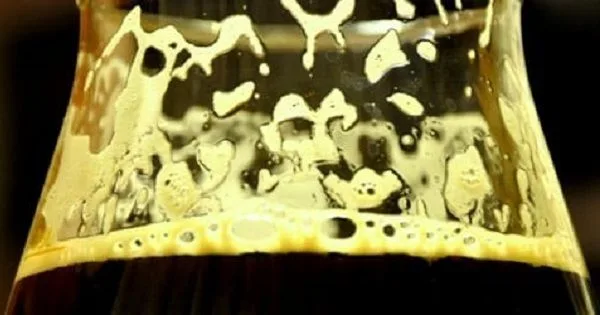
Beer foam also has a name of its own in Spanish. The dictionary of the RAE (Real Academia Española), the Diccionario de la lengua española, records “giste” as “beer foam”, a word borrowed from the German “Gischt”, which means foam.

Why is it called Belgian lace or Brussels lace?
The name describes what you see. When the foam dries on the glass, it leaves thin bands and irregular openwork that look like bobbin lace, with filled areas and transparent gaps.
The adjective Belgian brings together two things the country is famous for, its handmade lace and its beer culture. In English both forms are in use, “Belgian lace” and “Brussels lace”.
We have not found a reliable record of who first used the expression. What is documented is the chemistry behind the pattern.
How does lace form on the glass?
Charles Bamforth, a brewing science specialist at the University of California, Davis, explains it in the “cling” entry of The Oxford Companion to Beer (2012). Cling arises from the reaction between hydrophobic polypeptides and the bitter acids from hops, with metal ions acting as bridges between them.
That bond takes time to develop, between 30 seconds and 2 minutes according to the same source, and it grows in proportion to the bitterness of the beer. That is why an IPA with a high IBU bitterness index usually leaves more pronounced lace than a mild lager.
The type of hop product also changes the pattern. Reduced hop extracts, which some breweries use to protect beer from light, produce especially strong cling, while conventional iso-alpha acids leave a finer pattern.
Each ring usually marks the level the beer reached after a sip. The foam that sat on the surface sticks to the glass as the liquid drops, and the next sip leaves its own ring further down.
What does lace reveal about how clean the glass is?
According to Bamforth, cling depends on the glass being free of lipids and detergent. An invisible film of grease or detergent residue stops the foam from adhering, so it slides down without leaving a mark.
Another sign of a dirty glass is bubbles stuck to the walls below the surface of the beer. They mark spots where the CO2 finds residue to hold on to, something very different from nucleated glassware, which has marks etched on purpose to release bubbles.
That is why it pays to rinse the glass just before serving, since cold water washes away dust and brings the temperature of the glass closer to that of the beer.

Most drinkers see lace as a sign of beer quality. Bamforth points out that the appeal of the pattern is subjective and that some people see it as dirt.
In professional service, a glass free of grease and residue is called “beer clean”. The Colorado Brewers Guild beer glass cleaning guide, based on the Certified Beer Server syllabus of the Cicerone program, suggests three tests to check it.
| Test | How is it done? | Clean glass | Dirty glass |
|---|---|---|---|
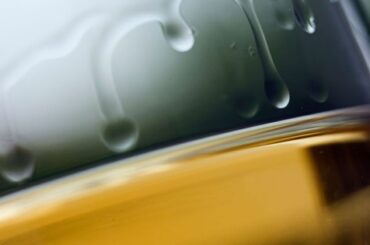
| Water sheeting | Fill the glass with water and empty it | The water coats the glass evenly | The water breaks into droplets or a web pattern |
| Salt | Sprinkle salt inside the wet glass | The salt sticks evenly | Some areas stay free of salt |
| Lacing | Pour a beer, drink part of it and let the foam settle | The foam forms parallel rings | A messy pattern or no pattern at all |
Origins of Belgian lace, the fabric that gave the foam its name
Lace is an ornamental, transparent fabric made from threads of silk, cotton, linen or metal, twisted or braided, and traditionally made by hand.
Needle lace grew out of 15th-century openwork embroidery, while bobbin lace is made by braiding many threads wound on small spools, according to the SFO Museum exhibition Lace, a Sumptuous History. The same exhibition places Belgium among the great centers of needle lace.

How do Brussels lace and Bruges lace differ?
Both cities made bobbin lace, in which the threads are wound on small spools and crossed over each other following a pattern held in place with pins. Brussels also took up needle lace, which is built stitch by stitch with a needle and thread and allows very fine motifs.
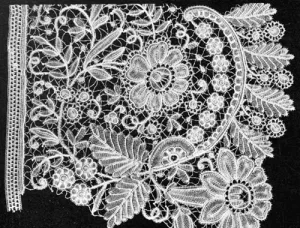
Bruges lace is also bobbin lace, not loom lace. According to the SFO Museum, it was made from the mid-19th century to the early 20th century with a thicker thread and larger motifs than earlier bobbin laces such as Brussels lace.
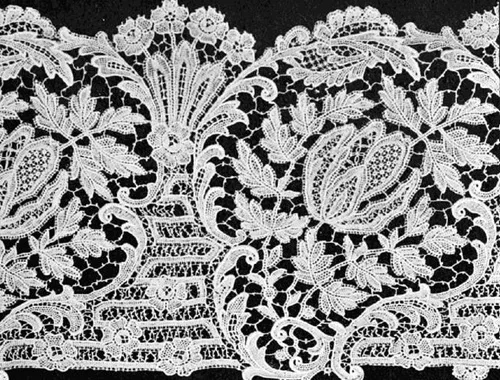
Bruges keeps the technique alive at the Kantcentrum, the city’s lace center, where you can watch lacemakers working with bobbins on Monday to Saturday afternoons. It is a natural stop for anyone exploring the beer culture of Flanders who wants a close look at bobbin lace.
Frequently Asked Questions (FAQ)
1. Why does beer foam leave rings on the glass as you drink?
Each ring matches the level the beer reached after a sip. The foam on the surface clings to the glass thanks to the reaction between hydrophobic polypeptides and the bitter acids from hops. That cling takes between 30 seconds and 2 minutes to set, according to Charles Bamforth in The Oxford Companion to Beer. That is why each sip usually leaves its own ring.
2. Which beers leave the most Belgian lace?
The most bitter beers, because cling grows in proportion to bitterness according to Bamforth. Reduced hop extracts, used to protect beer from light, strengthen that cling even further. Very mild lagers and lightly hopped beers leave fainter lace. In any style, a trace of grease on the glass is enough to make the lace disappear.
3. What does it mean for a glass to be “beer clean”?
It is a glass free of residue, sanitizer or anything else the CO2 could cling to. The Colorado Brewers Guild guide suggests three tests. In the water sheeting test, the water should coat the glass evenly. In the salt test, the salt should stick evenly to the wet glass. In the lacing test, the foam should leave parallel rings, and a messy or missing pattern points to a dirty glass.
4. Why doesn’t lace form in my glass?
The most common cause is a film of grease or detergent on the glass, which stops the foam from adhering. The beer also plays a part, since less bitter styles produce less cling. Before blaming the beer, wash the glass with a detergent that leaves no film, rinse it well with water and let it air dry. If the rings show up afterwards, the glass was the problem.
5. What is giste in beer?
Giste is the word the Diccionario de la lengua española of the RAE (Real Academia Española) records in Spanish for beer foam. It comes from the German Gischt, which means foam. At the bar, people more often talk about the head, the collar or simply the foam. Belgian lace is the part of that giste that clings to the glass after each sip.

Recommended
- 6 expert tips for better foam when brewing and pouring your beer
- What are beer bubbles? Home experiments to explain how they form