This post is also available in:
 Español
  Português
The AFNOR or ISO glass is an international crystal standard designed for the technical tasting of wines, beers and meads. Its structure allows adequate oxygenation and a clear view of the contents, facilitating sensory analysis of aromas and colors under uniform, neutral conditions.
Professional use requires filling the liquid to the widest point of the bowl to maximize the surface area in contact with air. To maintain its integrity, it should be handled by the stem and washed exclusively with water, avoiding chemical residues that could alter the organoleptic properties of the beverage.
The AFNOR glass, also known as “catavino,” is a vessel originally created in France by the Institut National de l’Origine et de la Qualité (INAO) in 1970, subsequently approved by the Association Française de Normalisation in 1971 (AFNOR, from whose acronym it takes its name) and finally by the International Organization for Standardization (ISO) in 1972.
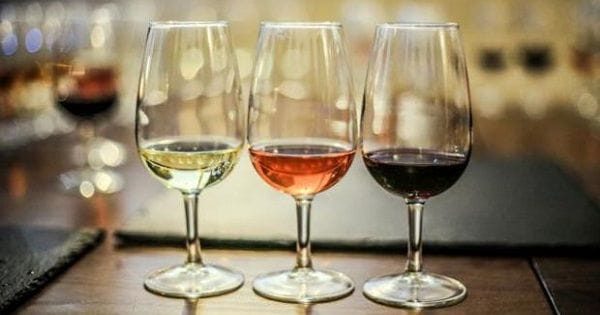
Originally, the AFNOR glass — also known as the ISO glass — was developed for the global tasting of wines, with the aim of standardizing a vessel for grape ferments of any variety and origin.
Years later, in 2009, the glass was also officially accepted by the International Organisation of Vine and Wine under the standard ISO 3591:1977, officially named “Sensory Analysis – Apparatus – Wine Tasting Glass.”
Versatile for all types of tastings
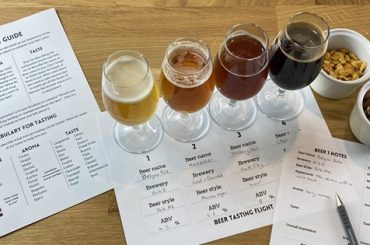
Over time, the AFNOR glass demonstrated its versatility and today is used not only for wine tasting but also for the tasting and appreciation of beer, as well as other fermented beverages such as mead.
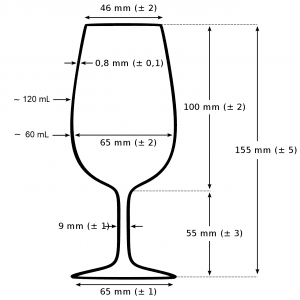
The glass forms a kind of “elongated egg” in its structure that closes at the top to concentrate the aromas of wine or beer during tasting, as well as to promote foam formation and carbonation where applicable.
It has a sufficiently secure base to provide excellent stability; with a stem of adequate height to hold the glass between the fingers, preventing the hand from warming the liquid.

AFNOR Glass Specifications
| Total glass height | 155 mm |
| Bowl height | 100 mm |
| Stem and base height | 55 mm |
| Rim diameter | 46 mm |
| Bowl horizon diameter | 65 mm |
| Base diameter | 65 mm |
| Total glass capacity | 215 ml |
| Tasting volume | 50 ml |
| Crystal thickness | 0.8 mm |
| Stem thickness | 9 mm |
| Material composition | Crystal |
Oxygenation and opening
The combined qualities of the base, stem and bowl allow the AFNOR glass to be swirled gently to oxygenate the wine or beer, enabling an adequate aromatic opening at the time of tasting.
Finally, because it is made of crystal rather than glass, its clarity makes it easy to observe the contents without any interference in color.
Frequently Asked Questions (FAQ)
1. Why does the original AFNOR glass standard require a percentage of lead in its composition?
The original standard specifies 9–12% lead because it provides greater clarity, light refraction and resonance without altering the liquid’s color. Modern manufacturers often replace lead with titanium or barium (lead-free crystal) to maintain the same transparency and thinness (0.8 mm) without the long-term risks of lead degradation.
2. Exactly how full should the AFNOR glass be filled during a tasting?
The ideal serving volume is 50 ml, filling the glass to its “equator” or widest point of the bowl (the 65 mm horizon). This maximizes air contact when swirled and leaves the upper space perfect for volatile compounds to concentrate before nosing.
3. How should an AFNOR glass be washed and maintained?
Wash exclusively with warm water — no aromatic detergents or dishwasher products, as residues destroy foam retention in beer and alter wine aromas. Air-dry upside down on a clean rack or use a lint-free microfibre cloth. Always store upright, never upside down on wood.
4. What is the difference between an AFNOR glass and a Teku glass?
The AFNOR is a neutral, multidisciplinary 215 ml laboratory standard for evaluating any fermented beverage. The Teku was designed specifically for craft beer: it has a more angular chimney, an outward-curved rim and a wider base that enhances aromas from intensely hopped styles.
5. Why do professional tasters hold the AFNOR glass strictly by the base or stem?
Holding the bowl transfers body heat to the liquid, raising its temperature and altering the perception of alcohol and volatile aromas. It also leaves fingerprints and grease on the crystal, interfering with the visual evaluation of clarity, color brilliance and foam adhesion.