This post is also available in:
 Español
 Português
 Français
The Brewers Association’s independent craft brewer seal is a free mark, shaped like an upside-down bottle, that small and independent American breweries display on their packaging. It launched on June 27, 2017, and 432 breweries signed up that same day.
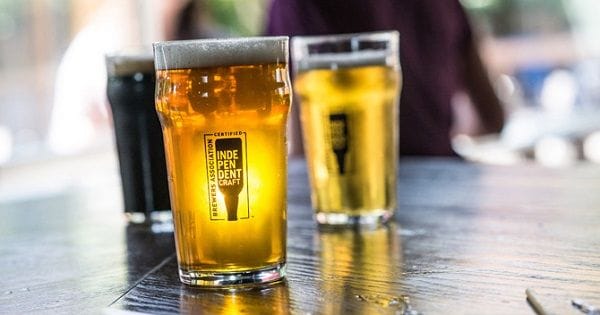
The association picked the inverted bottle to show how craft brewers turned the industry on its head. More than 5,700 breweries now use it, according to the official seal page, which does not date that figure.

Why did the Brewers Association create the seal?
For years, big brewers had been buying craft brands that kept their names and their look, so consumers struggled to tell who was behind each can. The seal set out to fix that with a visible signal right on the label.
The loudest reaction to the seal came from AB InBev’s breweries, which argued that the beer speaks for itself. At heart it was a debate about transparency, because the seal tells you who owns the brewery.
Who can use the seal?
It is free for any US brewery that meets the association’s craft brewer definition, whether or not it is a member, as long as it signs the license agreement. That definition caps production at 6 million barrels a year and requires that less than 25% of the brewery be owned by an alcohol beverage company that is not itself a craft brewer.
It also requires a TTB brewer’s license, issued by the federal agency that regulates alcohol and tobacco, or control of the intellectual property of brands brewed in the United States. Breweries mostly put it on bottles, cans, cases and keg collars.

What does being independent mean in the United States today?
When the seal was unveiled, the association estimated that more than 5,300 breweries were eligible to use it. The landscape has changed since then, as the association’s 2025 review counted 9,778 small and independent breweries, with 268 openings against 434 closures.
The idea has crossed borders through local initiatives, such as the ACERMEX seal in Mexico or the AECAI one in Spain. If you care about who is behind what you drink, checking the label is still a good place to start.
Frequently Asked Questions (FAQ)
1. What is the Brewers Association’s Independent Craft seal?
It is a mark shaped like an upside-down bottle, launched on June 27, 2017, that identifies small and independent American breweries. Brewers print it on bottles, cans, cases and keg collars so consumers can recognize that status without having to research who owns the brewery.
2. What requirements must a brewery meet to use it?
The brewery must produce no more than 6 million barrels a year, have less than 25% of its ownership held by a non-craft alcohol company, and hold a TTB license or control its brands brewed in the United States. It also signs a license agreement, which is free.
3. How many breweries use the seal?
On the first day, 432 breweries signed up. The Brewers Association’s official page now cites more than 5,700 users, though it does not say when that figure was recorded. It works as an order of magnitude next to the 9,778 small and independent breweries the association counted in 2025.
4. Does the seal guarantee a better beer?
The seal tells you about the brewery’s size and ownership, without judging the quality of what is in the bottle. A beer carrying the seal can be mediocre, and one without it, made by a brand bought by a large group, can be excellent. What it offers is transparency for anyone who wants to choose by that criterion.
5. Are there similar seals outside the United States?
In Mexico, ACERMEX, now Unión Cervecera Independiente, created a seal for the country’s craft beer, while in Spain AECAI introduced its own for craft and independent beer. Each one has its own requirements, so they are not equivalent to the Brewers Association seal.

Recommended
- Craft Beers Made by Multinationals
- Industrial vs. Craft Beer? A Distinction That Matters Less and Less to Drinkers