
This post is also available in:
 Español
 Português
 Français
Many of us would be surprised to learn that in Burkina Faso the most widely consumed alcoholic drink is dolo, a sorghum beer brewed almost exclusively by women.
Dolo is a traditional Sahel beer made from malted red sorghum, cloudy, sour and low in alcohol, at around 2.3%. It ferments spontaneously and has to be drunk within one to three days.

Deeply rooted in local culture and customs, beer has traditionally been offered as a gift in welcoming rituals or as a sign of respect and hospitality.
The Zulu people offer it to welcome visitors and, during a wedding celebration, it is given as a gift to the whole family.
The Dogon people of Mali use it in their oratory contests to choose the leader of their community’s elders.
Types of African Beer
In Africa, industrial barley beers, which dominate in the cities, coexist with a large family of traditional sorghum, millet or maize beers. The latter are brewed at home or in small venues and sold at markets.
It is these craft beers that we are interested in, since they showcase the incredible culinary richness of this continent.
African craft beers offer drinkers a wide range of flavors that don’t always fit European standards.
Behind each African beer there is a different base, which may be a cereal (sorghum, millet, rice, maize) or tubers (cassava flour), fruit (green bananas) and roots (munkoyo).
Many of them preserve very old starch conversion techniques, like the ones we covered in how saliva was used to make beer.
Traditional Beer
One of the most unusual traditional African beers is Dolo. This ancestral beer, very popular throughout the Sahel region (Burkina Faso, Mali), is made from malted red sorghum and sometimes millet. It is cloudy and sour, with a pH of between 3.2 and 3.6, and is nothing like a lager.
It is neither pasteurized nor filtered and is very unstable, so it must be consumed within 24 to 72 hours of brewing, according to a review published in Frontiers in Sustainable Food Systems in 2021.
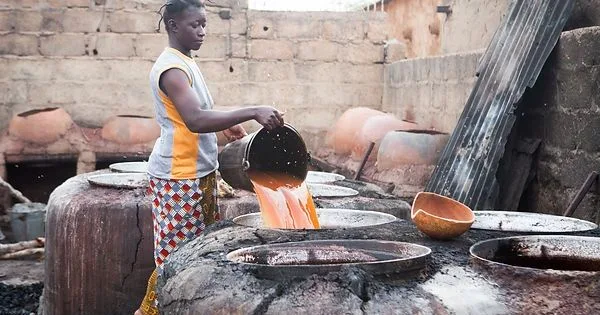
Dolo is drunk mainly in small market and neighborhood bars, where it is served in calabashes by the very women who brew it, known as “dolotières”.
The clientele is mostly male, although more and more women and young people drink it, according to the University of Toulouse. The recipe, on the other hand, is passed down among women.
How Is Dolo Made?
Malting the sorghum takes between 7 and 12 days. The grain is steeped for 5 to 48 hours, germinates for 2 to 5 days and is sun-dried for another 2 to 4 days.
The whole brewing process takes about 48 hours. After mashing, the wort undergoes spontaneous lactic souring for 12 to 16 hours and is then boiled for 3 to 5 hours.

To clarify it, brewers use mucilaginous plant extracts, such as the bark of certain trees or okra. Alcoholic fermentation lasts 9 to 14 hours and is started with yeast from a previous batch, a technique known as back-slopping.
The result is a light beer. In 30 samples bought at markets in Ouagadougou, the average alcohol content was 2.30% with about 21.8 kcal per 100 ml, according to a study published in the African Journal of Biotechnology in 2013.
The scientific literature reports values between 1.4% and 3.5%, according to the Frontiers review. Each kilo of sorghum malt yields about 4 liters of dolo.
Dolo in Rituals
According to local beliefs, before taking the first sip a few drops are poured on the ground for the spirits. It is a gesture of respect that accompanies many rounds of dolo.
It is also not unusual for dolo to be used in rituals honoring ancestors, genies or spirits, as a channel of communication between this world and the next.
According to local beliefs, it can also be consumed by beings from the other world, appeasing evil spirits and quenching the thirst of protective and benevolent ones.
How Important Is Dolo to the Economy of Burkina Faso?
In Burkina Faso almost 60% of the population drinks dolo, and around 75% of the country’s sorghum goes into brewing it. About 15% of Burkinabè women take part in producing or selling it.
In Ouagadougou alone, some 600 dolotières produce 36 million liters a year from about 9,000 tonnes of sorghum malt. These figures come from the 2021 Frontiers review.
The Cultural Roots of Dolo
All these traditions are proof of how deeply rooted beer has been in African societies.
This ancestral drink is not only tied to food and social life, it is also part of the rich spiritual world of these peoples. That is why beer has been a subject of study for sociologists and anthropologists such as Alain Huetz de Lemps (Boissons et civilisations en Afrique, 2001) and Éric Jolly (Boire avec esprit. Bière de mil et société dogon, 2004).
Other Traditional African Beers
Dolo is just one of the continent’s many sorghum and millet beers. We have gathered others in our world guide to indigenous beers and in our roundup of ancestral beers from Sahti to Dolo.
This table lists some of those cited in the 2021 Frontiers review, along with the countries where they are brewed.
| Beer | Countries |
| Dolo | Burkina Faso, Mali |
| Pito | Ghana, Nigeria |
| Tchoukoutou | Benin, Togo |
| Tchapalo | Ivory Coast |
| Burukutu | Nigeria |
| Bili-bili | Cameroon, Chad, Central African Republic |
| Merissa | Sudan |
| Ikigage | Rwanda |
| Chibuku | Zimbabwe |
| Munkoyo | Zambia, Congo |
| Busaa | Kenya |
Frequently Asked Questions (FAQ)
1. What is dolo?
Dolo is a traditional malted red sorghum beer from the Sahel, very popular in Burkina Faso and Mali. It is cloudy and sour, neither filtered nor pasteurized, and brewed mainly by women, the dolotières.
2. How much alcohol does dolo contain?
In 30 market samples from Ouagadougou the average alcohol content was 2.30%, according to a 2013 study in the African Journal of Biotechnology. The literature reports values between 1.4% and 3.5%.
3. Who brews dolo?
It is brewed by the dolotières, women who sell it in their own neighborhood or market bars. About 15% of women in Burkina Faso take part in producing or selling it, and some 600 work in Ouagadougou alone.
4. How long does dolo keep?
Dolo keeps for 24 to 72 hours at room temperature, because it is neither filtered nor pasteurized and keeps fermenting. That is why it is brewed in small batches and drunk almost fresh.
5. What other traditional beers are there in Africa?
Traditional African sorghum and millet beers include pito from Ghana, tchoukoutou from Benin, tchapalo from Ivory Coast, burukutu from Nigeria, bili-bili from Chad and Cameroon and merissa from Sudan.

Recommended
- Ancestral Beers? From Sweet Finnish Sahti to Spirited African Dolo
- World Guide to Indigenous Beers: 9 Varieties to Discover