This post is also available in:
 Español
  Português
  Français
In the world of food science, two chemical reactions are responsible for much of the magic that occurs during the cooking process: the browning of bread, the color of grilled meat, the appearance of beer, the aroma of freshly roasted coffee, or the deep flavor of caramelized onions.

These transformations, which generate complex colors, aromas, and flavors, are mainly due to the Maillard reaction and caramelization, which, although often confused or mentioned interchangeably, are fundamentally different chemical processes.
Chemical fundamentals and reaction mechanisms
To understand the essential difference between both processes, it is crucial to delve into the chemical mechanisms that govern them.
The Maillard reaction is not a single reaction, but a complex cascade of reactions that begins between a free amino group (generally from amino acids, peptides, or proteins) and a reducing carbonyl group (from reducing sugars such as glucose or lactose).
The reaction begins with the formation of a Schiff base, which rearranges to produce a ketosamine or aldosamine.
From this intermediate, the pathway branches out, producing a myriad of compounds, including melanoidins, which are high molecular weight polymers responsible for the brown color, and a wide variety of flavor and aroma compounds such as pyrazines, furans, and thiazoles.
Amino acid + reducing sugar → Schiff base → Amadori rearrangement → Flavor, aroma, and color products.
On the other hand, caramelization is a process of pyrolysis or thermal decomposition of sugars, which, unlike Maillard, does not require the presence of nitrogenous compounds (amino acids or proteins).
When a sugar, such as sucrose, is heated above its melting point (generally between 110°C and 180°C, depending on the sugar), it melts and undergoes a series of dehydration, fragmentation, and polymerization reactions.
These reactions produce volatile compounds that contribute to the aroma (such as diacetyl and hydroxymethylfurfural) and colored polymers known as caramelans.
Sugar + heat → Isomerization → Dehydration → Fragmentation → Polymerization → Caramel
| Parameter | Maillard Reaction | Caramelization |
|---|---|---|
| Reactants | Requires a reducing sugar and a compound with an amino group (e.g., amino acid, protein). | Only requires a sugar (reducing or not, such as sucrose). |
| Chemical mechanism | Reaction between an amino group and a carbonyl group. Complex cascade including Schiff base formation and Amadori rearrangement. | Pyrolysis (thermal decomposition) of sugar. Involves dehydration, fragmentation, and subsequent polymerization. |
| Temperature | Occurs over a wide range, from about 140°C to 165°C. Can initiate at lower temperatures over long periods. | Generally requires higher temperatures, starting at approximately 110°C for fructose and up to 160-180°C for sucrose. |
| Optimal pH | Favored in alkaline conditions (high pH). A basic medium accelerates the reaction. | Not strongly pH-dependent, but can be influenced by ions and the medium. |
| Main products | Melanoidins (brown pigments), hundreds of flavor and aroma compounds (pyrazines, furans). | Caramelans (brown pigments), volatile compounds (diacetyl, furfural). |
| Examples in food | Bread toasting, meat browning, roasted coffee aroma, malted beer color. | Onion caramelization, caramel sauce, toasted sugar aroma, crème brûlée crust. |
Table 1: Fundamental differences between the Maillard reaction and caramelization
What happens with beer?
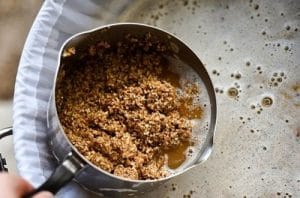
During malting and particularly during wort boiling, ideal conditions are established for both reactions.

The Maillard reaction occurs when reducing sugars (such as maltose and glucose present in the wort) interact with the free amino groups of amino acids and peptides derived from malt.
This complex cascade of reactions, which intensifies between 140°C and 165°C, generates melanoidins (polymers responsible for amber to brown color) and a range of aromatic compounds including furans (with sweet and caramelized notes), pyrazines (nutty and roasted aromas), and thiazoles (earthy characters).
In contrast, caramelization manifests during prolonged or intense boiling, where sugars such as maltose decompose to produce compounds like furfural (with almond-like notes) and hydroxymethylfurfural (HMF), as well as colored polymers called caramelans.
| Sugar type | Formula | Caramelization temperature |
|---|---|---|
| Fructose | C₆H₁₂O₆ | ~110 °C |
| Galactose | C₆H₁₂O₆ | ~160 °C |
| Glucose | C₆H₁₂O₆ | ~160 °C |
| Maltose | C₁₂H₂₂O₁₁ | ~180 °C |
| Sucrose | C₁₂H₂₂O₁₁ | ~160 °C |
Table 2: Approximate starting points of caramelization for different sugars
Impact on beer ingredients
The malting process is where the Maillard reaction exerts its deepest influence. Base malts such as Munich or Vienna owe their character to a malting process that favors this reaction, developing freshly baked bread and biscuit flavors.
Darker malts, such as chocolate or black malts, have been subjected to higher roasting temperatures where Maillard is intense, generating compounds that provide coffee, chocolate, and dry characters.
Crystal or Caramel malts, on the other hand, are processed in a way that specifically promotes caramelization.
They are roasted with a high moisture content, allowing the sugars to liquefy and caramelize inside the grain husk. This produces the sweet, caramelized flavors characteristic of styles such as Pale Ales, Ambers, and some Scotch Ales.
Frequently Asked Questions (FAQ)
1. What can be done to favor the Maillard reaction over caramelization?
To favor the Maillard reaction, the presence of the two key reactants should be maximized: reducing sugars (such as glucose or fructose) and nitrogenous compounds (amino acids or proteins). For example, when baking, a protein agent such as milk or egg can be added to the mixture, and simple sugars can be used. Additionally, a slightly alkaline pH (adding a little baking soda) accelerates the Maillard reaction.
2. Which compound differentiates the aroma of caramelization from that of the Maillard reaction?
The key volatile compound that differentiates caramelization is furfural (or hydroxymethylfurfural, HMF). These pure sugar dehydration compounds generate aromas of toasted almond and cooked malt. On the other hand, the Maillard reaction generates pyrazines and thiazoles, which provide bread, nut, chocolate, and toasted notes—characters that require the presence of nitrogen (amino acids) to form.
3. How can boiling temperature be manipulated to control Maillard vs. caramelization?
Brewers can manipulate temperature and time. A prolonged or intense boil (higher temperature and time) favors the caramelization of wort sugars, increasing compounds such as HMF and caramel color. Conversely, to limit caramelization and control the Maillard reaction, less intense heat can be used during boiling, focusing on the base malt profile and malting time (where Maillard is the dominant process).
4. If caramelization occurs at high temperatures, why does it also occur with onions over low heat?
When sautéing onions, the initial temperature is low, which favors enzymatic degradation. However, the final “caramelization” process is actually due to the Maillard reaction. Onions are rich in reducing sugars and, although they have a low amount, they also contain free amino acids. The prolonged evaporation of water raises the surface temperature, creating the perfect environment where the Maillard reaction dominates and generates the brown pigments and deep flavor.
5. Why is a reducing sugar necessary in the Maillard reaction and in caramelization?
A reducing sugar is any sugar that has a free carbonyl group (aldehyde or ketone), allowing it to act as a reducing agent. This carbonyl group is the chemical site of attack by the free amino group, initiating the Maillard cascade. In contrast, caramelization is a thermal decomposition (pyrolysis) of the sugar itself, and although reducing sugars do caramelize, non-reducing sugars (such as sucrose) also do so after being hydrolyzed or isomerized by heat.
We Recommend
- The sensory and nutritional impact of pasteurization on Ale and Lager beers
- How to adjust water characteristics to brew a better beer?