This post is also available in:
 Español
  Português
Spanish gastronomy is one of the most diverse and technically complex in the world. Its designations of origin, the richness of its cured and smoked products, as well as its regional variety—from Atlantic Galician cuisine to Levantine pastry—offer a vast territory to explore the principles of beer pairing.
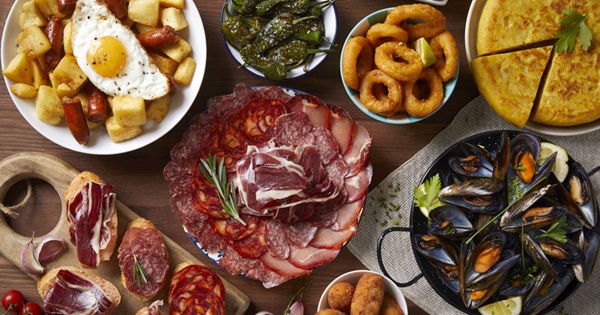
Unlike wine, where tradition has dictated for centuries what goes with what, beer pairing allows for freer analysis, based on sensory mechanisms such as aroma bridges, intensity contrast, and texture complementarity.
How to pair beer with Spanish gastronomy?
Before exploring specific combinations, it is helpful to be clear about the four principles that govern any pairing decision:
1. Intensity
A dish with intense flavor requires a beer of equal density. A stew or fabada will overwhelm a Blonde Ale; an Imperial Stout accompanies it without flinching. The most frequent mistake is choosing a beer that is too delicate for a full-bodied dish.
2. Sensory bridge
When an aromatic or flavor compound appears in both the dish and the beer, a bridge is created that amplifies the experience. Maillard reaction products—present in roasted malts and cured products—are the most frequent and powerful bridge in Spanish cuisine.
3. Contrast
Contrast works when a beer cuts or cleans something the dish provides in excess: carbonation dissolves fat, acidity balances richness, bitterness resets the palate. It is not opposition, it is balance.
4. Complement
Complement seeks to bring beer and dish together without merging: the delicacy of a Kölsch does not compete with the saffron of a paella, it surrounds it. The key is that neither cancels the other.
1. Acorn-fed Iberian ham and Märzen
Acorn-fed Iberian ham is, from a chemical point of view, one of the most complex foods in world gastronomy. After 36 to 48 months of curing, proteins have degraded into free amino acids that provide umami; monounsaturated fatty acids (mainly oleic) give unctuousness; and Maillard reaction compounds generate notes of nuts, caramel, and earth.
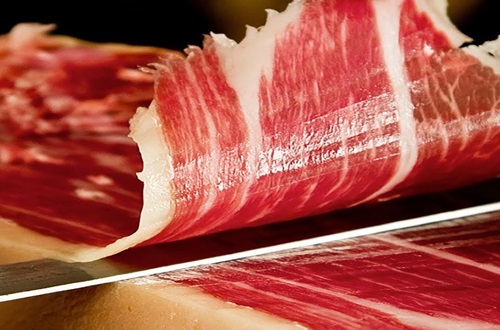
Märzen is its natural counterpart. Munich malt, the base of this Bavarian style, is loaded with melanoidins: the same compounds resulting from the Maillard reaction that dominate cured ham.
The sensory bridge is direct. The saltiness of the ham enhances the perception of malty sweetness, and Märzen’s medium carbonation slowly dissolves the fat, preparing the palate for the next bite. A bottom-fermented Märzen, with three or four weeks of lagering, amplifies the effect.
2. Aged Manchego cheese and Belgian Golden Strong Ale
Manchego with twelve or more months of aging develops tyrosine crystals, an intense lactic profile with notes of sheep, toasted butter, and nuts.
Its high fat content and long persistence on the palate make it a pairing challenge: beers that are too mild are overwhelmed, and those too bitter clash with the salt.
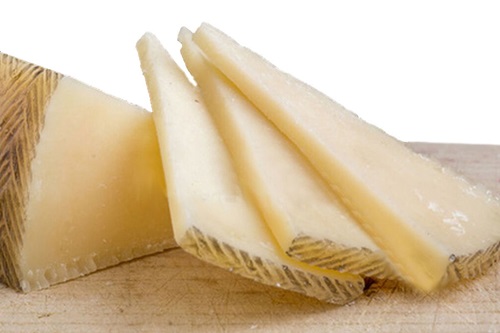
Belgian Golden Strong Ale solves the problem through contrast. Its high carbonation—fine, persistent—cuts through the lactic fat with precision.
The high alcohol content (8-10% ABV) acts as a solvent for aromatic compounds, amplifying both the beer and the cheese in the aftertaste. The dry finish and absence of aggressive bitterness avoid clashing with the salt. Duvel is the canonical reference for this pairing.
3. Galician-style octopus and Gose
Pulpo á feira is one of the most representative dishes of Spanish Atlantic cuisine: octopus cooked in a copper pot, served over cachelos (potatoes) with extra virgin olive oil, smoked paprika (sweet or spicy, sometimes smoked), and coarse sea salt.
Its sensory profile combines a texture that is both soft and firm, light oiliness from the olive oil, prominent saltiness, and the smoky nuance of the paprika.
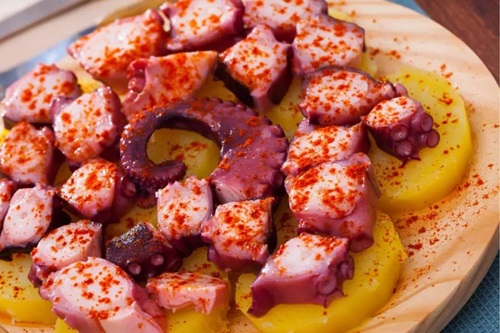
Gose is the most precise pairing. This German wheat style with added salt and lactic fermentation shares the dish’s minerality and salty touch. The lactic acidity cuts the olive oil without erasing it.
The smoked paprika finds an echo in the mineral and toasted notes of the wheat yeast. High carbonation refreshes between bites. The result is a pairing based on multiple affinities: salt with salt, mineral with mineral, acidity with fat.
4. Basque cod pil-pil pintxos and Witbier
Pil-pil is one of the most unique techniques in Basque cuisine: an emulsion obtained from the collagen of cod skin with olive oil and garlic, worked at low temperature.
The result is a gelatinous, delicate sauce, with an almost silky texture and a flavor that combines marine iodine, mild garlic, and the fatty neutrality of the oil.
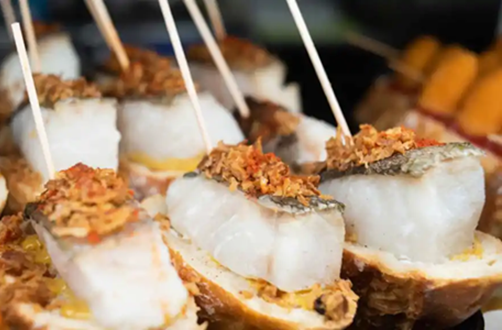
Witbier—a Belgian wheat style brewed with coriander and bitter orange peel—offers a high-precision complement. The coriander notes act as an herbal bridge with the garlic; the orange peel contributes a citrus touch that elevates the cod’s salinity without antagonizing it.
The low carbonation and light body of the Witbier do not break the pil-pil emulsion; they accompany it. Hoegaarden or any craft Witbier with moderate spice presence are starting points.
5. Segovian suckling pig and English Brown Ale
Segovian suckling pig—two- to three-week-old lamb—is a study in caramelization: the skin, subjected to a wood-fired oven for two hours, develops a brittle crust loaded with Maillard compounds, while the interior meat remains almost muscle-free, extraordinarily tender and fatty.
The tradition of cutting it with a clay plate is not folklore: it demonstrates the fragility of the skin and the quality of the cooking.
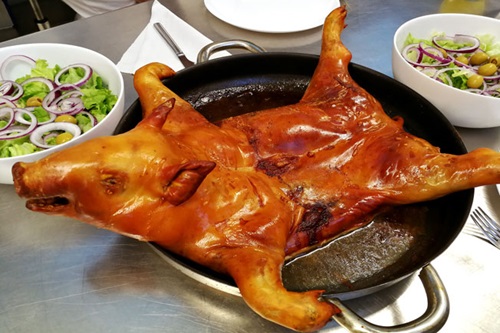
English Brown Ale is the most coherent pairing. Its medium-roasted malts contribute notes of biscuit, caramel, and hazelnut that share territory with the caramelization of the skin. The medium-full body of the beer resists the richness of the suckling pig without overwhelming it.
The low bitterness—a defining characteristic of the style—prevents the beer from competing with the delicacy of the meat. Samuel Smith’s Nut Brown Ale or any expressive-bodied craft Brown Ale works with precision.

6. Andalusian gazpacho and Hefeweizen
Andalusian gazpacho is the only great cold dish in Spanish gastronomy and one of the most complex in its apparent simplicity.
The emulsion of ripe tomato, cucumber, green pepper, garlic, olive oil, and wine vinegar creates an acidic, vegetal, fresh profile with an herbal and oily background. Served very cold, its temperature is part of the experience.
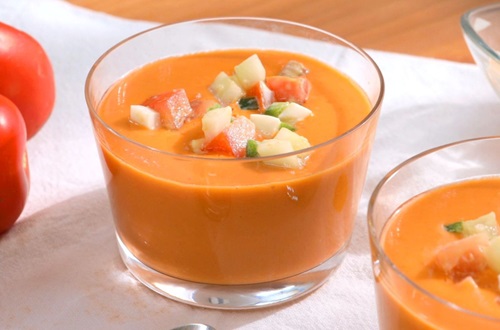
Bavarian Hefeweizen resolves the pairing through coordinated contrast. The banana esters (isoamyl acetate) of wheat yeast offer a sweet counterpoint to the acidity of the tomato.
The clove phenols (4-vinylguaiacol) subtly echo the garlic. The high carbonation—characteristic of unfiltered Hefeweizen—refreshes and cleans the olive oil. Both are served cold, and the lightness of the beer never competes with the delicacy of the raw vegetables.
7. Asturian fabada and Imperial Stout
Fabada is perhaps the most demanding dish in Spanish cuisine in terms of pairing. Granja beans, Asturian chorizo, blood sausage, pork shoulder, and salted bacon create an extremely rich, dense, long-lasting broth. Any beer below a certain intensity disappears into the dish.
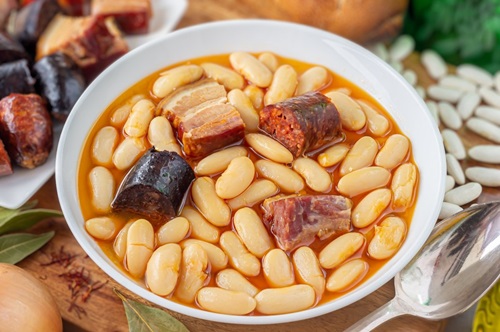
Imperial Stout is the only correct answer. Its dense body—often viscous—matches the texture of the broth. Notes of dark chocolate and roasted coffee establish a bridge with the smoked sausages.
The high alcohol content (10-14% ABV) acts as a counterweight to the fat of the bacon and chorizo. It is a pairing of parity of intensity: neither yields ground; both support each other. Founders Imperial Stout or any full-bodied craft Russian Imperial Stout are the reference.
8. Spanish omelette and Czech Pilsner
Potato omelette—with or without onion, an eternal debate—is one of the most democratic dishes in Spanish gastronomy and also one of the richest in terms of technical pairing.
Cooked egg provides coagulated proteins with a fatty and umami profile; potato provides starch and texture; olive oil provides long persistence on the palate.
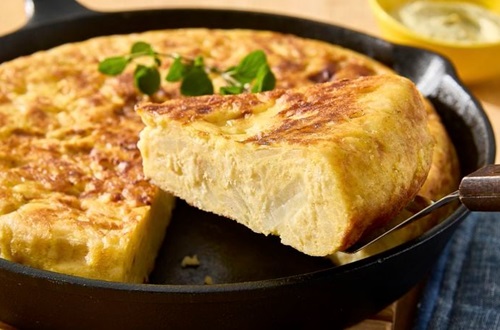
Bohemian Czech Pilsner—different from German Pilsner in its softer bitterness and more expressive maltiness—works through precise contrast. Saaz hops, characteristic of this style, contribute a herbal and floral bitterness that cuts the egg’s fat without aggression.
Fine carbonation cleanses the palate. The light-medium body does not compete with the omelette. It is the combination that any good tapas bar in Spain does intuitively, taken to its technical explanation. Pilsner Urquell is the unavoidable reference.
9. Valencian paella and Kölsch
Authentic Valencian paella—with chicken, rabbit, green beans, lima beans, and saffron—is a dish of complex and subtle aromas. Saffron, with its safranal and picrocrocin, provides a floral and slightly metallic note that is difficult to accompany without covering.
Socarrat—the caramelized rice at the bottom of the paella—adds high-temperature toasted notes.
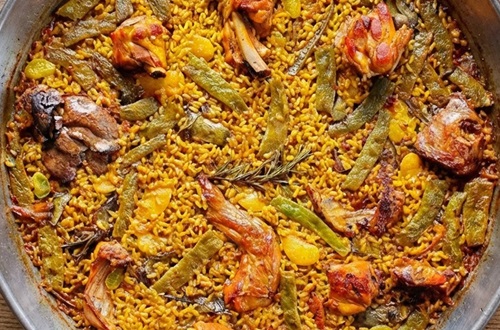
Kölsch is the most elegant pairing precisely because it does not compete. Its clean profile, with very delicate fruity esters and an extremely light body, surrounds the saffron without antagonizing it.
Fine carbonation complements the texture of the rice. The toasted notes of socarrat find a minimal but perceptible echo in the malt of the Kölsch.
It is a complement pairing by delicacy: the beer gives up prominence to the dish. Gaffel Kölsch or any properly fermented Kölsch is the starting point.
10. Smoked Idiazábal cheese and Rauchbier
Idiazábal is a cheese made from latxa or carranzana sheep’s milk, with a Protected Designation of Origin, produced in the Basque Country and Navarre. In its smoked version—the most characteristic—it is subjected to smoking with cherry wood, which contributes complex phenolic notes on an intense lactic base with good acidity. It is a cheese with a strong, unctuous, and persistent character.
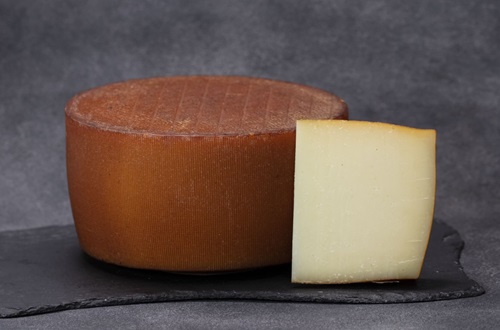
Bamberg Rauchbier—brewed with beech-smoked malt—is the only style that creates a synergy with Idiazábal rather than a redundancy.
The phenolic compounds of beech smoke (guaiacol, syringol) are different from those of the cheese’s cherry smoke, generating complexity rather than simple amplification.
The clean lager base of Rauchbier stabilizes the pairing and prevents it from becoming an exercise in excess. Schlenkerla Märzen Rauchbier is the world reference for this style and the mandatory starting point for this pairing.
Conclusions
Spanish gastronomy offers one of the richest territories for beer pairing precisely because its regional diversity—Atlantic, Mediterranean, inland, mountainous—generates radically different sensory profiles that require equally varied beer responses.
There is no single beer to accompany Spanish cuisine: there is a Gose for Galician octopus, an Imperial Stout for Asturian fabada, and a Rauchbier for Idiazábal. Exploring these combinations with sensory rigor is one of the richest experiences contemporary beer sommelier offers.
Frequently Asked Questions (FAQ)
1. Why do the dark chocolate notes of an Imperial Stout enhance the flavor of blood sausage in Asturian fabada?
This coupling works through a sensory bridge based on high-temperature aromatic compounds common to both products. During extreme roasting of barley malt to produce Imperial Stout, pyrazines are developed that mimic descriptors of bitter cocoa and coffee. When interacting with Asturian blood sausage, these compounds align with the spicy notes, cooked blood, and smokiness of the sausage, creating a synergy that softens the perception of animal fat and expands the depth of the broth in the aftertaste.
2. What is the chemical reason why Märzen is the natural pair for Iberian ham compared to a light lager?
Long-cured acorn-fed Iberian ham is extremely rich in melanoidins, which are the structural compounds resulting from the Maillard reaction that give it its hazelnut and earthy notes. Industrial light lagers lack the body and malt to sustain this profile, so the ham ends up canceling their flavor. Märzen, being brewed with Munich malt rich in those same melanoidins, creates an exact chemical mirror that complements the umami of the cured meat, while its carbonation homogeneously dissolves the fatty oleic acid.
3. How does the lactic acidity of a Gose beer balance the paprika and oil of Galician-style octopus?
Pulpo á feira saturates the palate with the fatty layer contributed by extra virgin olive oil and the density of coarse salt. Gose beer introduces an organic cutting contrast due to its acidic pH derived from fermentation with lactobacilli. This acidity immediately breaks the viscosity of the oil on the tongue, cleansing the taste buds. At the same time, the minerality and native sea salt contributions of the German style merge with the octopus’s juices, enhancing the sweetness of the potatoes without saturating with sodium.
4. Why do the tyrosine crystals of aged Manchego cheese require discarding beers with high bitterness?
Manchego cheeses aged for more than twelve months concentrate tyrosine crystals and high lactic salinity. The bitterness of hops, measured in IBU units, generates an unpleasant physicochemical collision when interacting with markedly salty foods, resulting in metallic, harsh, and astringent notes on the palate. Belgian Golden Strong Ale solves this conflict by diluting the fat through its high alcohol volume and extreme dryness, dispensing with aggressive hoppy bitterness to keep the cheese’s subtlety intact.
5. What sensory difference does beechwood smoke from a Rauchbier contribute when interacting with Idiazábal cheese?
The pairing between a Bamberg Rauchbier and smoked Idiazábal avoids redundancy thanks to the botanical origin of the fuels used in their respective drying processes. Basque cheese is traditionally smoked with fruit woods such as cherry, releasing sweet, light notes. The beer uses malt dried with beech wood, rich in guaiacol and syringol, compounds that provide denser, woodier nuances. This difference in phenolic compounds generates cross-aromatic complexity rather than a simple duplication of the smoky stimulus.