This post is also available in:
 Español
  Português
With issue N°100 of All About Beer magazine, Daniel Bradford had the opportunity to delve into the world of fine beers with two of the most influential individuals in the growth of the new beer revolution.
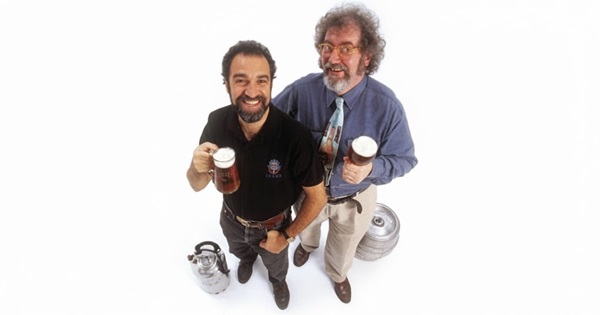
Legions of beer lovers, including Bradford, owe their awakening to Michael Jackson and his efforts to document the world of this beverage and foster its appreciation. And practically every person who takes up homebrewing has turned to the writings of Charlie Papazian. These two men have led the way for nearly two decades.

First Steps
All About Beer: How did you first meet?
Charlie Papazian: Was it at the ’81 conference at the American Homebrewers Association? Somehow I tracked you down and called you.
Michael Jackson: It was in Chautauqua, in Boulder. It wasn’t really a microbrewery conference in those days, it was a real gathering of homebrewers and we also talked about commercial beers. We didn’t really have a festival.
Charlie Papazian: I had your book World Guide to Beer and someone told me you lived in Portland, Oregon.
Michael Jackson: A lot of people thought I lived in Oregon. I was trying to persuade an editor in New York to let me write an article about microbreweries and he told me: “Well, I know everything that happens in New York, and I’ve never heard anything about microbreweries. What are you talking about? Where are they?”. And I said, well, most of the microbreweries are in California (that is, that was the case back then). He said: “Oh, well, that’s fine for you, because you’re from Oregon.” I told him no, that I was British. And he replied: “Well, Oregon, Great Britain, whatever.” That was really a big struggle in those early days, getting anyone on the East Coast to pick up any news, and of course, all the news media are headquartered on the East Coast.
Charlie Papazian: I met Fred Eckhart, who came to the conference for the first time.
Michael Jackson: That was the first time I met Fred.
Charlie Papazian: Yes, and Tom Burns, and the people from Boulder Beer who had just started.
Michael Jackson: And we joked a lot about Otto’s Zavatone. He had such a good name. We said there must be a brewer there, but we never really dreamed that one day people would talk about brewers quite more seriously.
All About Beer: Had Zymurgy been published as a newsletter for almost two years?
Charlie Papazian: Well, yes, the magazine format started in ’78.
All About Beer: And The Joy of Homebrewing? The self-published version had come out around…
Charlie Papazian: In ’76, that was really the first edition about that, and then I came out with another version in ’78.
All About Beer: And when did you start full-time?
Charlie Papazian: Full-time? ’81. That was the year I quit my teaching job.
All About Beer: And in ’82 was the first GABF (Great American Beer Festival).
Michael Jackson: I had been recording a commercial for Henry’s, in Portland, and I was flying there to visit A-B in St. Louis and I had to change planes in Denver. I think this was in 1979. I’m a newspaper nut, because I worked in newspapers since I was a teenager. I always buy the local newspaper wherever I am, and I got the Rocky and The Denver Post. There was a small review, just a paragraph about a homebrew competition that had taken place that weekend and I said: “Damn, I missed it!”.
Charlie Papazian: I remember there were some stories in the Denver and Boulder newspapers.
All About Beer: In the industry, you two would probably be the most qualified as celebrities. I think you are possibly the only brewers I know who can’t walk through the hall of a beer festival and enjoy it. What’s that like?
Michael Jackson: I feel a mixture of gratification and frustration at the same time. I’ll never be done being grateful for those people who are interested in what I do. If they are interested, they are reading and listening, I am truly gratified by that. A beer festival is often an opportunity to taste beers that you couldn’t taste otherwise, and that is sometimes frustrating, when I can’t get them.
Charlie Papazian: When I’m at those festivals, I feel like that’s the essence of my work and what I represent. That’s what I’m there for, to meet people, to be available for them to meet me. That’s why they went to the festival, the beer and meeting people like Michael and me. That’s part of the territory. If I really want to enjoy a beer, for personal enjoyment, I would sit down with one or two guys, with a beer.
All About Beer: And what do you think of the price you pay for a beer?
Charlie Papazian: I definitely no longer pay for a beer.
Michael Jackson: I didn’t know you could do that.
All About Beer: What thing?
Michael Jackson: Pay for a beer.
Michael Jackson: That wasn’t really your question. What is it?
All About Beer: What do you think the price has been that you’ve paid? Did you expect to be so recognized when you started?
Michael Jackson: I have no idea about that.
Charlie Papazian: I’m really amazed by how much people recognize me when I go out.
Michael Jackson: Sometimes it’s quite funny. The other day I was in Grand Central Station in New York, and a guy says to me: “Hey, Michael Jackson!”. My first thought was: this is someone who knows me, who I had met at a beer festival, somewhere. I wish I knew who he was, which of course, you can’t always do. But I say, he wasn’t someone I knew, he felt he knew me. He was very funny and cordial, but…
Charlie Papazian: More and more often people recognize my credit card when I buy something.
All About Beer: Isn’t that advertising?
Charlie Papazian: No, they look at the price and go “oh, you’re the beer guy!”. The most incredible experience I had was returning from South Africa via Kennedy airport, totally lagged, traveling about 25 hours, going to immigration, and I was looking for my passport when the immigration officer, even before I handed him my passport, says “Charlie Papazian”. “How do you know that, even before I give you my passport!”. He told me “I read Zymurgy. I’m a member. Where have you been? Where are you coming from? Will I read something about this?”.
All About Beer: You both have some issues with your names. Yours is unpronounceable, and yours I can’t believe you still have to differentiate yourself from the singer.
Michael Jackson: Yes, when I call someone who doesn’t know me, or even if I call breweries where I’m known but I’m going to talk to the receptionist who’s been there for three weeks, I say “my name is Michael Jackson, but I’m not the singer.” Once a lady told me: “actually, my name is Ella Fitzgerald, and I’m not the singer either.” Once when my mother was still alive, I joked with her: “You should have known I was going to be a writer when I grew up. You could have given me a more interesting name.” And she replied: “Well, it didn’t do any harm to that boy who sings, did it?”.
All About Beer: What have been the costs of being a celebrity in the beer world?
Michael Jackson: Everyone says: “Hey! How do you get a job like that? It’s hard to make someone believe that this is a stressful job. But it’s stressful to cover all the ground, and it’s getting more and more difficult. I’m really a shy person. I think many people who are in the public eye for one reason or another are perhaps overcompensating for shyness. Charlie mentioned that when he goes to a festival, some people have gone there just to meet him, the other side of that is what can you give these people? How do you give yourself? Perhaps you can never be as interesting as their fantasies about how you should be.
Charlie Papazian: What I’m learning in these last few years is that there are a lot of expectations out there when you travel. I have to let go of those expectations and try to focus on being more myself, because that’s what people appreciate.
All About Beer: What would the expectation have been?
Charlie Papazian: That I know everything about beer. I’ve traveled a lot, but I haven’t been everywhere, I haven’t visited every brewery. Michael certainly travels much more than I do. I don’t feel the urgency, the stress, and the expectation of having to visit every brewery. Many people tell me that they really follow me through the book The Complete Joy of Homebrewing, the way I express myself. That’s what they expect, a natural way, relaxed, like “relax, don’t worry, have a homebrew.” To maintain that for myself, I need to take time away from beer from time to time, a kind of re-energizing.
Michael Jackson: The problem for me is that I express myself best by writing or speaking, rather than in front of a microphone. Someone puts a microphone or a television camera in front of me and somehow I can rise to the occasion and act. When I’m not in those situations, it’s tough. People expect a lot of anecdotes and descriptions of where I’ve been. I’ll meet people at a festival and they’ll say “where have you been lately?” and sometimes I can’t even remember where we are. You know: “What’s the best German-style Weizenbier you’ve tried on the East Coast?” and without going to my computer I probably can’t remember it.
All About Beer: Did you really anticipate that beer would be your profession?
Michael Jackson: My first major book on beer, The World Guide to Beer, was published in 1977, so I worked on it during ’75 and ’76. I remember Charlie once asked me when I wrote the book, and when I told him he replied “My God! You were ahead of your time.” Nothing like that had existed before in terms of beer, at all.
All About Beer: So, when you published your first book on beer, that’s what you wanted to do.
Michael Jackson: The first book I wrote was called English Pubs, published in 1976. While writing it I talked to many brewers who were pub owners in Britain, and I thought: “No, I don’t want to write about pubs, I want to write about beers.” And around that time, Hugh Johnson’s World Atlas of Wine was paving the way and, you know, a lot of people had been involved in positioning that book. I thought, you know, we could do something like that but about beer. I found it difficult to sell the idea to publishers. I actually had to create a company with a guy who did all the photography and art direction, and another who raised the money for the book and did the sales to various publishers around the world. This company owns that book. Really, that’s how hard it was to get a book out on the subject.
All About Beer: You came to beer literature with a desire to write about beers.
Michael Jackson: Yes, no one thought about beer in that way in those years, so you know, I was so ahead of my time that I was talking to people who didn’t understand what the hell I was telling them.
All About Beer: What was motivating you? Were you seeing the future?
Michael Jackson: No, not at all. The simple story is that at 16 I worked at a newspaper, I drank a lot of beer, and I was fascinated at that time (we’re talking about the late 1950s). Why did they taste different? What did their names mean? And I couldn’t find anyone who was interested. When CAMRA (The Campaign for Real Ale) formed in ’71, suddenly beer became a topic in Britain. I wasn’t an active member of CAMRA, I had nothing to do with its beginnings, but I joined them early. I had already traveled a bit as a journalist, and had tried good beers in other countries. I was particularly impressed by Belgian traditions and to some extent by those in Germany. I thought it was very good that CAMRA fought for British traditions, but what about the traditions of other countries? I think the motivation was almost like that of some musicologists like Alan Lomax who went down the Mississippi Delta in the 50s and recorded the old blues musicians before they died. I wanted a kind of record of Belgian beer before those brewers ceased to exist. I certainly didn’t see it as a possible career, but I thought that all, or many journalists have in them a kind of thing for being a defender.
Charlie Papazian: I started as a teacher, from kindergarten to third grade to fourth grade (I also taught homebrewing). What really inspired me to dive into homebrewing was the people I taught to make beer and the enthusiasm that was generated, and the conversations and excitement – not only from homebrewers but also from distributors who would come to the classes to do tastings with their beers. Then I started the American Homebrewers Association, which evolved the interest in microbrewing.
Michael Jackson: It was inconceivable in those times that someone could think of making a career out of this. It really hadn’t been invented yet.
Charlie Papazian: When I started the Association I remember someone saying how we were going to incorporate this thing. This was never going to be a million-dollar business. That was part of the fun…
Michael Jackson: It was all part of the thing, Colorado hippie-ish. Wasn’t it in those days?
Charlie Papazian: Yes, it was an idea without a business plan, without foresight, without other goals than to fulfill a desire to have fun and share information. Once there were reactions from people, I began to think, well, if they react this way, let’s show them that path. The industry and the phenomenon have led me over time. I think my specialty is more like that of an observer over the years, observing beer cultures. One of the things I find myself doing now is not going to brewpubs or a specialty beer bar, but going to an average bar that has a few of these beers and observing the beer culture.
Twenty Years Ago
All About Beer: Tell me about the brewing landscape as it was when you started in ’77-’78.
Michael Jackson: I can remember coming to Aspen, Colorado, and my first visit to Colorado in 1978. I had met a bunch of people and we decided to have a party and I was in charge of buying the beers. The most interesting thing I could get was Fred Koch’s Ale from Dunkirk & Dos Equis.
Charlie Papazian: I remember Heineken and perhaps St. Pauli Girl and XX were the only beers.
Michael Jackson: But I’d like to go back a bit to the previous point. I selected the styles hoping that by writing about them I could help keep them alive. Many brewers in North America who are making those styles I wrote about, and who were not known in their cities at the time, probably don’t know that I brought them back. The Belgian government gave me an award called the Mercurius Prize. A nice thing the Crown Prince said to me when he gave me this award was: “You have been doing a lot of things over the years. I would like you to know that it has not gone unnoticed.” So I tried to classify these styles, to try to give beer appreciation a language of categorization.
I think I was the first person to have used the phrase “beer style.” The next thing I try to define is what they are, which is what many people have done since then, but I think I was the first to do it. But by then my goal really became to talk about those styles, to try to describe the flavors of beers. When I wrote my first work on this subject, no one else described the flavors in beer. It’s very frustrating when you read old beer books. There’s a book in Britain written by a man named Barnard who went to every brewery in Britain, when there were a hundred. One wonders how he did it. He tells us everything about the breweries, but never tells us what the beers tasted like. Of course, I had always been interested in the cultural and social backgrounds of those beers. How are they consumed in their countries of origin? How did they come to be there? It’s not that I want to tell Americans: “If Germans like to have a Weissbier, you should do the same thing.” That’s not the point. The point is to offer some kind of context for those beers.
All About Beer: I heard you both talking about some isolation in the work you were doing in the ’70s. Wasn’t there a community?
Charlie Papazian: There really wasn’t one, although one did develop in Boulder.
Michael Jackson: And there was the CAMRA community. They would say: “Do you like Real Ale?”. And you would say: “Yes,” and they “Oh, there’s a pub down the street that sells Samuel Smith’s. Want to go there?”. And it was a bit like you belonged to a secret society. For me, the real isolation was that of the writer. I was trying to persuade editors to bring in topics on this subject. And when you persuaded them to let you write an essay, the next question would be: “Can our readers buy these beers?” Very often they couldn’t.
Charlie Papazian: The entire travel industry has changed that perspective on the beer industry as well.
Michael Jackson: Yes, some of our readers can find these beers, but they also want to go to those places. If you tell them there are great beers in Belgium, they’ll want to go there. If you tell them there’s a whole brewery scene in Portland, Oregon, they’ll like to travel there. But you won’t be able to build a level of awareness unless you get media coverage, although you won’t get media coverage unless the editor feels there’s a level of interest out there.
All About Beer: You mentioned that you actually have distributors going to your classes…
Charlie Papazian: Yes, we’ve done blind tastings and we’ve put commercial beers without telling people. Then we’ve talked about them, scored, voted, and people gave their comments.
Michael Jackson: It’s often difficult to get distributors interested, because very often, the people who were selling beer weren’t interested in it, they might go to the annual meeting of the National Beer Wholesalers Association in Las Vegas and be drinking fine whiskies.
Charlie Papazian: People think “all those Boulder hippies,” who couldn’t be further from the truth. We weren’t hippies, we were people with some ideas that no one else had.
Michael Jackson: Well, I think I used the phrase “Boulder hippies”…, but it was in a somewhat ironic sense.
All About Beer: Were there similar enclaves throughout the United States?
Charlie Papazian: I had discovered that perhaps there were half a dozen enclaves that were emerging at the same time. There’s a group somewhere in California that’s going to have their twentieth annual beer party. I’m sure there were enclaves here and there. It just happened that one in Boulder evolved with the magazine and the newsletter.
Michael Jackson: Well, perhaps the fact that you were a teacher could have helped. Perhaps you’re a natural propagandist, a natural disseminator of ideas.
All About Beer: And the brewers you met then… who are some of them and what was the atmosphere for them?
Michael Jackson: The great, the main person one obviously has to talk about is Fritz Maytag, who was beyond everything, who anticipated it…
Charlie Papazian: Do you really think he anticipated it – I think it was more a love for it –, or was it the same kind of attitude that we probably had?
Michael Jackson: I’m using the word “anticipated” in its purest sense, it wasn’t that he knew what was going to happen, but that he did something before it happened. On the Atlantic coast where I live, you have Peter Maxwell Stuart in the same year, starting the brewery at Traquair House. So they were a bit ahead of their time.
All About Beer: I know that Fritz Maytag had always had this kind of “cutting the wind”…. He once mentioned the phrase “sailing the wind.” Around the same time was Bert Grant.
Michael Jackson: Before that we have to talk about Jack MacAuliffe, the first microbrewer in the United States.
All About Beer: And if I remember correctly, he was also a bit of a maverick…
Michael Jackson: He was a very solitary character, take my word for it. He made a very decent beer. The first time I got his beer, I had a bottle of that beer in a brown bag, and it fell through the bag in the middle of San Francisco airport. The bottle barely touched the ground and exploded. It was a bottle of beer to be conditioned. I was surprised, I didn’t want to be taken for a terrorist. But the surprising thing is that all those people rushing for their planes, they were all very kind to me and said: “Oh! Isn’t there some way we can salvage some of this beer?”. But Jack was a very isolated character. He couldn’t really figure out a way to sell his beer. De Bakker for a short time made good beer, and then, when his wife had a child, he really had to go back to being a full-time firefighter. He made a very good kind of fruity, healthy beer. But Ken Grossman and Paul Camusi were so different, and I greatly admired them for what they did, they were so determined. They were simply hardworking and didn’t make any concessions to the “dumb advice” anyone gave them. I also remember very well the founder of Red Hook, Gordon Bowker. He came to me at the Great British Beer Festival and said: “I’m going to start a brewery in Seattle.” We got drunk enough talking about that plan and I said: “Well, I’ll see you when you open your brewery.” When they had released their first beer, I was in Seattle. I was doing a live TV report, and someone gave me this beer and I said: “Well, it’s a very Belgian beer in its characteristics.” So it was then considered the Great Belgian beer of Seattle.
Charlie Papazian: In the first five to seven years of the microbrewery business, almost everyone who evolved did so from the passion of the homebrewer. I don’t know if I can say the same about what happens today. There are still a few people evolving simply out of passion. That’s what drove the industry in the beginning and that’s what still drives it.
Michael Jackson: I must mention Charlie Finkel, too. Charlie Finkel was, I think, very influential. He had my World Guide to Beer, and he looked for the beers I had raved about and went out and tried to import them.
Why Did This Happen?
All About Beer: I’m curious about what made you believe this was going to happen?
Michael Jackson: I had an almost naïve belief that people if they liked good beer wouldn’t go back to well-made but boring beer. When people ask me: “Why is this happening now?”. I always say I can’t understand why it didn’t happen before. Market segmentation was already happening in every other industry. I’m surprised it didn’t come to beer sooner. People no longer eat all the same cheese, or no longer drink the same coffee.
Charlie Papazian: The years ’78, ’79, ’80, for me were the core of homebrewing. Microbrewing was an idea that a couple of guys at Boulder Brewing Co., a couple of guys in Chico had.
Michael Jackson: Didn’t you see it then as part of the beginning of a movement?
Charlie Papazian: I thought that was the beginning of a movement, but I didn’t foresee what it entailed. It was the passion of homebrewers that really was the essence of the whole movement. Even in countries that have such a strong tradition in brewing, like Germany, there are people in the industry who are jealous of what has happened in the United States because of how far consumer awareness and beer culture have come. “Wouldn’t it be nice if we could have passionate homebrewers in Germany, so they could develop another perspective in beer culture?”. There are other people around the world, in Japan, Latin America, even Africa, who would love to make beer more accessible to the consumer. Homebrewing is a way to do that, and also information and books that teach homebrewing.
Michael Jackson: I think it’s an interesting point that Charlie has brought up here, of the homebrewing route, however, I came here from the food and wine route.
Charlie Papazian: Homebrewing is done at a household level and is a very personal thing. Food, wine, and drinks are a personal thing. And that’s what involves us both with the very lowest rung of the ladder, the consumer bases, developing consumer knowledge.
Michael Jackson: And I’m not really writing about food and drinks. I’m writing about a celebration of good things to eat and drink; the writers I particularly admire are people like Elizabeth David. In the ’50s, she wrote a book on Italian food and everyone said: “What’s there to write about Italian food? All there is is just spaghetti.” David taught the British, and to some extent Americans, about Italian and French cooking. Or people in this country like MFK Fisher, whom I visited before she died. It’s in this tradition that I see myself trying to work. Julia Child one year opened the AIWF Beer Festival in New York and the following year I inaugurated it.
Charlie Papazian: I see my work and my participation in making people feel comfortable that beer and its appreciation in this context is accessible. Before Michael and I developed our themes, beer was inaccessible.
Michael Jackson: There was an element you weren’t able to appreciate. If you had started talking about different beers, different tastes, you got exhausted.
Charlie Papazian: That was perhaps a little further left than wine.
Michael Jackson: Fritz [Maytag] talks about beer as the common man’s drink, and I disagree with that, I think beer is everyman’s drink, which is not the same thing. It was never the case that beer was purely a working-class drink and wine was purely an upper-class drink, but to the extent that those stereotypes exist, I think the two drinks have come together in the middle; there has been a democratization of drinks. People needed to be given permission to enjoy beer.
Charlie Papazian: People need to feel they are allowed to talk about beers.
Michael Jackson: To say: look, it’s okay to try this beer, and it’s going to taste a little different, and that’s not the end of the world. There are good things about this different taste. I’ve become aware in these last two or three years that things have somehow taken a quantitative leap forward, and this hit me very strongly. I was drinking in one of these HostMarriott bars at an airport. The people who were drinking weren’t saying: “Let’s go to the airport for a beer.” There were people on their way to business meetings in Omaha, or something like that. And they went there and said: “What’s today’s new recommendation? Do you have any of that Weizenbock you had last time I was here? What do you think of this ale?”. I found it incredible, sitting there just listening to two ordinary guys who weren’t part of any secret society of beer drinkers, with such a level of knowledge.
Charlie Papazian: I was reading the history of SchneiderWeiz, Schneider Brewery in Germany, and how wheat beer became so popular that it self-destructed. This message is that it became so popular that it turned into a common beer, and people were looking for something different.
All About Beer: Where do you see the pressures today, in the 1990s, that you probably wouldn’t have imagined in the 1970s?
Michael Jackson: I think there is pressure on brewers to produce more beer, and perhaps to cut corners. There is an increase in the influence of financiers who expect quick returns.
Charlie Papazian: Imitations. People are afraid to stand out and be different.
Michael Jackson: The small brewing industry is sliding back to marketing men again. I used to joke that there should be a sacrifice of marketing men once a year, because for every good person in that activity, there are about 10 %&@%$#. That’s a bad influence on the industry.
Charlie Papazian: I think that as long as marketing people and the pressure to grow and be profitable don’t take over the essence of what this industry is based on, there is opportunity to make even more creative beers, and also to discover traditional beers from other parts of the world. You travel through the Netherlands or Holland, and you enjoy their beers there, and you come back here and it’s still a desert in terms of those beer styles. We claim that some microbreweries make good German-style lagers. They make good beers. But to make a flavor and character that is truly recognizable as that German character… there are still plenty of opportunities to produce those types of beers here.
Michael Jackson: It must be recognized that even when that quantitative leap into the mainstream has been made, it’s a small part of the market.
All About Beer: How can you call it mainstream, isn’t it only two percent?
Michael Jackson: In consciousness, it’s of that type in the mainstream. I saw a guy at Logan airport in the Shipyard bar asking very embarrassed: “Do you have anything like Budweiser here?”. He was embarrassed to ask for a Bud, and this is the United States.
All About Beer: Doesn’t that worry you both, that we have this incredible awareness, and it still doesn’t represent two percent of the total market?
Michael Jackson: Well… how much of the wine market is represented by fine wine? How much of the CD market is represented by good jazz or classical music?
Michael Jackson: It’s natural for it to be a small market. The question is really how small or how large can it be.
Charlie Papazian: What if it were fifty percent of the market? Wouldn’t it no longer be a specialty beer market, would it be a mainstream?
Michael Jackson: Well, you don’t have to be a mass market to mean something. Good bread means something. Good cheeses mean something. Charlie was saying that if it reached fifty percent it would no longer be a specialty. In Britain, fifty percent of the market is reasonably tasty ales, so you could say that ales are not a specialty. But it’s an availability of an interesting product.

Charlie Papazian: In the end, it really doesn’t matter what we classify it as. Are consumers better than they were 15 years ago? And will they be better in 10 years? Of course they will. We may think differently as beer enthusiasts and aficionados about where the market is going, but the availability, I think, will still be there in 10 years. The face of American beer has changed for one or two more generations.
All About Beer: Is the industry fragile or well-founded?
Charlie Papazian: Do you mean disappearing from the shelves? If so, then there are always homebrewers. If the market forces diversity off the shelves, then homebrewers will return and everything will start again. It won’t happen, but if it does, that alternative is still there.
All About Beer: Given some of these tensions you’ve already listed: are we seeing a risk?
Charlie Papazian: There are risks for certain types of businesses with certain types of market strategies, and certain types of growth.
All About Beer: Any specific ones?
Charlie Papazian: Amber ales… people who based their entire production line on amber ales as their flagships. The niche for amber ale or amber lager may well become the next battleground in the United States. In the ’50s, ’60s, and ’70s it was the American lager that the big brewers started making, which left the small ones out of business. So, it could happen with American amber lagers… everyone can put their eggs in one basket. That’s where the risk lies.
Michael Jackson: What I heard is that that category is almost in decline.
All About Beer: And what about fruit beers? What was once classic in Belgium with some really interesting styles is now often closer to Snapple fruit juices.
Michael Jackson: I mean there’s nothing intrinsically wrong with making a light, fruity beer, no more than there’s nothing intrinsically wrong with making a light lager. If you make a nice, sweet, easy-drinking fruit beer that opens doors to people who previously didn’t drink beer, then I think they could evolve into something more. I think there’s a phenomenon in all marketing too. When Haagen Daz started, everyone thought it was great ice cream, and then it became more commercial. And as it became more commercial, Ben and Jerry’s emerged behind it. I think the same is happening now with Starbucks. People thought three years ago that Starbucks was a really interesting coffee. Now they think it’s less interesting, but there are other more specialized coffee makers coming along. What I’m saying is that by being commercial, I think, it’s being commercially driven, and that usually means making concessions to a lower level or a less sophisticated level of public taste. Charlie mentioned people who make beer for profit even though there were other ways to make beer, and really, if you’re in the business world you have to make a profit. We all know that, but some people are driven by the need for profit. Fritz Maytag brews beer on a professional basis. He asks for a wage for it, he does it to make a living from it, and he has had commercial success. But he is not driven by it as a first condition. He has done that with a view to his survival. He is not trying to make more and more money.
All About Beer: Are you thinking that the industry can be covered today by more people who see this as a financial opportunity, whereas twenty years ago it was well dominated by passionate people?
Charlie Papazian: Well, there’s no doubt about that.
All About Beer: Does it worry you that those might lead to the proliferation of beers that are mediocre, but position themselves as part of the microbrewery movement?
Michael Jackson: That kind of thing certainly happens. They make me mad. I’d like to hit these guys who talk to me as if I were some kind of totally naive person and tell me: “See, the thing is, American consumers like light-flavored beers.” As if this were a shocking new idea, and you have some complete idiots with money running a brewery, telling me this. Yes, a lot of Americans enjoy the taste of very light beers, and they should be very well taken care of by A-B and Miller and Coors. These guys don’t get it. There are a lot of these around, and many of them don’t last long.
The Next 10 Years
All About Beer: According to some beer historians, the largest number of operating breweries we’ve had in the United States is something like between 1,400 and 1,500.
Michael Jackson: And we’ll probably exceed that number quite soon.
All About Beer: How does that make you feel?
Michael Jackson: I think it’s exciting. People say that things aren’t as good as they used to be, and here’s a case (and it’s also true in coffee, wine, dining out, single malt scotches, and bourbon to a lesser degree) where things are much better than they were before.
Charlie Papazian: I think the biggest growth will be in brewpubs, but the market where breweries will be successful will be closer to home. You won’t find a hundred microbreweries with national distribution. I don’t think that’s going to happen. I think the microbrewery market is going to shrink, and they’re going to have to strengthen in their regional areas.
Michael Jackson: Well, there’s a limit to how many beers you can have on a shelf, obviously. I was developing this point about when someone does something that’s meant to be very good and has a rare value, then it becomes widely available and seems more commercial, then something else comes along behind it. I think there’s an opportunity there, for microbreweries and brewpubs to make even more characterful beers at higher prices. While many of the breweries that were once perceived as real rare specialties had moved more into the mainstream, there is room for more specialized and more expensive beers to come along behind them. I think the issue of pricing is something that brewers in all countries find difficult to deal with. In the wine industry, a bottle of fine wine sells for 10 or 20 times the price of a jug wine. In the beer industry, if you find a beer that costs, say, four or five times more than another, that’s as far as you’ll go in terms of price differences. And if we’re really going to have characterful beers, we probably need to widen that difference a bit.
All About Beer: Do you see that as likely to happen in the next five to ten years?
Michael Jackson: I see the emergence of some higher prices, of very intense specialties. I’m reluctant to say that, because I’m often accused of being elitist and it seems I’m a defender of more expensive beers.
Charlie Papazian: I think you’re also a defender of the survival of specialty beers, and it has to happen that way.
All About Beer: I’ve been hearing quite a bit over the last two years, that one of the issues our industry is showing from new breweries, is the restriction of market access. It seems there’s a whole plethora of issues that are going to make it increasingly difficult for these breweries without significant influence to get on the shelves.
Charlie Papazian: I think those market restrictions or manipulations are appropriate to create opportunities for entrepreneurs to fill those gaps that are artificially created. My stance on the wholesale business is that they are where microbreweries were ten years ago, as far as marketing people go.
All About Beer: Do you see an impending clash between major breweries and microbreweries? A fight at the retail level?
Charlie Papazian: Only if the microbreweries let them. To have a battle you must have two sides. If the microbreweries enter the battle, there will be one. If they are smart, they won’t lower their prices, they won’t try to compete. They will retain the personality that the microbrewery industry has developed and that will sustain it. If they lose that, and try to compete with the larger breweries, like regional breweries in the ’50s and ’60s – they went head-to-head changing their products, their strategies or their attitude, and they fell.
Michael Jackson: It was suicidal.
Charlie Papazian: The microbrewery industry will continue to evolve. People have to think of different strategies, whatever that strategy may be, to survive.
All About Beer: Do you see these segments of this new industry going in different directions in the next five or ten years?
Charlie Papazian: I think the microbrewery market in this country, in the United States, is a bunch of geographic localities that are at different stages in terms of their maturity, and you’re not going to compare the beer market in Dayton with that in Denver. Dayton should be where Denver is now, but it will take them five years to get there.
Michael Jackson: I wonder about the resistance of large brewery contracts. I think it’s true that you can, in certain circumstances, produce a very good beer through contract brewing. But some of these contracts are operating by marketing. I wonder if you get rid of the advertising altogether… does the thing just collapse? I see the development of, if you like, macrobreweries like Red Hook. They will have quite a bit more marketing behind them; there will be the more classic type of microbreweries, like Sierra Nevada. There will be the smaller ones, very regionally rooted like Summit, Stoudt’s, Boulevard in Kansas City.
Charlie Papazian: Old Dominion.
Michael Jackson: Perhaps Abita Springs. I particularly feel a promising future for that type of brewery – being consciously managed, and very, very rooted in their own regions.
All About Beer: They all seem like visionaries at the forefront to me. You take all those people who run those breweries, put them all together in a room… they all look very similar.
Michael Jackson: They are quite visionary. They are not the type of mad genius people. They are people who thought, they just thought: “I can do this job,” and they managed to do it. They didn’t spend a lot of money on marketing, they spent a lot of shoe leather, knocking on doors to sell their beers, and they kept a good product. They didn’t change their formulas, the name of their brands, they didn’t change their graphics.
All About Beer: There’s a whole group of these macro micros. They had done IPOs (Initial Public Offering), and all had quickly jumped from perhaps 30,000 to 200,000 barrels of beer. Suddenly we had 800 pounds on the landscape that were picturesque, three to five years ago. What do you think is the destiny of these?
Michael Jackson: I think they had enough momentum before moving to the next stage. Some of the others… you wonder what happens after the hot air goes or flees.
Charlie Papazian: How they are going to manage their growth when they get big and continue to grow at that pace… any “blip” in the beer landscape is going to devastate them. Take the example of Fritz Maytag with Anchor. It seems he had a slow growth plan. Where you have companies that are growing fifty percent per year each year and suddenly, something happens in the beer market, and you have all this equipment and loans and service expenses to pay.
All About Beer: I remember, eight years ago, you were telling some reporter… a brewpub in every town.
Michael Jackson: I can remember the specifics. I really think it could be feasible that every large city in the northern half of the country might have one or even two microbreweries. Perhaps two or even three brewpubs. People thought this was a very crazy prediction.
All About Beer: You both have talked about the reasonable possibility of having a major local brewery, which I’m sure is no different from Yuengling or Leinenkugel.
Michael Jackson: That’s what the Summits and Boulevards are doing, aren’t they? They are the new Leinenkugels.
All About Beer: It’s almost like they’re replenishing the ranks. Then we have this other category that seems to be indeterminate… the one you call the macro micros.
Michael Jackson: There are the macros, there are the ones based on the regional, and then there are that kind of small, fun micros like Hair of the Dog, or something like that.
All About Beer: It sounds like you and Charlie are saying they have more to do with the way they run their businesses than with what they do.
Michael Jackson: Well, they rarely make top-quality products. I think there are big questions in the brewpub movement. I don’t think there’s any question that a really significant number of Americans now want more characterful beers and are used to the idea of buying them from companies that are not nationally known. The brewpub concept is a bit of a novelty and I’m not sure anyone has realized what brewpubs would be. There’s room for a brewpub like McNeills in Brattleboro, which is a very basic pub where you can barely get anything to eat, and you can still find very good beer. I compare Ray McNeill’s operation with, say, Gordon Biersch, which I think is the brewpub that works best in terms of offering good food and good beer. What I’m not sure about is brewpubs that offer bad food, which is what most do. I wonder if a place that is truly famous for a certain type of cuisine can also be famous as a brewpub. I’m not sure what the answer is.
All About Beer: Do you feel that these brewpubs, as part of the bar/restaurant landscape, are here to stay, or are you suggesting they might not be viable, that they might be a passing fad?
Michael Jackson: They are viable. I think the issue is that there’s no real reason to brew on premises unless your beer is outstanding for its freshness or its characteristics and individuality. I drink in my local pub. I never go to a brewpub because there isn’t one nearby that makes a more interesting beer than my local pub serves. But I don’t think many US brewpubs really get that. The beer needs to be the hero.
Charlie Papazian: Possibly right now you’re saying it, with the American landscape, it’s not the beer that brings people in, it’s the brewpub. The fact that it’s a brewery and that it may be part of the trend.
Michael Jackson: People go to Gordon Biersch, and certainly don’t go just because they’ll get good beer, they know they’ll get good food. I think they get good beer. I’m not sure they particularly go there for the beer. The issue becomes sharper in the Typhoon environment because people really go there because it’s a great Thai restaurant. There would be no problem if they stopped making beer. I believe in incorporating these elements and making beer the central element, but with other ingredients within it. I’m not sure anyone has noted that.
All About Beer: Wynkoop.
Michael Jackson: That’s a good example where the beer is the hero. People enjoy the atmosphere, they like the place. People understand that when they go to Wynkoop they are going to a brewpub, they know what that is.
All About Beer: It seems you both feel that the consumer will continue to have choice. Interesting choice.
Michael Jackson: And that more consumers will have that choice.
Our Brewing Roots
All About Beer: For me there has always been something very beautiful about native beers. How are they doing?
Michael Jackson: It’s the connection to our roots, isn’t it? Even in a relatively industrially advanced country like Mexico, there is still pulque widely spread throughout the Mexico City area, so they are surviving. I wonder about places like South Africa, what opportunities traditional beers have to survive.
Charlie Papazian: Many of these beers are very strange to our Western culture. I have some experience traveling through Estonia and Latvia, tasting – for lack of a better word – national beers made in small breweries that are falling apart. And the beer, a week old, a week out of the brewery, simply doesn’t survive, but it’s so delicious and refreshing. Those styles are the ones that are in danger because due to Westernization, they are modernizing and becoming profitable – which is something they need to do to survive –, but I was telling them that if they become profitable, I hope they remember their roots and don’t forget what I would call native beers.
Michael Jackson: But one day they will forget.
Charlie Papazian: Yes… and how will they reproduce it? They will be so technological that they will forget that good beers, interesting beers, can be made and enjoyed and are not necessarily technically clean.
All About Beer: Is there anything that happened in the United States over the last twenty years that makes you think there may be hope for those beers?
Charlie Papazian: Redhook, when they started.
Michael Jackson: Yes, but that would be helpful if they continued to make those beers and people continued to drink them, but they won’t keep making them.
All About Beer: In your travels around the world, did you see the same dynamic beginning to show internationally? I mean, you’ve seen other people picking up this flag as discovery?
Michael Jackson: The hope is that once these countries have become a kind of United States twenty years ago, they will catch up and be like the United States is today. I went and wrote quite extensively about the beers of the Baltic countries and I called those beers “country beers.” They were seen as very obsessed with what would be done with open fermenters. They even cut the closed fermenters because everything has to be open. In Finland there are new breweries commercially brewing satsi, which was originally a kind of homebrew. But I can’t see that happening in, say, Lithuania, or Estonia. When these small breweries close, it’s hard to imagine someone ten years later coming down the hill saying: “Let’s open a dirty brewery with open fermenters and try to brew the kind of beer we used to drink.” That’s what Pierre Celis did with wheat beer in Belgium although it had never ceased to exist. But I’m pessimistic about the Eastern Bloc in general. In some ways they were luckier under the benign neglect of communism than under the cold project of capitalism.
Charlie Papazian: It’s the rush to catch up with what they perceive as the rest of the brewing world. Ready for export, ready for a place in the market to place your beer and be able to survive for a month or two, or three or six months.
Michael Jackson: They all have a pack of Marlboro cigarettes in their pocket, it’s a kind of badge of Westernization. If you tell those people: “Look, if you smoke cigarettes in the United States, they’ll send you to the electric chair,” they don’t believe you, they think you’re crazy. In Poland they make a smoked wheat beer with something lactic (unintelligible words). I told the guy “This is the most interesting beer in your country” and he replied “you’re crazy, you know. That brewery is about to go out of business any moment.”
Charlie Papazian: The bottom line, however, before anything can be saved, there has to be a beer culture of the people. If there is no beer culture like in the United States, and there really wasn’t any in the ’50s, ’60s, and ’70s, there’s no reason to make those smelly beers.
All About Beer: You both believe that that culture existed, it was just neglected.
Michael Jackson: I think there’s like a kind of inherited memory in countries that lose that inherited beer culture but once had it. The question is to what extent some of these countries really had a beer culture.
All About Beer: To what extent has the new beer movement in the United States influenced beer cultures around the world?
Charlie Papazian: Quite a bit. From Germans to Asians…
Michael Jackson: The most dramatic place it’s happening is in Japan.
Charlie Papazian: I see tremendous, tremendous potential in the big cities of Latin America, in Brazil, Argentina, Chile. There’s some money being put into this, there are microbreweries and brewpubs opening up. But the question is, whether the US experience influences others, and it does.
Michael Jackson: I think in time the American experience will influence even Britain in some small way. Because I wrote about oatmeal stouts was that Charlie Finkel first made a beer of that style. That beer was only found in the United States, and Americans began to take it to Britain and then complained that there they didn’t drink that style. They went to a Samuel Smith pub and didn’t have it, so Samuel Smith – all kicking and screaming –, was forced to make it available in Britain.
All About Beer: A similar story is almost duplicated with Porter or Russian Imperial Stout.
Michael Jackson: I write a lot in Britain about what’s happening in the United States, to help the British rediscover themselves a little more. I get a lot of bad reviews about this from a lot of people in CAMRA who just refuse to accept that there is good beer in the United States. They think I’m some kind of traitor, and I’m a kind of native who has left. But there are about three groups of investors looking at the idea of opening an American-style brewpub in Britain. An American brewpub like, say, Dock Street, serves thirteen different styles of beer, in Covent Gardens it would be a tremendous shock to the system, to all those young guys who are drinking a Bud from the United States. When Sam brings guys of his generation home, I always tell them if they’d like an American beer or a Czech beer or a German beer. Of course, they always opt for an American thinking I’ll give them a Bud. But I give them Bert Grant’s or something like that and say: “This is what people drink in the United States.” I think that leaves them totally bewildered. It’s a kind of fun exercise.
All About Beer: So you think other countries are going to follow suit with this revitalization?
Charlie Papazian: Yes, because people like me, who are into it, are passionate people and that’s what it takes.
All About Beer: Similar to that first wave you spoke of from the ’70s or early ’80s, and then that group of local regions you mentioned earlier… are you seeing them around the world?
Charlie Papazian: I see it, yes. It doesn’t come as a tidal wave, right now, everywhere.
Michael Jackson: I would say it’s in Japan.
Charlie Papazian: And I think in some South American countries it will happen within the next five years.
Michael Jackson: Apart from the beer industry, you have to consider the influence of the United States around the world. There is tremendous ambivalence towards the United States: on the one hand there is a feeling that Americans are immature, big-headed, rough guys who think the whole world should be like them, and on the other hand there is a feeling, yes, that we want to be like them.
Charlie Papazian: And I think market niches will eventually discover specialty beers from the United States, something not necessarily from the US, but brewpubs or breweries that make special styles.
All About Beer: Can you honestly say there is an American phenomenon or is it a beer phenomenon?
Charlie Papazian: Part of the phenomenon is that in the United States we are free to express ourselves. Brewpubs or microbreweries or specialty beers could be one of those icons that we will follow, they will say: “We want to copy that.” Which is safe to do, because in their own culture they haven’t been raised to be able to express themselves in a very creative way, like we have in this country.
A Perfect Pint
All About Beer: What do you think is your next challenge individually?
Charlie Papazian: Well, with the Brewers Association and with my participation, not to become serene and get into the beer industry, but to be able to evolve and change.
Michael Jackson: What I’m always trying to do is reach a wider audience within the US and elsewhere. I’m always trying to talk to more people and not always preach to the converted. I’ve explored new media. Having written a number of books on beer, I did the first TV series on beer, and then I got into CD-ROMs. All these things are ways to try to reach a wider audience. I would like to feel less obliged to try and write about every brewery in the world, since that has become impossible to do. I enjoy writing narrative about beer immensely, I’m a writer, and for me that is central to what I do… I’m not a brewer, I’m a writer.
All About Beer: Is there any particular book you would really like to publish that you haven’t had the opportunity to?
Michael Jackson: Well, I’ve always wanted to write a travel narrative book about beer, about drinking my way through America, but that kind of travel narrative book is not very popular in the United States. They are more popular in Britain.
Charlie Papazian: I think the challenge I’m going to be involved in in the near future is the internationalization of beer. Beer has been thought of as “this beer is from this country, this style is from that country, and this is the way we do it here, this is the way we do it there.” I think with the opening of the international market, and the flow of information on the Web, there will be more information available and many more markets that will be accessible, and beers and ideas entering this country, and beers and information flowing out of this country. I think newer generations are able to accept change. We have thought of beer as having geographic limits. I like to preach that beer has no geographic limits. You can make a Dusseldorf or an alt in Dusseldorf, and there is heritage, there is tradition there and it should be appreciated for what it is. But that quality beer can be made anywhere else and get into the culture in an entirely different way. Now there will be breweries, even small breweries, that will be able to communicate and push ideas, not to mention that they may be able to move their beers.
Michael Jackson: That’s what I tried to do with myself for The Beer Companion. My previous books were written about certain styles of beers from certain places, and in this book, I deconstructed the styles and then put examples of styles from different countries, as much as I was able to.
All About Beer: You have both been working in this industry for almost twenty years. How do you think age has changed you?
Charlie Papazian: I now have more confidence in my ideas, I go out with more confidence now because I’ve seen a lot. I can walk into a new brewpub and know in an instant if they are going to do badly or not. I know. And you know when people are genuine, whether they are passionate about beer, or if they are going with a profit-oriented business orientation. You’ve seen many directions and movements in the industry and some have failed and you saw the reasons why they failed. And you see them repeating themselves in other countries. I’ve been in this for 20 years now, and there’s a certain cyclical nature in the industry that I can identify. I think we are now in a longer-lasting cycle.
Michael Jackson: Why do you think of a longer-lasting cycle?
Charlie Papazian: Because the landscape has changed so dramatically. Never in the history of the United States have there been so many new beer drinkers with so much choice. Never in history, even when there were more than 1,500 in the United States, did they have a choice, they were all local. So… what will be done for these drinkers when they are forty or fifty years old?
All About Beer: What is the possibility that they will switch to other drinks?
Michael Jackson: The baby boomers will. But part of this idea of cycles – which I think is worrying, really –, is that no one wants to do what their parents did. So their parents drank beer made in microbreweries, what will the next generation do?
Charlie Papazian: From what I understand, in Italy, younger people are switching to beer made in microbreweries because they are trying to move away from wine.
Michael Jackson: Perhaps here younger generations are switching to microbrewery beer because their parents drank Bud and Miller. But I don’t think they will. I think that is an important motivation, but it’s not the only one.
Charlie Papazian: Sometimes I walk into a brewery, and I can see beyond what I’m seeing – I can see the potential. I was at Larry Bell’s for the first time a couple of weeks ago and I actually turned down an invitation to go through the brewery. What was more interesting was that Larry Bell was running it for him as a person and as a kind of visionary for that brewery and for the community… what he has done, and where he is going to go with that company, by the level of energy he is providing for his employees and the spirit of the beer and the people in the pub, how they react to all those strange beers and alcoholic beers and some not so much, but most of them are beautifully alcoholic. That was unique, it was a special brewery that is different from many breweries I’ve been to.
Michael Jackson: And another example of what Lakefront in Milwaukee would be.
Charlie Papazian: And on a larger level, when I last visited Big Rock Brewery in Calgary, which is probably four years ago, and Anchor Brewing, which I visited years ago, there was a spirit there that the Company’s employees and the community… you know they will be successful, you can see behind the equipment and beyond the label that those people are going to make it work in a way that many breweries wish they could.
All About Beer: Let me ask you… Can you describe a really perfect beer experience?
Michael Jackson: I can think of many perfect beer experiences. But none better than walking three minutes to my local holding a very fresh pint of Fuller’s Chiswick Bitter on a Friday night. Which may seem a strange thing for someone who has traveled much more than anyone else, except perhaps Charlie.
All About Beer: I actually understand it completely. It’s refreshing. That’s your home. It’s your local.
Michael Jackson: I love having a pint of Bavarian or Bohemian lager with that characteristic double decoction malt character, that characteristic freshness of the malt, and the very light delicacy of the hops on a spring afternoon in a beer garden. And when I’m in Britain, spending time, I start to miss the very hoppy ales of the Northwest. I’ll be in a British pub and I’ll get a pint and I think that’s great, and the second pint is very good, but by the third I’m wondering why they didn’t put more hops in there.
Charlie Papazian: A quintessential beer experience? Like Michael, I’ve had many, I’m sure. I think the best ones were when I was able to share my homebrew in my home, with close friends. Then, when I was on vacation I just enjoyed being a beer drinker and watching life go by, wherever, on a café sidewalk, somewhere on the beach, or in a beer garden in the Alps or whatever.
Michael Jackson: That sense of making and watching life go by can be very good. A couple of times I’ve been to Embudo Station Brewery on the way to Taos, it’s on the right on the banks of the Rio Grande, just sitting there by the river in a kind of mountain clearing, it’s a very important place for Native Americans, they believe it’s a sacred place. It has a kind of sense to it. Just sitting there drinking a good strange beer that that guy makes. Both times I was there I combined the two elements, being there to work and research and sitting while I drank a beer watching the world go by. Of course there is always that feeling that you have to move, you want to hang out there indefinitely, but you have to move on to the next place and try the beer they make there, you head down the road to Taos, you know, and you try Eske’s beer in his adobe brew house.
Charlie Papazian: That’s a way you and I are different, Michael. I’ll put aside part of the time, whether it’s a few days or a couple of weeks, and there will be the temptation to visit this or that brewery. If I’m on vacation, and I decide to visit a brewery, it changes the whole aspect of being able to relax and have a beer. So I resist quite well.
Michael Jackson: I might react more than when I’m in Britain. If I go somewhere in Britain and I know there’s a local brewery, I have to resist the temptation if I’m really there for another reason, but in the United States, I always feel that who knows when I’ll be in this place again.
Charlie Papazian: It doesn’t mean I don’t have the spirit of being in a country, and someone tells me there’s a brewery on the other side of town, and I say: “Really, I didn’t even know there was a small brewery.” It’s a fun adventure, it’s part of the vacation adventure, instead of becoming a job. It’s about going to visit it without trying to chronicle or take notes, just live the experience, go in and say “hello”.

We Recommend
- Psychedelics position themselves as a powerful tool to treat alcoholism
- Premium water tastings become the most sought-after alcohol-free experience