

This post is also available in:
 Español
  Português
At the beginning of the 18th century, London was not the refined capital that Victorian literature would later suggest. It was a growing, overcrowded, and hungry metropolis that became the setting for what historians call the Gin Craze.
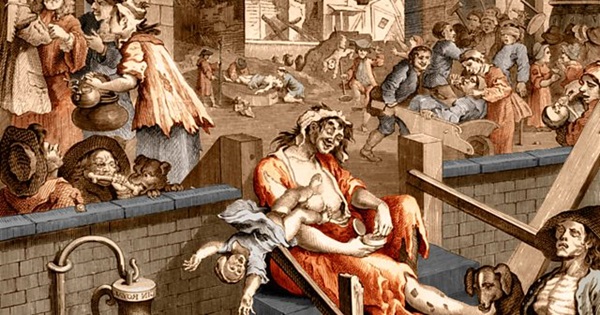
This phenomenon was not a fleeting consumer fad, but the first public health crisis caused by a legal narcotic in modern history.
A political decision with unforeseen effects
The tragedy began, ironically, as an act of economic patriotism. After the accession of William III of Orange to the throne in 1688, England entered a prolonged military and commercial conflict with France.
To strike the French economy, the Crown banned the importation of brandy and enacted laws that liberalized the distillation of local grain.
The result was an unprecedented explosion in production. Since complex licenses or high taxes were not required, any citizen with a basement and a still could produce spirits.
By 1720, it is estimated that one in four houses in certain neighborhoods of Westminster and Southwark functioned as a distillery or point of sale.
A British parliamentary debate from 1729 documented in The Journal of the House of Commons records:
No known pestilence or disease has wreaked such havoc on the population as this vile drink. The hospitals are overflowing and the streets reek of desperation.
“Drunk for a Penny”
The gin of that era bore little resemblance to today’s premium beverage. It was a crude brew, often adulterated with industrial substances such as turpentine, lime, sulfuric acid, or even paint thinner to simulate the alcoholic “kick” consumers sought.
Its success was due to an unbeatable factor: it was cheaper than beer and even more accessible than clean water or milk in neighborhoods without sanitary infrastructure.
Establishments displayed sadly infamous signs: “Drunk for 1 penny, dead drunk for tuppence, straw for nothing!!” (Customers could sleep off their stupor on straw on the establishment’s floor).
For a population mired in the extreme poverty of the pre-industrial era, gin was not a luxury; it was a liquid anesthetic against cold, hunger, and misery.
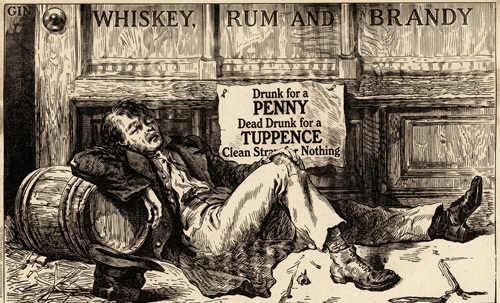
Unlike other alcohols, gin penetrated deeply into the female demographic. Consumption among working women and single mothers soared, leading to terrifying demographic consequences.
The term “Mother’s Ruin” emerged as observers noted how addiction destroyed childcare and family structure.
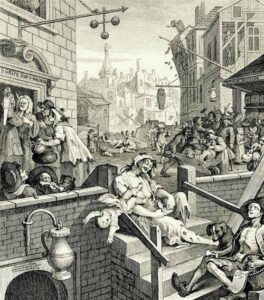
The art of the period captured this horror masterfully. William Hogarth’s engraving “Gin Lane” (1751) shows a society in absolute decay, featuring a mother dropping her baby, a skeletal man dying of hunger, and a pawnbroker exploiting misery.

Although it was a work of moral propaganda, it reflected the genuine concern of the enlightened elites. William Hogarth, in a letter to his friend Dr. Richard Mead, 1751, writes:
My intention was not only to entertain, but to warn. London is not being destroyed by war, but by the glass.
The long road to regulation
The British government tried to stop the chaos with a series of laws called the Gin Acts. The first attempts (1729, 1736) failed spectacularly by adopting an extreme prohibitionist approach: expensive licenses, disproportionate fines, and criminalization of small-scale sales.
This only fueled a violent black market, bribery of inspectors, and street riots. Henry Fielding, magistrate and writer, in An Enquiry into the Causes of the Late Increase of Robbers (1751), wrote the following:
Prohibiting gin without offering alternatives or regulating its sale is like trying to put out a fire with gunpowder.
It was not until the Gin Act of 1751 that a balanced solution was found. Instead of prohibition, Parliament established the following:
- Mandatory requirement for distillers to sell exclusively to licensed retailers.
- Gradual but firm tax increases, shifting consumption towards regulated establishments.
- Encouragement of beer consumption as a “healthy,” patriotic, and lower-alcohol alternative.
This law, combined with poor harvests that raised the price of base grain, the emergence of the Methodist movement (which promoted temperance and self-control), and a slight economic improvement in the country, finally brought the craze to an end by the middle of the century.
| Impact | Social consequences |
|---|---|
| Infant mortality | In parishes like St Giles-in-the-Fields, only 25% of children survived past age 5 (1730s). |
| Criminality | 400% increase in arrests for petty theft and street violence to finance consumption (Old Bailey records, 1725-1740). |
| Public health | Massive cases of cirrhosis, blindness, miscarriages, and “madness” due to adulterant poisoning. |
| Demographics | For the first time, deaths in London consistently exceeded births (1725-1735). |
| Peak consumption | England consumed ~8-11 million gallons annually in 1743, compared to ~1 million in 1700. |
From misery to sophistication
The Gin Craze left a lasting lesson about the relationship between the state, the market, and addictive substances. It showed that total deregulation in contexts of extreme poverty is a recipe for health disaster and that prohibition without regulation usually worsens the crisis.
Curiously, from the ashes of this crisis, the modern gin industry was born. Distillers who survived the new regulations began refining their methods.
This gave rise to continuous alcoholic distillation, activated carbon filtration, and an emphasis on natural botanicals (juniper, coriander, citrus peel). In this way, London Dry Gin emerged, today synonymous with purity and elegance.
Gin went from being a “poison for the poor” to one of the most sophisticated drinks in the world, but its history will always carry the scar of those decades when London nearly drowned itself in a glass of spirits.
A historical warning that resonates whenever a society faces the balance between free markets, public health, and social justice.
Frequently Asked Questions (FAQ)
1. Was gin really cheaper than water?
Not exactly. Water in 18th-century London was often contaminated, but gin was relatively cheaper than beer or milk, and its low price was due to the absence of taxes and the grain surplus. Additionally, alcohol provided immediate warmth and numbing effects, something water could not offer.
2. Why did the early Gin Acts (1729, 1736) fail?
Because they adopted a prohibitionist approach with no real alternatives. Licenses were unattainable for poor sellers, fines drove sales underground, and police corruption became widespread. History repeatedly shows that prohibition without regulation tends to generate more dangerous black markets.
3. What role did religion play in ending the crisis?
The rise of Methodism (John Wesley, 1730s) and other evangelical movements promoted temperance, self-control, and family responsibility. Although not the sole factor, it created a cultural climate that reinforced legislative reforms and stigmatized uncontrolled consumption.
4. Is there any modern parallel to the Gin Craze?
Yes. Public health historians often compare this crisis to the opioid epidemic in North America or the rise of alcopops and alcoholic energy drinks in the 2000s. In all cases, common factors include cheap access, aggressive marketing, socioeconomic vulnerability, and the need to balance regulation with harm reduction.
5. How did the transition from adulterated gin to today’s London Dry Gin happen?
After 1751, regulation forced distillers to compete on quality rather than price. The invention of the column still (19th century), the use of standardized botanicals, and the elimination of toxic additives transformed the drink. Today, the London Dry Gin designation is legally protected and requires distillation with natural botanicals, without added sugars or colorants.
Recommended
- Who was Hildegard of Bingen? Life, work, and legacy on the use of hops in beer
- Recipe development with Claude Code: Precision engineering in brewing