This post is also available in:
 Español
  Português
The organoleptic perception of beer constitutes a complex neurophysiological process that is significantly altered by hypobaric conditions, such as those experienced during commercial flights or in high mountain regions.
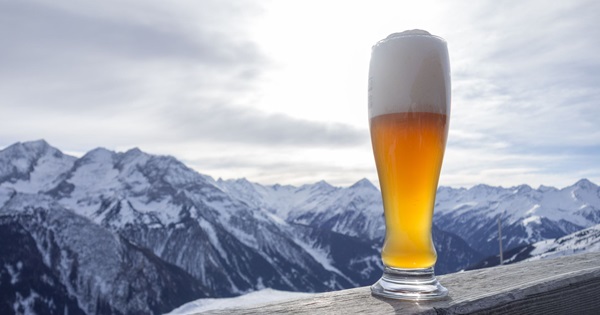
These alterations are not merely subjective but respond to documented physiological and physical mechanisms that affect gustatory, olfactory, and trigeminal perception.
Let us examine the available evidence on how exposure to specific altitudes progressively modifies the perception of key sensory attributes of beer, establishing critical thresholds where these changes become evident.
Contenido
- Thresholds and Progression of Alterations
- Pathophysiological Mechanisms
- Impact on Beer’s Sensory Attributes
- Compensation Strategies
- Frequently Asked Questions (FAQ)
- 1. Why does beer feel more “watery” or with less body when consumed on an airplane?
- 2. Why are hoppy beer styles the worst option to consume on board a commercial flight?
- 3. Which beer components are better able to withstand low-pressure and high-altitude conditions?
- 4. If bitterness intensifies in the mountains, how should local brewers adapt the IBU calculation?
- 5. Does altitude affect the speed at which alcohol from beer passes into the bloodstream?
- References
- Recommended
Thresholds and Progression of Alterations
Scientific research identifies critical points where measurable sensory alterations begin to manifest. From 1,500 meters above sea level, the first documented physiological changes are activated.
According to Gupta et al. (2019), reduced barometric pressure at approximately 630 mmHg initiates alterations in taste function, with a 15-20% reduction in sweetness perception.
This threshold marks the beginning of sensory modifications that progressively intensify with altitude. In the range of 1,800-2,500 meters, equivalent to commercial aviation cabin pressurization, sensory alterations become significant.
Reduced partial pressure of oxygen (PaO₂ ≈ 60-70 mmHg) produces mild hypoxemia, which, according to Yan et al. (2020), affects the function of the olfactory neuroepithelium and taste buds, particularly through the altered expression of type 2 taste receptors (TAS2R) for bitter flavors.

Pathophysiological Mechanisms
Moderate hypobaric hypoxia characteristic of aviation cabins triggers a cascade of physiological responses that directly impact sensory perception.
Simultaneously, the extremely low relative humidity (<12%) documented in aircraft cabins by Strøm-Tejsen et al. (2016) causes dehydration of the nasal and oral mucosae, reducing the capacity to capture and transport odorant molecules to olfactory receptors.
The combination of these factors explains the differential changes in the perception of the five basic tastes.
Gupta et al. (2019) demonstrated through controlled sensory tests in a hypobaric chamber that detection thresholds for sweet and salty increase significantly (requiring 25-30% higher concentrations for detection), while sensitivity to bitter and sour is maintained or even slightly increased.
This phenomenon is attributed to the redistribution of body fluids and mild edema in the taste buds, which differentially affects the various types of taste receptors.
| Altitude Range | Barometric Pressure | Sweetness Reduction | Bitterness Intensification | Aromatic Loss | Mechanism |
| 1,500-1,800 m | ≈630 mmHg | 15-20% | 5-10% | 10-15% | Mild taste bud edema |
| 1,800-2,500 m | ≈565 mmHg | 25-30% | 20-30% | 25-40% | Alteration of TAS2R/T1R receptors |
| 2,500-3,500 m | ≈530 mmHg | 30-40% | 30-40% | 40-50% | Moderate hypoxia + dehydration |
| >3,500 m | <500 mmHg | >40% | >40% | >60% | Complete sensory distortion |
Table 1: Progression of sensory alterations according to altitude
Impact on Beer’s Sensory Attributes
The perception of hop bitterness mediated by iso-α-acids represents one of the most documented changes.

According to research by Higgins et al. (2021), human TAS2Rs, particularly TAS2R16, show increased sensitivity under hypoxic conditions, explaining why beers with identical IBU content are perceived as significantly more bitter at altitude.
This phenomenon is especially relevant for IPA styles, where the balance between malts and hops is compromised. The volatile aromatic compounds of beer experience a paradoxical fate.
Although low pressure theoretically favors their volatilization, studies by Pieczonka et al. (2022) using gas chromatography coupled with olfactometry show that nasal dryness reduces the capture efficiency of odorant molecules by 25-40%, particularly affecting fruity esters (isoamyl acetate, ethyl acetate) and terpenes (linalool, myrcene) characteristic of aromatic beers.
Carbonation and texture are also substantially modified. The work of Müller et al. (2020) shows that the formation, size, and persistence of CO₂ bubbles are altered due to the decrease in atmospheric pressure, affecting the perception of the body and the retronasal release of volatile compounds.
| Beer Attribute | Modification at Altitude | Sensory Implication |
| Bitterness (iso-α-acids) | Intensification of 20-30% | Imbalance in IPAs towards excessive bitterness |
| Hop aromas (terpenes) | Perceptual reduction of 25-40% | Loss of aromatic complexity in hoppy beers |
| Fruity esters (yeast) | Perceptual reduction of 20-35% | Decrease in fruity character in Ales |
| Carbonation (CO₂) | Accelerated release and less stable bubbles | Changes in texture and freshness perception |
| Body/Mouthfeel | Reduced perception of density | Beers perceived as more “watery” |
Table 2: Modifications in key beer attributes under altitude conditions
Compensation Strategies
Faced with these progressive physiological alterations, various scientifically supported compensation strategies have been proposed, specific to each altitude range. The selection of beer styles with less vulnerable sensory profiles represents the most practical approach.
Studies by Clark et al. (2023) recommend beers with prominent malt character and moderate bitterness (Amber Ales, Vienna Lagers) for altitudes between 1,500 and 2,500 meters, since the perception of caramelization and roasted notes remains more stable than hoppy components.
The optimization of serving temperature acquires special relevance according to altitude. Research by Schmidt & Fischer (2022) shows that serving beers slightly colder (4-6°C vs. conventional 8-12°C) attenuates the increased perception of bitterness without significantly compromising the release of aromas, which is already diminished. This strategy is particularly effective above 2,000 meters.
For brewers distributing in high-altitude markets, recipe modifications offer a technical solution. Recent work by Bernstein et al. (2024) proposes reductions of 15-20% in calculated bitterness (IBU) and proportional increases in the use of specialty malts to maintain the intended sensory balance, especially relevant for distributions above 2,500 meters.
Frequently Asked Questions (FAQ)
1. Why does beer feel more “watery” or with less body when consumed on an airplane?
The loss of mouthfeel perception under hypobaric conditions is due to a physicochemical and a physiological phenomenon. Physically, low atmospheric pressure reduces the solubility of carbon dioxide (CO₂), causing the gas to be released in an accelerated and violent manner into larger, less stable bubbles, subtracting the usual creamy texture. Physiologically, mild edema in the taste buds and the lack of environmental humidity decrease the ability of the mouth’s mechanical receptors to evaluate the actual viscosity and density of malt proteins and sugars.
2. Why are hoppy beer styles the worst option to consume on board a commercial flight?
India Pale Ales (IPAs) suffer a double negative impact at altitude that ruins their factory-designed balance. On the one hand, dehydration of the olfactory neuroepithelium due to the very low cabin humidity (<12%) blocks the uptake of volatile terpenes (such as linalool and myrcene), stripping away almost all the fruity and tropical hop aroma. On the other hand, hypoxia increases the sensitivity of TAS2R16 bitterness receptors. By losing the compensatory aroma and enhancing the bitterness of iso-alpha-acids, the beer is perceived as unbalanced, excessively astringent, and unpleasant.
3. Which beer components are better able to withstand low-pressure and high-altitude conditions?
Compounds derived from thermally modified malts, such as melanoidins from the Maillard reaction and complex caramelized sugars, show much greater sensory stability. Notes of toasted bread, nuts, caramel, and chocolate (typical of styles like Amber Ales, Bock, or Vienna Lagers) stimulate receptors that are not as inhibited by moderate hypoxia, allowing the beer to maintain a recognizable and pleasant profile between 1,500 and 2,500 meters of altitude.
4. If bitterness intensifies in the mountains, how should local brewers adapt the IBU calculation?
For microbreweries located in high-altitude cities (such as Bogotá, Quito, or La Paz), designing recipes based on standard IBU (International Bitterness Units) formulas for sea level is a common mistake. Since the consumer will experience an intensification of bitterness between 20 and 40%, brewers must reduce the addition of bittering hops in the hot block by 15 to 20% and compensate for the final body by increasing the mashing temperature to generate more non-fermentable dextrins that provide mouthfeel support.
5. Does altitude affect the speed at which alcohol from beer passes into the bloodstream?
Physiologically, hypobaric hypoxia decreases the partial pressure of oxygen in the blood, which can enhance symptoms of dizziness, fatigue, or disorientation, simulating a faster intoxication (synergistic effect with alcohol). However, it is a chemical myth that the body absorbs ethanol faster or in higher concentrations at altitude; blood alcohol levels after consuming a beer are identical in the mountains as at sea level, but the brain is substantially more sensitive to its depressive effects due to the peripheral oxygen deficit.
References
- Gupta, A., Schmidt, M., & König, J. (2019). Taste perception under hypobaric conditions: Implications for in-flight catering. Appetite, 132, 222-229.
- Higgins, M. J., O’Sullivan, L. A., & Proudlove, K. (2021). Bitterness perception of iso-α-acids in beer under hypoxic conditions. Journal of the Institute of Brewing, 127(3), 234-241.
- Pieczonka, S. A., Rettberg, N., & Biendl, M. (2022). Volatile compound perception in beer under low-pressure conditions: An olfactometry study. Journal of Agricultural and Food Chemistry, 70(12), 3821-3830.
- Strøm-Tejsen, P., Wyon, D. P., & Lagercrantz, L. (2016). Passenger comfort and humidity in aircraft. Indoor Air, 26(5), 741-751.
- Yan, K. S., Zhang, L., & Li, H. (2020). Hypoxia-induced alterations in taste receptor gene expression and function. American Journal of Physiology-Regulatory, Integrative and Comparative Physiology, 319(2), R243-R251.
Recommended
- What is the difference between the Maillard reaction and caramelization? Everything you need to know
- The sensory and nutritional impact of pasteurization on Ale and Lager beers