
This post is also available in:
 Español
  Português
Lambic beers and their various variants are a living relic of a time when all beer was fermented at the mercy of nature, and their production process has remained virtually unchanged for several centuries.
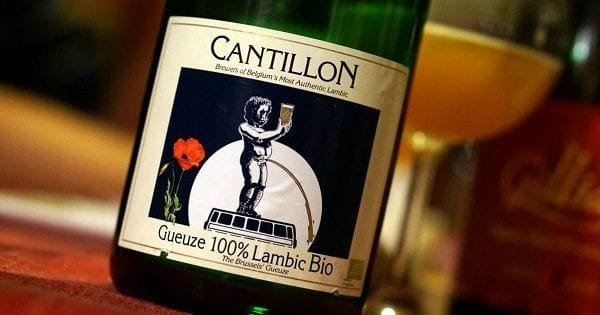
Unlike most modern beers, which are fermented with carefully cultivated yeast strains, Lambic beers are still spontaneously fermented, exposing the wort to wild yeasts and bacteria present in the environment of the Senne River Valley near Brussels, Belgium, during the months of October to May.
Contenido
Etymology of the Term Lambic
According to an article published in the French newspaper Tirailleur in 1883, the term “Lambic” would originate from the belief of ancient Belgian farmers that a Lambic beer, being very “harsh” on the palate, was actually a distilled beverage.

According to research by Belgian writer Roel Mulder, the earliest mentions of Lambic beers, from 1794 to around 1824, refer to “allambique” or “alambic,” derived from the French word “alambic,” which comes from Arabic and means “alembic” or “distillation by boiling.”
On the other hand, Belgian historian Godefroi Kurth, who agrees that the term Lambic derives from the word “alambic,” suggests that the latter was actually an ancient name used to refer to the mashing vessel required for brewing beer.
A third theory, cited by the international gastronomy dictionary, indicates that the word “alambic” may have originated from the Latin verb “lambere,” which in its infinitive form means “to sip.”
The widespread use of the term would be explained by the growing influence of Latin in post-Greek times (“lambere” derives from the Arabic “al-anbīq” and Greek “ambyx”) and its impact on numerous languages, which would have extended its use to fermented beverages.
Additional Theories
A fourth theory, proposed by researcher Hubert van Herreweghen and described by him as “very imaginative,” states that during the Spanish occupation of Brabant, soldiers often marched with a leather flask hanging from their belts. This flask had two compartments, one filled with water and the other with wine.
Due to this dual function, they called it “el ambiguo,” which eventually evolved into the word “Lambic.”
Finally, one of the most widespread but poorly documented theories claims that the word Lambic, often spelled Lambik or Lambiek (according to Belgian-Dutch etymology), derives from the name of the Belgian village Lembeek, a small brewing community where Brouwerij 3 Fonteinen is still located today, near the Senne River.
Etymology of the Term Gueuze
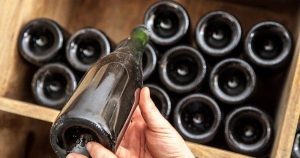
The Gueuze variety, on the other hand, is made by blending two or more Lambics of different ages (aged Lambic and young Lambic), which is then bottled.
Since the young Lambic has not yet completed its fermentation process, it still contains some residual sugar, allowing for a secondary fermentation in the bottle, producing natural carbonation—the so-called “Champenoise” method.
As with the term Lambic, there is no proven etymological history regarding the origin and use of the word “Gueuze” in beer.
Writer Jean-Xavier Guinard, in his book Classic Beer Styles: Lambic, states that the term Gueuze likely originated in Lembecq, a small town outside Brussels.
Around 1870, the town’s mayor, who also owned a brewery, hired an engineer named Cayaerts. Together, they began using the Champenoise method to referment Lambic beers in bottles.
Lambic des Gueux
The result of this “new” beer was called “Lambic des Gueux,” as a tribute to the liberal ideas of the mayor, who belonged to the political party of the same name. Soon, Lambic des Gueux became known simply as Gueuze.
Another theory, again referenced by Hubert van Herreweghen, relates to the Spanish occupation of Brabant. It suggests that the word “gueuze” derives from the French word “gueux” (beggar), used by the Spanish to refer to their rivals, who carried only a single container of sour beer, without compartments. They mockingly called it “gueuze el ambiguo,” which eventually evolved into the term “gueuze-lambic.”
Today, the use of “Gueuze” and “Geuze” varies by brewery, much like the terms “Lambic” and “Lambik.” The spelling of the word is generally governed by the geographical-linguistic location of the brewery using it.
References
We recommend
- The Psychedelic Beer That Helped the Ancient Wari Empire Rule the Andes
- Parti-Gyle Brewing: History, Technique, and Basic Mathematics