This post is also available in:
 Español
  Português
A team at Chalmers University of Technology in Gothenburg has published one of the year’s most striking materials science papers: a biodegradable compound made from baker’s yeast—the same byproduct generated during beer fermentation—brown algae alginate, wood cellulose fibers, and vegetable glycerol. The material is processed as a hydrogel and 3D printed at room temperature, with no intensive heating, no support structures, and no waste.
Four Ingredients, One Hydrogel
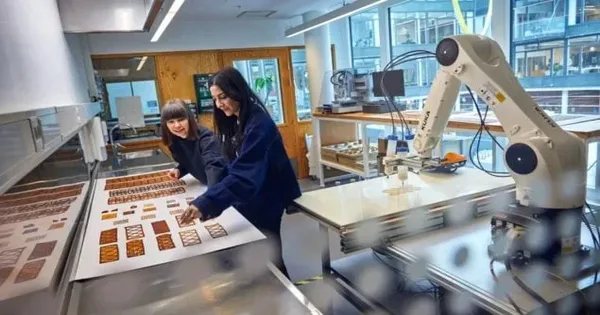
The material is not a single compound but a precise combination of four natural-origin elements. Baker’s yeast acts as a binding agent: its cells adhere to the other components and give the mixture cohesion. It is abundant, inexpensive and, as lead researcher Malgorzata Zboinska notes, has operational advantages that synthetic materials simply cannot match:
“It grows exponentially. It does not require strictly controlled environments and is not particularly sensitive to contamination.”
Alginate, extracted from brown algae, provides dimensional stability. Wood cellulose fibers reinforce structural resistance, and vegetable glycerol adds the flexibility needed to prevent cracking during air drying. The finished pieces develop natural yellow-to-brown tones—no added pigments required.
The research was published in June 2026 in Frontiers of Architectural Research, with funding from the Swedish Energy Agency and collaboration from cellulose behavior specialists at Aalto University in Finland.
No Heat, No Waste: A Different Kind of 3D Printing
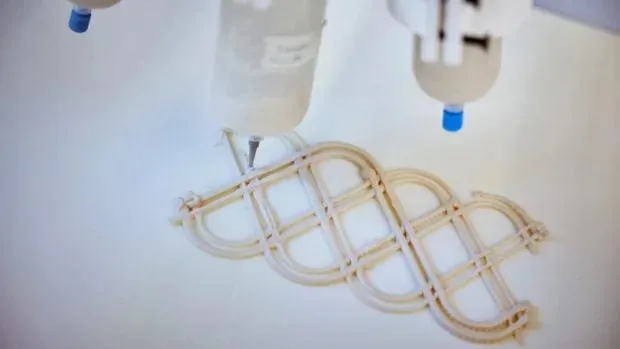
Conventional 3D printing of construction materials typically requires high temperatures, temporary support structures that are later discarded, or both. Chalmers’ hydrogel is extruded at room temperature: the ingredients are mixed, loaded into the print head, and deposited layer by layer until the final shape is reached—fixed simply by air drying.
This eliminates two of the main waste generators in the process: discarded support material and the energy consumed in heating. The final geometry is determined solely by the digital model, enabling organic or complex shapes impossible to achieve with plaster or traditional molded materials.
A Sector That Generates 40% of All Waste
Context matters here. The construction industry accounts for roughly 40% of solid waste in developed countries. Conventional materials—from concrete to synthetic panels—do not biodegrade, or do so over decades while leaving persistent compounds in soil and water.
Chalmers’ compound decomposes naturally without persistent residues. It does not compete directly with structural steel or concrete, but rather with finishing, partition, and interior modulation materials: the ones that define the appearance and functionality of a space without bearing significant structural loads.

The connection to the brewing industry is more than anecdotal: baker’s yeast and brewer’s yeast are different strains of Saccharomyces cerevisiae, but biomass recovery processes are similar. Breweries generate large volumes of spent yeast—usually destined for animal feed—that could be incorporated into higher-value technological supply chains like this one.
Current Applications and What Comes Next
The Chalmers team has identified four applications for the current development phase:
- Light-modulating screens for interior spaces
- Solar protection elements on building facades
- Lightweight, temporary space dividers
- Wall cladding systems with customized geometry
The next research steps aim to characterize the material’s behavior under fire and humidity—the two critical variables for indoor use—scale up digital manufacturing processes, and explore functional variants: self-repairing versions and others designed to purify indoor air.
No commercialization timelines have been announced, but publication in an open-access architecture and engineering journal suggests the researchers are deliberately seeking to accelerate technology transfer to design and construction teams.
Frequently Asked Questions
What does beer have to do with a biodegradable construction material?
The link is yeast. Chalmers researchers use baker’s yeast—also a byproduct of the brewing industry—as a binding agent in their mixture. The result is a hydrogel combining fermentation residues with algae alginate, wood cellulose, and vegetable glycerol.
What advantages does it have over conventional materials like plaster?
Unlike plaster or synthetic materials, this compound is fully biodegradable, allows complex geometries impossible with traditional molds, and requires no heating or support structures during printing. It also generates no material waste in the process.
Is the material strong enough for real-world applications?
Algae alginate provides dimensional stability, wood cellulose reinforces structural resistance, and glycerol adds flexibility during drying. Next steps include evaluating fire and humidity resistance before scaling up manufacturing.
Where was this research published and who funded it?
In June 2026 in Frontiers of Architectural Research, funded by the Swedish Energy Agency and led by Malgorzata Zboinska of the Department of Architecture and Civil Engineering at Chalmers University of Technology, Gothenburg, Sweden.
Recommended
- Researchers develop a fiber 50% stronger than wool from brewing yeast waste
- What are smart packaging solutions and how will they transform the beer industry?
- How to detect gluten in beer using computer vision