This post is also available in:
 Español
  Português
By Infobae
Among the list of Mexican spirits that have become fashionable, there is one that experts consider the forgotten beverage.
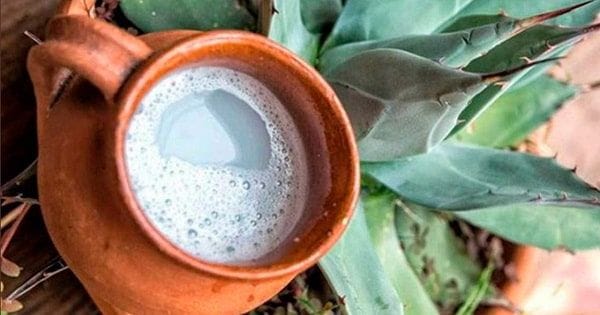
This is pulque, traditional among ancient Mexicans, which, amidst the boom of beer and tequila, aims to compete in the segment of those seeking more organic and less industrialized products.
What is pulque?
Pulque is a fermented beverage obtained from the maguey when its leaves are ripe. From the heart of the plant, a mixture of sweet liquid is extracted and left to ferment in wooden containers, to which any fruit is later added, resulting in a drink with different flavors.
Stone carvings depicting the beverage have been found dating back to the year 200. In pre-Hispanic times, only those who were to be sacrificed or men and women over 50 years old who had retired from public life could drink it, but during festivities, children could also drink it.
The sick were given it mixed with medicinal herbs, mainly to women during childbirth.
After the Spanish conquest, ancient Mexicans continued consuming it not only for their celebrations but also as a substitute for meat due to its high protein, vitamin, and carbohydrate content. Its alcohol content is generally 4.2 degrees.
The beverage had its peak at the beginning of the last century, but after being labeled as an alcohol for the lower class, urban growth, and the boost received by Mexican spirits such as tequila and mezcal, pulque production and consumption are mainly limited to the states of Baja California Sur, Chiapas, Coahuila, Durango, Hidalgo, Jalisco, Nuevo León, Oaxaca, Querétaro, San Luis Potosí, Tamaulipas, and Veracruz.
The country has about 70 varieties of maguey that produce pulque, according to the National School of Anthropology and History (ENAH).
Dark stories of pulque
Marcela Ramírez, a visitor to the El Rinconcito pulquería in the Zapopan Market, comments:
I really like its flavor; I drink it with aguamiel, chili, orange, and onion. It was a tradition to go every year before Christmas; my mother, rest in peace, and I kept going for over 20 years because nearby we bought the turkey and then came for our pulque, and this year I wanted to continue that custom.
Given the lack of regulation in the sector, the latest available production figure dates back to 2010, when Hidalgo (Central) consolidated as the main producer of the beverage with approximately 206 million liters, equivalent to 80% of the country’s total, while tequila has 254 million liters in inventory, plus the 172.4 million liters produced between January and August 2016.
Beer production exceeds 124 million hectoliters – each hectoliter equals 100 liters – with a per capita consumption of 61 liters. Mexico is also the world’s leading beer exporter, with sales to 189 countries.

At the beginning of the last century, according to the book “El Rey del Pulque,” written by Mario Ramírez Rancaño, a researcher at the National Autonomous University of Mexico, there were approximately 1,500 pulquerías—a type of cantina where only this beverage is sold—in the country’s capital.
Now it is estimated that about 150 survive, scattered in different places. Estimated consumption was 3 liters per person per day; now some businesses supply barely 20 liters per week.
Despite its long tradition, it represents only one-tenth of the total alcoholic beverages consumed in the country, while tequila accounts for 39%, but those who preserve the tradition trust that young people and tourists will help its rebirth despite the dark stories that weigh on its production.
Raúl Cervantes, marketing manager of the La Marisquita restaurant group and a member of a “pulque family” that has been in the business for over 30 years, recalls that among these dark stories is one that points to the use of animal feces wrapped in gauze placed inside fermentation containers to speed up the process.
Defenders of pulque
Some defenders of pulque claim that its consumption is healthier than tequila, which they say is a mixture that is 96% chemicals and sugars, while pulque can be considered almost organic as it preserves the traditional process in which no chemicals or preservatives are added, it is mixed with seasonal fruit, and it is always fresh.
Charly, the manager of Wichitos, a pulquería in the bohemian neighborhood of La Condesa in Mexico City, comments:
If it’s not fresh, it gets thrown away; it is always kept refrigerated, but if 10 days pass after it is brought in, it gets thrown away.
Although he acknowledges that drinking it is quite an experience because its consistency is not like any other beverage:
It is very heavy, thick, it has a kind of slime, and when you drink it, some people’s stomachs don’t tolerate it well because it is a very strong fermented drink. Beer, tequilas, mezcals, many trendy drinks have hit pulque, but there will always be a market as long as people keep asking for it, and we trust that young people who are now seeking to consume healthier, organic things will rescue this tradition.
Frequently Asked Questions (FAQ)
1. What is “cured” pulque, and how does it differ from natural or white pulque?
Natural pulque (also called white or legitimate) is the liquid extracted directly from the fermentation of maguey aguamiel, with a slightly acidic taste, yeast notes, and its characteristic viscous consistency. Cured pulque, on the other hand, is the mixture of this natural pulque with fruits (such as strawberry, guava, or piñón), seeds (such as walnut or almond), or vegetables (such as celery), which are ground and sweetened to soften the drink’s acidity, making it much more accessible for new or young palates.
2. What is the scientific origin of the myth of the “muñeca” (doll) and the supposed lack of hygiene in pulque?
The myth of the “muñeca” (which claimed that animal feces wrapped in cloth was introduced to speed up fermentation) was a commercial smear campaign strongly promoted by the beer industry at the beginning of the 20th century to take market share away from pulque. Scientifically, this myth is completely false: pulque is an extremely sensitive and microbiologically delicate fermentative ecosystem. If any type of fecal matter or harmful external bacteria were introduced, the process would become contaminated immediately, cutting off fermentation and turning the liquid into a sour, putrid waste unfit for consumption.
3. Why does pulque have that characteristic viscous or “slimy” texture?
The viscous texture of pulque is due to the action of beneficial bacteria of the genera Leuconostoc and Lactobacillus naturally present in the fermentation process. These bacteria transform the sugars of aguamiel into exopolysaccharides (mainly dextrans). These complex carbohydrate chains not only give the drink its density and gelatinous body but also act as a powerful prebiotic that protects and regenerates the microbiota or intestinal flora of those who consume it.
4. Is it true that pulque is highly nutritious and equivalent to meat?
From a nutritional perspective, the popular saying “it lacks one degree to be meat” has real scientific basis. Because it is a live fermented drink that does not go through drastic filtration processes or industrial pasteurization, pulque retains a huge amount of essential amino acids, B-complex vitamins (B1, B2, B3, B6), vitamin C, iron, phosphorus, and calcium. Historically, in the arid areas of Mexico where drinking water and animal proteins were scarce, pulque functioned as a vital food supplement for the working population.
5. Why cannot artisanal pulque be bottled or commercialized on a large scale in a traditional way?
Unlike beer or wine, pulque is a beverage with active and continuous fermentation. As it contains no chemical preservatives nor undergoes processes that kill live yeasts and bacteria, it continues to consume residual sugars continuously. If sealed hermetically in a regular bottle at room temperature, the accumulation of carbon dioxide (CO₂) would cause the container to burst within a few days. For this reason, artisanal pulque must always be kept refrigerated, in containers with gas escape valves, and ideally consumed within the first few days after extraction.