This post is also available in:
 Español
  Português
  Français
A Pumpkin Ale is an autumn beer brewed with pumpkin pie spices and, often, with pumpkin, which the BJCP guidelines classify under category 30B, Autumn Seasonal Beer. Its history begins in the North American colonies, where people turned to pumpkin when barley ran short, and its modern version was born at a California brewery in the mid-1980s.
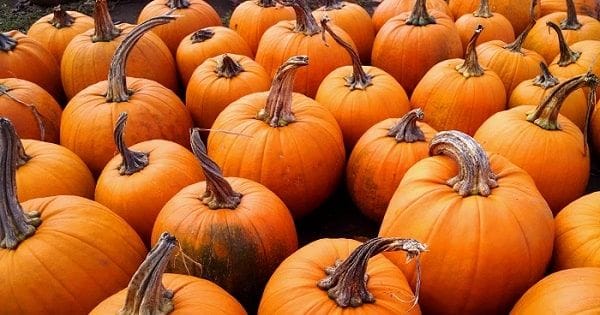
The pumpkin used in these beers belongs to the genus Cucurbita. Today it is a seasonal craft beer ingredient, especially in the United States.
Why Did Colonists Brew Beer with Pumpkin?
Because the early colonies lacked barley for malting, while pumpkins grew in abundance. Historian Cindy Ott sums it up this way in Food Republic, when people had no barley for beer, they could turn to the prolific pumpkin.
A 17th-century poem boasts of being able to make liquor “of pumpkins, and parsnips, and walnut-tree chips”.
Pumpkin provides little sugar. According to the USDA, 100 g of raw pumpkin contains 91.6 g of water and only 6.5 g of carbohydrates, and a simple calculation shows why it could hardly have been the only source of sugar.
A beer with an original gravity of 1.040, taken as a reference, has about 10 °Plato, which equals about 104 g of extract per liter.
[math]°P \approx 259 – \dfrac{259}{1.040} \approx 9.96[/math]
[math]1.040 \times 1000 \times 0.0996 \approx 103.6 \ \text{g/L}[/math]
Even assuming that all the carbohydrates in pumpkin were converted into fermentable sugar, it would take more than a kilo and a half of pumpkin for every liter of beer.
[math]\dfrac{103.6}{0.065} \approx 1{,}594 \ \text{g}[/math]
Colonial pumpkin beers were mixed with whatever was at hand, and the Pilgrims added persimmons and maple syrup (Food Republic, 2015). In practice, they were seasonal beers made out of necessity.
Did George Washington Brew Pumpkin Beer?
Washington’s only surviving beer recipe contains no pumpkin. That recipe, written in 1757 in his notebook as a colonel in the Virginia militia and kept at the New York Public Library, calls for bran, hops, molasses, and yeast (Marketplace, 2011).
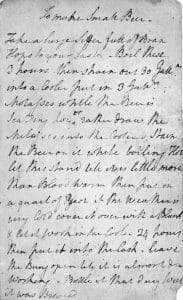
It is a small beer, a weak one, with three gallons of molasses for every thirty of wort. Even so, the first commercial Pumpkin Ale was inspired by a story that credited Mount Vernon’s autumn beer with containing pumpkin (The Hustle, 2024).
Who Created the Modern Pumpkin Ale?
After the end of Prohibition in the United States, German and Bohemian-style lagers dominated. Pumpkin returned to beer with the craft revival of the 1980s.
Bill Owens opened Buffalo Bill’s, one of the first brewpubs in the country, in Hayward, California. Inspired by that story about Mount Vernon, Washington’s estate, he brewed a pumpkin beer there roughly a year after opening (The Hustle, 2024).


Owens baked pumpkins and added them to the mash, but the first batch was disappointing because it tasted like vegetables. He then bought a jar of pumpkin pie spice, ran the spices through a percolator, and added that liquid, and the beer came out spicy and sweet.
In 1986 the brewery renamed it Pumpkin Ale and began selling it in supermarkets and liquor stores.
What Does a Pumpkin Ale Taste Like?
The 2021 BJCP guidelines describe it as a malty, spiced beer, often with a moderately rich body and a somewhat warming finish. Spices are required, and the most common are allspice, nutmeg, cinnamon, clove, and ginger (BJCP, 2021).
Pumpkin is optional and, when used, can give the beer an orange hue. The guidelines add that alcohol usually exceeds 5% and that most examples are copper-amber in color.
When judging these beers, balance, drinkability, and execution of the theme matter more than identifying each ingredient. Molasses, brown sugar, honey, or maple syrup are common adjuncts in the style.
Pumpkin Ale Examples
The BJCP guidelines list Dogfish Head Punkin Ale, Elysian Punkuccino, Rogue Pumpkin Patch Ale, Schlafly Pumpkin Ale, UFO Pumpkin, and Weyerbacher Imperial Pumpkin as commercial examples.
Punkin Ale, from Sam Calagione‘s brewery, is a 7% brown ale brewed with pumpkin, brown sugar, allspice, nutmeg, and cinnamon. It was first released commercially in 1995 (Brewbound).
Why Is It Associated with Halloween?
The season for these beers coincides with the pumpkin harvest, Halloween, and Thanksgiving, holidays when pumpkin takes center stage both on the table and in decorations.
Punkin Ale itself was born from that tradition. In 1994 it won a baking contest at the World Championship Punkin Chunkin, an event on the Delaware coast where competitors tried to hurl pumpkins as far as possible, held on and off between 1986 and 2016 (Brewbound).
How Should You Serve and Pair a Pumpkin Ale?
An American pint glass (shaker) or a wide-mouthed chalice works well for appreciating its spicy aromas.
Its sweet, spicy notes complement autumn desserts such as pumpkin pie, apple pie, or caramel desserts. It also goes well with roasted meats like turkey or pork, aged cheeses, and mild curries.
Frequently Asked Questions (FAQ)
1. What Is a Pumpkin Ale?
It is an autumn beer made with pumpkin pie spices and, often, with pumpkin. The BJCP guidelines place it in category 30B, Autumn Seasonal Beer, and describe it as malty, spiced, and with a somewhat warming finish.
2. Do Pumpkin Ales Contain Real Pumpkin?
Some do and some don’t. In the BJCP guidelines, spices are required and pumpkin is optional, and Dogfish Head Punkin Ale, for example, is brewed with real pumpkin.
3. Who Invented Pumpkin Ale?
The first modern commercial version is attributed to Bill Owens, of Buffalo Bill’s in Hayward, California, in the mid-1980s, and by 1986 it was already being sold as Pumpkin Ale. North American colonists were already brewing pumpkin beers centuries earlier.
4. How Strong Is a Pumpkin Ale?
It depends on the base beer, although according to the BJCP guidelines it usually exceeds 5%. Dogfish Head Punkin Ale is 7%.
5. What Food Pairs with a Pumpkin Ale?
Autumn desserts such as pumpkin pie or apple pie, roasted meats like turkey or pork, aged cheeses, and mild curries.