This post is also available in:
 Español
  Português
At the heart of the most recognizable Christmas tradition in the Western world lies a fascinating story that interweaves seemingly disparate elements.

The story of Santa Claus, far from being a simple children’s tale, emerges as a complex tapestry weaving ancestral shamanic practices, a millennia-old symbiosis between humans and reindeer, and a profound connection with the natural cycles of the Arctic world.

The Guardians of the Arctic Circle
In the vast snow-covered expanses of Lapland, where the northern lights illuminate the winter sky, the Sami people have maintained a millennia-old connection with their environment for more than four thousand years.
Their traditional territory, Sápmi, stretches across northern Norway, Sweden, Finland, and the Kola Peninsula in Russia, encompassing a vast landscape of tundra, boreal forests, and snow-capped mountains.
Their shamanic practices, especially those performed during the winter solstice, reveal surprising — and far from coincidental — parallels with our modern Christmas celebrations.
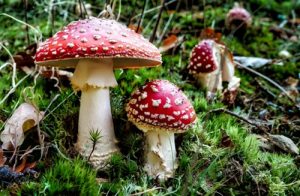
Sami shamans, acting as bridges between the visible and invisible worlds, developed sacred rituals involving Amanita muscaria, a psychedelic mushroom whose characteristic red cap with white spots would prefigure the distinctive colors of Santa Claus.
Ethnomycologist Gordon Wasson even proposed that this mushroom was the legendary “soma,” the divine substance venerated in the Vedic tradition, which, unlike other entheogens considered mere intermediaries with the divine, was recognized as a deity in itself.
The Importance of Reindeer in Sami Culture
Reindeer (Rangifer tarandus) have been the central axis of Sami culture for thousands of years, providing not only material sustenance but also a profound spiritual connection with the natural world.
This symbiotic relationship has influenced every aspect of Sami life, from their migration patterns to their shamanic practices.
Shamans believed that reindeer could guide souls through the different levels of the cosmos, a belief that would later be transformed into the image of Santa Claus’s flying sleigh.
These animals actively seek out and consume these mushrooms in the wild, a behavior that the Sami observed and subsequently incorporated into their spiritual practices.
Sami shamans observed that reindeer not only consumed the mushrooms, but also appeared to seek out and consume the yellow snow where other reindeer had urinated after eating them — a behavior that shamans would later imitate in their own ritual practices.
The explanation for this is that their liver metabolizes the psychoactive components of the mushroom, transforming ibotenic acid into muscimol, a more potent and less toxic compound.
The reindeer’s ability to find food under deep snow, their exceptional endurance, and their skill at navigating the darkness of the Arctic winter made them symbols of wisdom and spiritual guidance.

Migration and Rituals
The traditional Sami calendar is structured around eight distinct seasons, each marked by different activities related to reindeer herding.
During the winter solstice, when darkness envelops the Arctic, the Sami celebrated particularly significant rituals involving both reindeer and Amanita muscaria.

Sami shamans, dressed in ceremonial costumes decorated in red and white — colors that reflected those of the sacred mushroom — performed elaborate rituals that included chanting, dancing, and the ceremonial consumption of Amanita muscaria.
The purpose of these rituals was to establish communication with the spirit world and ensure the community’s survival through the long Arctic winter.
The Spiritual Shamanic Journey
The evolution of these ancient Sami practices into the modern image of Santa Claus represents a fascinating example of cultural transformation and appropriation.
The original shamanic elements — the spiritual journey, the flying reindeer, the red and white colors, the giving of gifts during the winter solstice — survived, though transformed, in the modern Santa Claus narrative.
This process of cultural transformation was not accidental. The location of Santa Claus’s home at the North Pole, the presence of the flying reindeer, and even the colors of his suit all find their roots in the ancient shamanic practices of the Sami people.
However, these elements were gradually stripped of their original sacred meaning and reinterpreted through the lens of modern Western culture.
Christian Cultural Syncretism
The Christian tradition anchors the origins of Santa Claus in the historical figure of Saint Nicholas, a Greek bishop of the 4th century who lived in Anatolia, present-day Turkey.
Venerated for his generosity and miracles, Saint Nicholas became one of the most popular saints of the Middle Ages.
However, the transformation of this Mediterranean saint into the current polar Santa Claus involved a fascinating process of cultural syncretism.
The Commercialization and Marketing of the Myth
The final evolution of Santa Claus toward his contemporary image occurred in the 19th century, when various cultural elements converged in the United States.
Writer Washington Irving transformed the Dutch Sinterklaas into Santa Claus in 1809, while poet Clement Clarke Moore established the narrative of the gift-giving elf in his 1823 poem.
The definitive visual representation would come from German illustrator Thomas Nast in 1863, who created the image of the jolly bearded man we know today.
Implications for Contemporary Culture
The story of Santa Claus represents a fascinating example of how cultural symbols evolve and transform through time.
The persistence of Sami shamanic elements in one of the most recognizable figures of modern popular culture invites us to reflect on the nature of cultural transmission and the transformation of sacred symbols.
This story reminds us that cultural traditions are not static entities, but living organisms that evolve and adapt, maintaining subtle yet significant connections with their ancestral roots.
In an increasingly globalized world, the story of Santa Claus and its origins in Sami shamanic practices offers us a valuable lesson about the importance of recognizing and preserving indigenous traditions, even as we celebrate their modern transformations.
It reminds us that behind every contemporary cultural symbol there may lie a rich history of ancestral wisdom, waiting to be rediscovered and revalued.

Recommended
- Beer consumption and cholesterol levels: effects on your cardiovascular health
- The history of Duvel and the origins of the true “devil” of Belgian beers