This post is also available in:
 Español
  Português
Researchers at the University of Bristol in the United Kingdom conducted an experiment that sought to demonstrate how the shape of the glass has a huge effect on the speed at which we consume a beer.
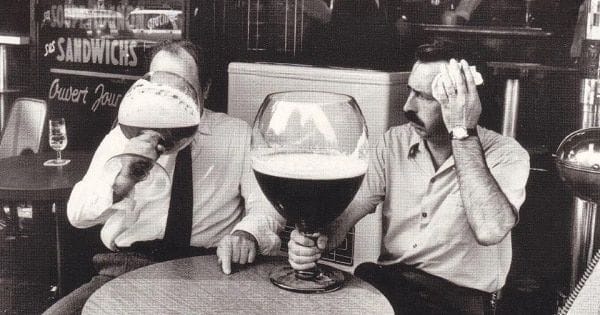

During the experiment, participants were served a glass of beer without knowing that their consumption was being carefully monitored, all while watching a documentary and then answering some questions.
Psychology of consumption according to the glass used
The glasses used were a Pilsner glass, curvilinear with a narrow base that widens towards the top, along with another cone-shaped glass with straight sides from the base, Stange type.
The result was that those subjects who consumed beer in the straight-sided glass were an incredible 60% slower at finishing their beer, about 12 minutes compared to 7 minutes, than the group that used the curved-sided glass.
The researchers attributed the difference to the difficulty of estimating the midpoint in the curved glass.
In other words, the participants had a mistaken impression of how far along they were in their consumption. Subsequent tests seem to confirm this.
When the glasses were provided half-full, there was no difference in consumption speed. Furthermore, the researchers confirmed that the subjects who used the straight-sided glass were much more accurate in estimating the midpoint.
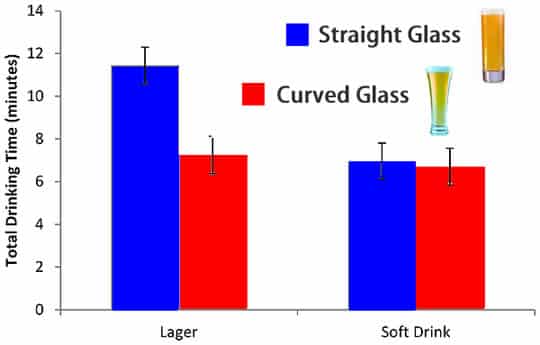
Another surprising finding was that the slower consumption effect of the straight-sided glass did not follow the same pattern for non-alcoholic beverages, in which case consumption occurred in approximately the same time for the curved-sided glass, meaning faster consumption.
Your personality according to your favorite beer style
It is said that you are what you eat, but there is no doubt that you are also what you drink; your preferred beer style says a lot about who you are, even if you don’t believe it.
So, when you meet someone new and want to know more about their personality in a matter of seconds, you just need to ask them about their favorite beer style.
They will be telling you quite a bit without realizing it. Below we leave you with what each beer style says about you.
Pilsner
You are efficient, direct, and traditional; you don’t like to explore completely, and you are definitely not someone who takes many risks.

Dark Ale
You are somewhat moody and even intolerant. You tend to be aggressive, but once people get to know you, they discover that you actually have a very sensitive heart.
India Pale Ale (IPA)
Appearances are very important to you, and you always want to know what others think of you. You are in search of constant change and self-improvement. You like to think you are sophisticated.
Lagers
You like simplicity and never complicate things; you seek casualness and are very friendly; you also adapt very easily to anything. You tend to be the most fun person in the group.
Brown Ale
You often feel misunderstood; you think no one pays attention to what you say, and you tend to feel like an outcast.
Stout
You are refined and very adventurous; you are not pretentious, but you definitely know how to appreciate good taste. You consider yourself demanding, and some things just no longer satisfy you.
Bock
It could be said that you have quite a bit of class, but some of your habits are not usually the best, or at least that’s what they say.
Wheat beers
You prefer things as they are, natural; you like to show that you have style, but sometimes others tend to dismiss your comments or tastes. You are also prone to misunderstanding things.
Frequently Asked Questions (FAQ)
1. What is the psychological mechanism that explains why one drinks faster from a curved glass?
The acceleration in consumption is due to a visual distortion known as midpoint estimation error. In a straight conical glass, the volume is predictable to the eye. In a curvilinear Pilsner glass, the geometry deceives the consumer’s brain, making them believe they have less liquid left than they actually do during the first half of the glass. This false perception of visual scarcity unconsciously alters the swallowing rate.
2. Why does the curved glass distortion not affect the consumption speed of non-alcoholic beverages?
In the experiment with soft drinks, the speed remained high in both designs because the consumption of non-alcoholic beverages is not regulated by social self-control mechanisms. With alcohol, the human brain actively evaluates the intake rate to self-manage the level of intoxication. When the visual reference of volume in the curved glass fails, the psychological control mechanism breaks, accelerating the speed.
3. How can the gastronomic sector use this finding to optimize its sales?
Bars and restaurants can apply this design science to strategically modify consumption habits. Serving beers in curved glassware increases table turnover by shortening the customer’s stay time per served portion. Conversely, using straight, cylindrical, stange-type glasses is ideal for tasting events or establishments seeking to promote slow, paced consumption.
4. Why did the study participants consume at the same rate when the glasses were half full?
When receiving the glass with only 50% of its total capacity, the estimation error disappears completely. The brain no longer needs to abstractly calculate where the midpoint of the container is, since the initial liquid level exactly coincides with the actual reference point. Without the optical illusion that distorts the upper part of the curved glass, the consumption rate equals that of the straight glassware.
5. What scientific validity do the correlations between beer style and consumer personality have?
Unlike the glass volume test, which is a controlled behavioral psychology study, the personality profiles according to beer style fall within the realm of psychographic marketing and popular culture. They do not have rigorous neuroscientific backing, but they are highly effective commercial tools that brands use to segment markets based on lifestyle and customer self-image.

Recommended
- The rise of the can as a distribution format for craft beer
- Essential kit for creating video content on social media