This post is also available in:
 Español
  Português
  Français
Tesgüino or tejunoo (from Nahuatl: texwinoh ‘dough drink’) is a corn beer produced by the Rarámuri in the Sierra Tarahumara, Chihuahua, with a documented production process that predates European contact and remains integrated into labor exchange systems, ritual organization, and the identity reproduction of this ethnic group in northern Mexico.
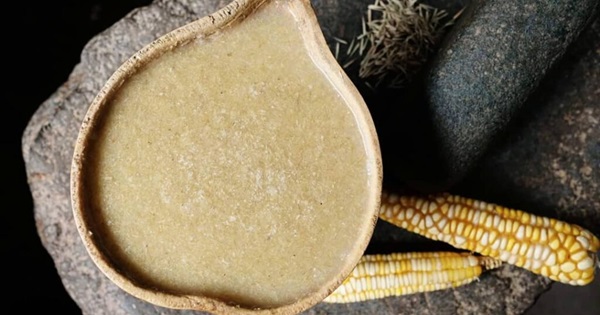

From the perspective of beer history, it constitutes an independent fermentative tradition based on corn malting and spontaneous fermentation.
The Rarámuri, also known as Tarahumaras, occupy the territory of the canyons and plateaus of the state of Chihuahua, a topographic configuration of the canyon system known as the Copper Canyons that historically functioned as a geographic barrier that limited missionary and administrative penetration by the Spanish.
This relative isolation allowed the continuity of fermentative practices that in other Mesoamerican regions were interrupted or radically transformed.
After colonial contact, tesgüino became part of ceremonies that combine Catholic elements and Rarámuri traditions. In these contexts, the beverage retains its functions of work organization, reciprocity, and ritual mediation, now also linked to saints and Christian symbols.
Production Process and Technology
From a brewing typology perspective, tesgüino is classified as a spontaneously fermented malted cereal beer with a production development that has biochemical homologies to barley beer brewing, adapted to the resources available in the Sierra ecosystem.
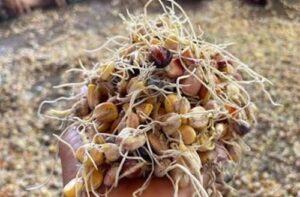
The first phase consists of controlled germination of corn. The grains are moistened and placed on petates or pits for periods of three to seven days, allowing the enzymatic activation necessary for the hydrolysis of starch into fermentable sugars. This stage corresponds functionally to industrial malting.
Subsequently, the germinated grain is ground on a metate and subjected to prolonged cooking in water. Unlike industrial brewing protocols, stepped mashing is not always performed; cooking simultaneously fulfills the functions of starch gelatinization and sugar extraction.
In documented variants, plant materials such as lechuguilla stalks (Agave salmiana), oak bark, or wild roots are incorporated during cooking. These additives serve technical functions such as providing nitrogenous nutrients for the fermentative microbiota, regulating wort pH, and providing additional inoculation of environmental microorganisms.
Fermentation is spontaneous and uninoculated. The fermentative agents come from the environment, the grain surface, and reused clay or wooden vessels, which act as reservoirs of adapted microbial cultures.
Under the thermal conditions of the Sierra, primary fermentation is completed in intervals of two to four days. The resulting product is cloudy, with a color ranging from creamy white to yellowish depending on the corn variety used, an alcohol content between 2% and 5% ABV, a predominant lactic acid profile, untoasted cereal notes, and low residual carbonation.
The corn varieties used correspond to local landraces adapted to altitude and semi-arid conditions. Organoleptic differences associated with the grain type have been recorded: blue corn produces ferments with greater aromatic complexity and more pronounced acidity compared to white corn.
These variations are the result of accumulated empirical selection and transmitted predominantly by women, who assume the main productive role in most documented domestic units.
Economic Function and Social Organization
Tesgüino consumption is institutionally articulated through the tesgüinada, a collective event that links production, distribution, and consumption of the beverage with the mobilization of labor.
Anthropologist John Kennedy (1978) identified this institution as the central mechanism of social cohesion in dispersed Rarámuri communities.
The tesgüinada operates as a system of deferred reciprocity linked to the cultural principle of kórima. A host summons participants for specific productive tasks (agriculture, construction, harvesting) and provides tesgüino as immediate compensation.
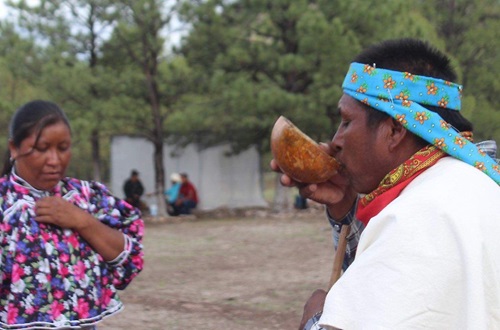
No monetary transaction or formal contract mediates; the obligation to reciprocate in future events functions as a guarantee of compliance. This mechanism allows the execution of work that exceeds individual labor capacity without requiring capital accumulation.

Kennedy recorded male participation of up to one hundred days per year in tesgüinadas. In addition to their labor function, these events constitute spaces for conflict resolution, negotiation of marriage alliances, transfer of land rights, and community decision-making.
The beverage facilitates social interaction in a population distributed in rancherías with significant distances between them. Structurally analogous functions have been documented in Andean chicha systems.
Ritual Function and Cosmological Framework
Tesgüino integrates ritual components of the Rarámuri ceremonial cycle. In the yúmari, a ceremony associated with the agricultural cycle and cosmogonic renewal, the beverage is offered to Onorúame (creator deity in Rarámuri cosmology) and to saintly entities of Catholic syncretism.
The offering of tesgüino constitutes a necessary element for ritual validity; its absence invalidates the ceremony according to traditional protocols.
Ritual specialists (owirúame) use tesgüino as a mediator in diagnostic and therapeutic practices. Its presence is also recorded in rites of passage (birth, death), agricultural propitiatory ceremonies, and traditional sporting events (rarajípari for men, rowá for women).
Tesgüino production is a necessary condition for the execution of these events; it does not function as an optional accompaniment but as a structural component of the rite.
This ritual integration distinguishes tesgüino from other Mesoamerican fermented beverages whose current consumption is predominantly secular or festive. In the Rarámuri context, the native category explicitly differentiates ritual tesgüino from other psychoactive or alcoholic substances without ceremonial status.

Historical Context and Development
Archaeological evidence places the production of fermented corn beverages in Mesoamerica and Andean areas with millennia-old antiquity. Available data indicate that these traditions constitute independent technological developments from the barley and wheat fermentations documented in Mesopotamia and the eastern Mediterranean.
There is no evidence of technological diffusion between the two traditions; they are convergent solutions based on the fermentation of locally available cereals. As a global comparative reference, The Beer Times documents Neolithic evidence of cereal fermentation in Shangshan dated to 10,000 years ago.
The continuity of tesgüino during the colonial period is partially explained by geographic factors. The topography of the Copper Canyons hindered missionary and administrative access.
Jesuit attempts to suppress consumption (17th century) did not succeed in eradicating the practice; tesgüino remained operational within ceremonial structures that incorporated Catholic elements without altering its preexisting social and economic functions.
Dynamics and Factors of Change
In the 20th and 21st centuries, transformations in tesgüino production and consumption patterns have been documented, associated with multiple factors:
- The expansion of evangelical missions since the mid-20th century has generated community segmentation between households that maintain the practice and households that have discontinued it due to religious adherence.
- State economic integration programs have introduced monetary circulation into systems previously based on reciprocity, modifying the economic function of the tesgüinada.
- Labor migration to urban centers (Chihuahua, Ciudad Juárez) reduces the availability of specialized labor in production. Intergenerational transmission of technical knowledge depends on staying in the territory and access to local corn varieties.
Concurrently, academic documentation and heritage recognition initiatives have been recorded, positioning tesgüino as an intangible cultural asset. Craft breweries in northern Mexico have developed products inspired by Rarámuri fermented corn profiles.
These commercial products differ technically from traditional tesgüino in production methods, scale, and consumption context. The reproducibility of traditional technology outside its sociocultural and geographical context presents documented limitations.
Frequently Asked Questions (FAQ)
1. What is tesgüino and how is it made?
It is a fermented corn beer produced by the Rarámuri in the Sierra Tarahumara, Chihuahua. The process includes corn germination (3-7 days), grinding on a metate, prolonged cooking (with occasional addition of botanical catalysts such as lechuguilla), and spontaneous fermentation (2-4 days) with environmental microbiota.
2. Technical differences between tesgüino and chicha?
Both are corn ferments, but they belong to distinct technological traditions. “Chicha” designates heterogeneous Andean and Caribbean variants (some with salivary saccharification). Tesgüino is specific to the Rarámuri of northern Mexico and uses germination as the sole mechanism for starch conversion. They share substrate and spontaneous fermentation; they differ in geography, saccharifying agents, and cultural context.
3. Biochemical homologies with industrial beer?
Yes. Corn germination is equivalent to barley malting. Cooking ground grain is equivalent to mashing/wort boiling. Spontaneous fermentation is equivalent to controlled fermentation (same metabolic pathway, different strain and temperature management). The main differences are higher acidity, lower microbiological stability, and lack of standardization.
4. What is the functional definition of a tesgüinada?
It is a Rarámuri reciprocity institution that links the host’s provision of tesgüino with the collective work provided by those summoned. Additional functions: conflict resolution, marriage alliances, territorial negotiation, decision-making. Documented by Kennedy (1978) as the primary mechanism of social cohesion in dispersed settlements.

We Recommend
- Neolithic evidence of rice fermentation in Shangshan (China, 10,000 years ago)
- Chicha Beer: commercial adaptation of Andean jora corn styles