This post is also available in:
 Español
  Português
The basic definition establishes that a cocktail (from the English “cocktail”) is a combination of different beverages (alcoholic or not) such as fruit juices, sodas (carbonated drinks), fermented drinks (beer, cider), and/or spirits (whiskey, rum, vodka, etc.)
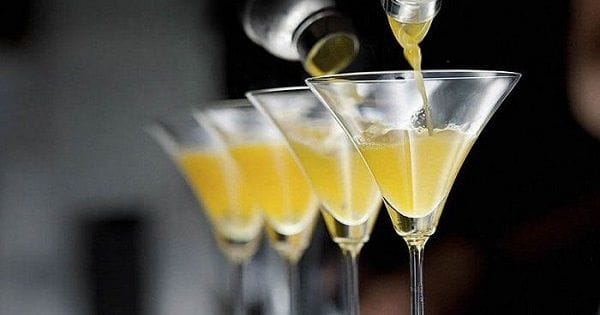
Although its origins can be traced back to the late 18th century in England and the United States, its definitive popularity came in the 1920s during Prohibition, when adding fruit and/or flavored beverages to alcoholic drinks helped mask the poor quality of bootleg alcohol.
What Does the Word Cocktail Mean?
Although we use the words cocktail interchangeably today, the most recognized theory about the origin of the word “cocktail” says it developed from the contraction of the English words “cock’s tail,” which literally means “tail of a rooster.”
It was in the 19th century, during the reign of Queen Victoria of the United Kingdom, that English merchants began arriving at the port of San Francisco de Campeche in Mexico to offer their high-quality timber cargoes.
In those years, local taverns regularly served wines and spirits without mixing, but their offerings also included what they called “dracs”—beverages composed of two or three types of distilled spirits and fruit juices, mixed during preparation with low-quality metal spoons that gave the blend a poor final taste.
It was from this inconvenience that local bartenders, to avoid this bad taste, began using thin, smooth roots of a local plant known and named for its appearance as “cola de gallo” (rooster’s tail), whose English translation “cock’s tail” would have originated the word “cocktail” to refer to the mixture of various beverages.
Bartending Tools
The idea of making delicious cocktails at home can seem daunting at first, as specialists usually have various tools that allow them to develop their skills to the fullest. But don’t worry—any basic bartending kit should include:
1. Essentials
2. Optional
Components of a Cocktail
In practice, most cocktails are composed of three fundamental elements: base, modifier, and flavoring agent.
1. Base
This is the main element—the foundation that defines the structure of the cocktail. Generally, the ingredient with the greatest volume, density, or alcohol content is considered the base.
2. Modifier
This builds and gives character to the cocktail; in some cases, liqueurs added to complement it, or in others, sugars, syrups, or fruits. It is generally represented by a single beverage.
3. Flavoring Agent
This is what transforms the cocktail—those ingredients added to define its final personality, intended to enhance the aroma, flavor, and/or appearance, generally measured in dashes or drops.
Cocktails by Function
Cocktail recipes, according to their function, can be classified into the following categories:
1. Aperitif Cocktails
These contain aperitif beverages that stimulate the appetite and should be consumed before a meal.
2. Refreshing Cocktails
Recipes whose ingredients help quench thirst. Generally these include sodas, sparkling water, fruit juices, and soft drinks—the quintessential summer beverages.
3. Digestive Cocktails
These contain digestive beverages that aid digestion and are consumed after meals, especially heavy ones. The most commonly used liqueurs in this type of recipe are Cointreau, Cognac, Amaretto, Kahlúa, among others.

4. Nutritive Cocktails
Recipes combined with ingredients that contain vitamins or minerals, such as milk, cocoa cream, herbal infusions, egg whites, etc.
5. Winter Cocktails
These cocktails use high-proof spirits that warm the body and may incorporate other caloric ingredients such as chocolate, coffee, etc.
Cocktails by Preparation Technique
By their preparation technique, recipes can be classified into:
1. Shaken Cocktails
Their preparation requires a cocktail shaker, blender, or mixer. These are cocktails whose ingredients contain milk, creams, egg whites, fruit pulp, or crushed ice.
2. Stirred Cocktails
Their preparation requires a mixing glass. These are recipes that, in addition to the predominant spirit, include another spirit as a softener or complement—and can even include two additional spirits—but never cream-type ingredients.
3. Built Cocktails
As the name suggests, preparation is done directly in the glass where the final product will be served and presented.
4. Frozen Cocktails
These are cocktails prepared in a blender with ice to achieve a consistency similar to a slushy or granita.
Garnish, Adornment, and Decoration
When talking about bartending, it is important to understand the difference between these three elements, which are commonly confused.
1. Garnish
A garnish in the presentation of the cocktail that can directly influence its flavor characteristics. For example, a few drops of Angostura bitters.
2. Adornment
A detail in the presentation of the cocktail that, despite being edible, has no influence on its final flavor characteristics. For example, a lemon slice on the rim of the glass.
3. Decoration
A non-edible element that does not affect the final flavor of the cocktail, used as an aesthetic touch or for a specific function. For example, cocktail straws.
Frequently Asked Questions (FAQ)
1. What is the technical difference between a shaken and a stirred cocktail?
The difference lies in the density of the ingredients and texturization. The shaking method (using a cocktail shaker) is used when the drink contains juices, eggs, or creams, requiring force to emulsify and inject air bubbles; the stirring method (using a mixing glass) is reserved for clear, translucent spirits that only need to be chilled and slightly diluted without becoming cloudy.
2. What role does the “flavoring agent” play in a recipe?
The flavoring agent functions as the final accent or perfume of the cocktail. It is measured strictly in drops or dashes—such as Angostura bitters or citrus oils from the skin of a fruit—and its technical objective is to bind the aromas of the base with the modifier, injecting complexity without altering the volume of the drink.
3. Why is “garnish” distinguished from “adornment” if both go in the glass?
The distinction is purely functional with respect to flavor. The garnish (such as a squeezed orange peel twist) is edible and directly modifies the chemistry and aroma of the liquid. The adornment (such as a lemon slice on the rim) is aesthetic and edible, but does not alter the balance of the drink unless the guest decides to squeeze it.
4. What is a “frozen” style cocktail and how is its perfect consistency achieved?
It is a slushy cocktail made in a high-powered blender where the spirit is processed along with crushed ice. To achieve the smooth, homogeneous consistency of ice cream, an exact balance of sugars and alcohol is required—which act as antifreeze agents, preventing the ice from forming large, hard crystals.
5. What is the correct way to use a bar spoon?
The bar spoon (with a helix handle) should be gently slid along the inner walls of the mixing glass, keeping the back of the spoon in constant contact with the glass. This allows the ice to rotate in uniform blocks fluidly and silently, cooling the spirits by thermal conduction without breaking the ice or generating air bubbles.
Recommended
- What Is Umami? The Fifth Basic Flavor of Monosodium Glutamate
- The Best Non-Alcoholic Cocktail Recipes, Ingredients and Step by Step