This post is also available in:
 Español
 Português
The world of beer is a rich and complex universe, interwoven with history, culture, science, and of course, mathematics.

At first glance, the number Pi (π), that transcendental mathematical constant known for its approximate value of 3.14159, seems to inhabit a completely different domain from malts, hops, and fermenters.

However, as we delve into the engineering and science behind beer production, we discover a fascinating relationship between π and beer, especially relevant today, March 14, when we celebrate Pi Day, a date chosen for its numeric format (3/14).
1. Equipment Design and Operation
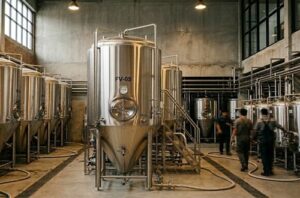
The heart of a brewery beats in its fermentation tanks, structures that, for efficiency and tradition, often take on cylindrical shapes.
This is where π enters the scene, playing a crucial role in calculating volume (πr²h) and the surface area of these vessels, variables essential for managing the fermentation and maturation of beer.
These calculations not only ensure precision in production, but also optimize the use of space and resources.
TECHNICAL NOTE: Although the basic formula applies to perfect cylinders, many modern fermenters are cylindroconical. The calculation is adjusted to include the conical part, but the geometric base of the upper cylinder still depends fundamentally on π.
2. Efficiency in the Brewing Process
Brewing beer involves a dance of liquids and gases flowing through pipes, heat exchangers, and cooling systems, each designed with equations that make use of π.
This use extends to optimizing liquid distribution, ensuring efficient heat transfer and maintaining adequate pressures, fundamental for processes such as carbonation, clarification, and filtration.

3. Perfect Carbonation
The sensory experience of enjoying a beer is greatly influenced by its carbonation level.
Precision in the use of CO₂ cylinders and the calculation of pressures for ideal carbonation indirectly involves π.
These calculations allow brewers to control the effervescence and texture of the beer, key elements for the final product profile.
4. Temperature Control
Temperature stability and control are vital at stages such as fermentation and pasteurization.
The systems that enable these controls, including heat exchangers, are designed with a deep understanding of mathematics and physics, where π plays a leading role.
These calculations facilitate the design of systems that respond efficiently to the specific needs of the brewing process, ensuring the quality and consistency of each batch.
5. Fluid Dynamics
The movement of wort and beer is governed by the Reynolds number (Re), which determines whether the flow is laminar or turbulent. To calculate it in pipes, the hydraulic diameter is needed.
The fluid velocity depends on the cross-sectional area of the pipe (A = πr2). If the calculation fails, the brewer could face shear problems (damage to wort proteins) or poor cleaning (CIP), since friction against the pipe walls depends on the circumference perimeter (P = 2πr).
6. Heat Exchangers
After boiling, the wort must be cooled rapidly to avoid contamination and precipitate proteins. This is typically done in plate or tube heat exchangers. In tube exchangers (or coils), heat transfer is directly linked to the exposed surface area.
The more contact surface there is (calculated by multiplying the circumference 2πr by the tube length), the more efficient the cooling will be. Without π, it would be impossible to design a system that drops the temperature from 100°C to 18°C in the exact time that the yeast requires.

7. Flow Rate and Dosing
Precision in filling barrels and bottles depends on electromagnetic or turbine flow meters.
These devices measure the linear velocity of the liquid and convert it into volume using the area of the circle (πr2). A minimal deviation in the value of π or the sensor radius would result in thousands of liters lost or improperly filled bottles over a year of production.
Celebrating Pi Day at the Brewery
Beyond the technical and design aspects of the relationship between Pi (π) and beer production, there are other areas where this connection can be explored creatively and symbolically, especially in the context of beer culture and celebrations.
Let us explore some of these aspects that further expand the intersection between π and the world of beer.
1. Educational Events
Pi Day offers an excellent opportunity for breweries and bars to educate their customers about the science behind beer.
Through talks, workshops, and themed tastings, beer enthusiasts can learn about the importance of mathematics and physics in brewing.
2. Marketing and Promotions
Breweries can take advantage of Pi Day to launch special products or promotions. For example, they could offer special discounts of 3.14% or sell pints for US$3.14.
They could also create special or limited-edition beers that celebrate the concept of π, using ingredients or production processes that somehow pay tribute to mathematics.
3. Pi-Inspired Beers
In terms of product innovation, breweries could experiment with recipes that incorporate π in creative ways, whether in ingredient ratios, fermentation times, or the final alcohol content.
For example, a beer with an ABV (alcohol by volume) of 3.14% or that uses 3.14 different types of hops or malts.
4. Interdisciplinary Collaborations
Celebrating Pi Day can inspire collaborations between breweries and professionals in mathematics, education, and art.
These collaborations can result in events, products, or campaigns that celebrate both beer and mathematics, fostering a rich and educational exchange between different communities.
Final Thoughts
In summary, the relationship between the number π and the world of beer encompasses much more than engineering and equipment design.
Through education, marketing, product innovation, and the creation of a community around Pi Day celebrations, creative and cultural dimensions can be explored that unite mathematics with the art of brewing.
These initiatives not only enrich the beer experience, but also highlight how seemingly abstract concepts, such as π, have a tangible and festive impact on our daily lives.
Frequently Asked Questions (FAQ)
1. How does the geometry of a fermenter affect the taste of beer?
Geometry, where the number π defines the surface-to-volume ratio, is critical for fermentation kinetics. A cylindroconical tank optimizes yeast flocculation and hydrostatic pressure management. If the aspect ratio (based on radius and height) is incorrect, the yeast may become stressed, generating unwanted by-products such as diacetyl or fusel alcohols that alter the sensory profile.
2. What is the Beer-Lambert law and what does it have to do with brewing?
Although the name is just a coincidence, the Beer-Lambert law is fundamental in the brewing laboratory. It is used through spectrophotometry to measure beer color intensity (SRM or EBC degrees) and to calculate the concentration of iso-alpha acids, which determine the actual bitterness (IBUs) of the final product.
3. Why is the golden ratio or mathematical sequences used in recipe design?
Many master brewers use the Fibonacci sequence or the golden ratio to balance the complexity of malts and hops. For example, hop additions can be made at time intervals based on these numbers to achieve a more natural flavor transition, uniting mathematical precision with the art of sensory balance.
4. How does the glass shape influence foam retention?
The physics behind foam involves surface tension and glass geometry. The diameter of the opening determines the rate of CO₂ release. A glass with a narrower mouth concentrates the aromatic compounds and maintains bubble pressure for longer, while a conical design helps sustain the structure of the malt proteins that form the foam crown.

Recommended
- 20 beer cocktail recipes to make and enjoy at home
- History and etymology of the word “Beer”: Everything you need to know