
This post is also available in:
 Español
 Português
 Français
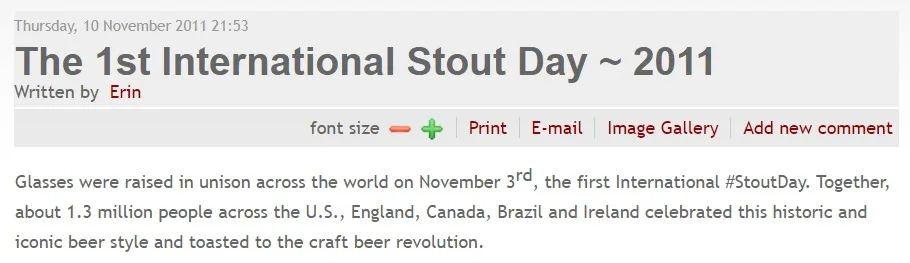
International Stout Day was born in 2011 in the United States to celebrate this iconic and diverse beer style, with the idea that drinkers in every country could get to know it, understand it and raise a glass to it on the first Thursday of November.

The English word stout originally meant “proud” or “brave”, although after the 14th century its meaning gradually shifted toward “strong”.

History of Stout Beer
Stout is a style with almost 300 years of history, closely related to the Porter style, the favorite beer of London’s working classes in the early 18th century. Its name is said to come from the porters who carried goods to and from the city’s markets.
For a long time it was repeated that Porter was invented in 1722 by a London brewer named Ralph Harwood, who supposedly blended three beers (Brown Ale, Pale Ale and an aged or “stale” beer) in a single cask that he called “Entire”.
Beer historians now consider that story a legend, because its only source is a book by John Feltham published in 1802, eighty years after the events it describes.
Over the years new versions of Porter appeared. The strongest and fullest-bodied were called Stout Porter, because stout was then the adjective used to describe a robust beer.
In time Stout established itself as a style in its own right, giving rise to many variations.
The BJCP 2021 style guidelines, the current edition for beer, recognize eight Stout styles. They are Irish Stout, Irish Extra Stout, Sweet Stout, Oatmeal Stout, Tropical Stout, Foreign Extra Stout, American Stout and Imperial Stout, which many people still call Russian Imperial Stout.
The best known example of Irish Stout is still Guinness Draught Stout, served with nitrogen and much lighter in body than its color suggests.

Origin of International Stout Day
The idea came from Erin Peters, known as The Beer Goddess, an award-winning travel and beer journalist from Southern California who in 2011 decided to organize the event with a group of fellow bloggers and brewers.
I have always liked the idea of celebrating a beer style or a place. Just as vineyards and the wines they produce tell the story of the people, the climate and the land behind them, beer also tells a story about how it was made. In 2011 I reached out to other bloggers and breweries. That is how the day was born.
Her goal was for both beer enthusiasts and new drinkers to discover and appreciate the many varieties of Stout, while promoting beer culture in countries around the world.
Erin died of ovarian cancer in 2022, although her legacy lives on every year in the worldwide celebration of Stout.
When and How to Celebrate International Stout Day?
Stout Day is celebrated on the first Thursday of November, which in 2026 falls on November 5, in homes, bars, breweries and pubs all over the world.
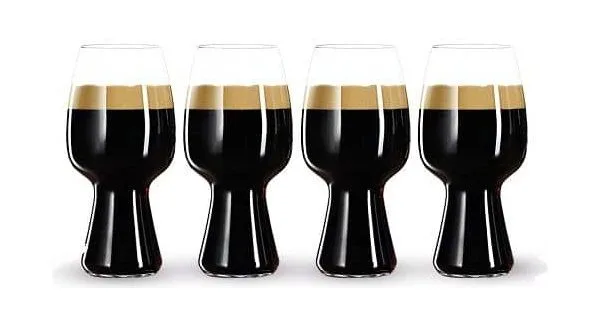
If you want to join in, all it takes is opening one of the many varieties of Stout, ideally poured into a traditional Stout glass, and then sharing photos, videos, tasting notes or events with the hashtags #StoutDay or #InternationalStoutDay on your social media.
In little more than a decade International Stout Day has become a fixture on the beer calendar, complete with its own Untappd badge, which is good proof that craft beer is more than a passing fad.
Frequently Asked Questions (FAQ)
1. What is the difference between a modern Stout and the original Porter?
The modern distinction lies mainly in the use of unmalted roasted barley in many Stouts, whereas traditional Porter was based on roasted malts or Brown Malt. Roasted barley gives a drier, coffee-like flavor, often with a more burnt character. The Stout family is also broader and includes versions with oats, lactose or high alcohol that are not typical of Porter.
2. Why was Porter the “working-class beer” of London?
Porter became popular in the early 18th century because it was a dark, full-bodied beer that was cheap to brew on a large scale thanks to brown malt. It was the favorite drink of dock and market workers (the porters), who found in it calories and energy for long working days.
3. Why did Imperial Stout become the strongest and fullest-bodied Stout?
Imperial Stout descends from the strong Porters that England exported in the 18th century, the same beers that, according to tradition, won the favor of the Russian imperial court. To help them survive the long sea voyage, brewers raised the alcohol content (ABV) and the amount of hops, which acted as preservatives. The result was a powerful, dark and dense beer.
4. Which ingredient sets a Sweet Stout apart?
Most Sweet Stouts contain lactose (milk sugar), a sugar that brewer’s yeast cannot ferment, so it remains in the finished beer. It gives a noticeable residual sweetness, more body and a creamy texture, hence the names “Sweet” and “Milk Stout”. The BJCP 2021 guidelines describe it as a frequent ingredient rather than a required one, since the sweetness can also come from other unfermented sugars.

Recommended
- The True Story Behind the Origin of the Russian Imperial Stout Style
- Courage Russian Imperial Stout Recipe: The Legitimate Heir of the Original Style