This post is also available in:
 Español
  Português
In a context where post-Prohibition American beer was synonymous with light lagers produced on an industrial scale by a handful of brewing giants, the story of Jack McAuliffe marked a turning point.
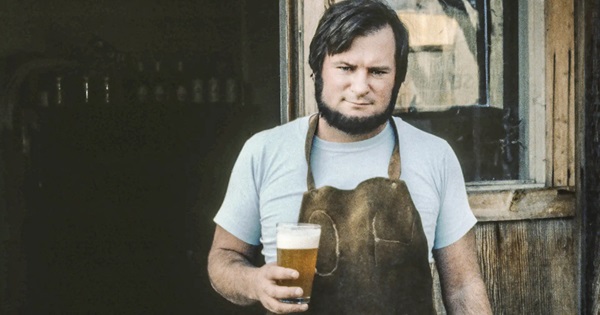
Considered by many as the “father of American craft beer,” McAuliffe founded New Albion Brewing Company in 1976, widely recognized as the country’s first modern microbrewery.
His recent passing on July 15, 2025, at age 80, invites us to reflect on and appreciate his profound legacy in the world of beer.
Origins and Disruptive Vision
Jack McAuliffe was born on May 11, 1945, in Caracas, Venezuela, the son of an American cryptographer and a teacher. He grew up in Colombia and Virginia, later developing technical skills as a welding apprentice.
After serving in the U.S. Navy, where he was stationed in Scotland, McAuliffe discovered British beer styles — particularly Stouts and Porters — that would inspire him to replicate that sensory richness on American soil.
After settling in California and working as an engineer, he never abandoned his brewing dream. In 1975, together with Suzy Denison and Jane Zimmerman, he founded New Albion Brewing Company in an old warehouse in Sonoma, California.
The project started with just 400 barrels per year, an insignificant figure compared to the millions of liters produced every minute by breweries like Coors or Anheuser-Busch.
Beer Before “Craft”
What McAuliffe did was not just small in scale — it was radically different. Instead of industrial lagers, he brewed ales using traditional methods and ingredients.
The lack of access to raw materials in small quantities forced him to improvise: he built his own production line using recycled materials and began using Cascade hops, rejected by large breweries for their citrusy, resinous character, but which would later become a symbol of the craft movement.
McAuliffe’s do-it-yourself (D.I.Y.) philosophy laid the foundations of the artisan ethos that today defines thousands of breweries.
Theresa McCulla, beer historian at the National Museum of American History at the Smithsonian, summed it up:
He proved that if you could weld and build your own equipment, you could also make good beer.
The Brief Rise of New Albion
The name “New Albion” paid tribute both to an old Californian brewing settlement and to the name Sir Francis Drake gave the region in 1579.
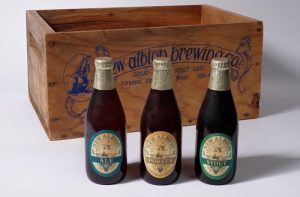
The brand’s labels featured an illustration of the Golden Hind, Drake’s galleon, lending a historical and distinctive character.

Despite growing interest and media coverage, including features in The New York Times and The Washington Post, McAuliffe was unable to secure financing to expand the brewery. In 1982, after just six years of operation, New Albion closed its doors.
Nevertheless, its impact was far-reaching. Figures such as Ken Grossman (Sierra Nevada), Jim Koch (Samuel Adams), and Sam Calagione (Dogfish Head) have cited New Albion as a direct source of inspiration.
Calagione summed it up with a musical metaphor:
Just as the Ramones launched a thousand punk bands, Jack McAuliffe launched 10,000 craft breweries.
Legacy and Recognition
After New Albion closed, McAuliffe briefly worked at Mendocino Brewing Company before stepping back from the active industry. He continued, however, to collaborate on key causes such as the legalization of brewpubs alongside Fritz Maytag (Anchor Brewing).
In 2012, Jim Koch revived New Albion Ale as a limited edition and returned the brand rights to McAuliffe, along with the profits. That same year, McAuliffe traveled across the country reconnecting with a brewing community that was finally acknowledging his legacy.

In 2019, the National Museum of American History at the Smithsonian incorporated New Albion objects into its permanent exhibition on craft beer, including an original bottle of his ale and a photograph of McAuliffe.
For the museum’s oral history project, when asked how he viewed his legacy, McAuliffe responded with humor and humility:
The craziest thing I’ve ever seen in my life. It’s hard to believe this actually happened.
Context and Current Relevance
Before McAuliffe, the American beer landscape was a wasteland in terms of diversity. In fact, in 1978, there were only 89 registered breweries in the U.S., and most of them produced similar versions of lager.
The reopening of the market to home brewers, following the legalization of homebrewing in 1978 under Jimmy Carter, marked a turning point — but New Albion had already planted the seed.
Today, with more than 9,900 active breweries in the U.S. (according to the Brewers Association, 2025), the majority of them micro or nano-breweries, McAuliffe’s vision has been far surpassed in scale but never in originality.
Even though many new generations don’t know his name, the diversity of styles such as Saison, Gueuze, Kölsch, Barleywine, and other variants that were hard to imagine in the 1970s are a direct consequence of that brave, artisan experiment in Sonoma.
Jack McAuliffe was not just a brewer — he was a cultural revolutionary who challenged beer’s homogeneity and, with limited resources but immense passion, laid the foundations of a movement that today transcends borders.
His life and work are an invitation to value creative independence, quality over quantity, and the courage to make beer when no one else dared.
No se encontraron productos.
Recommended
- How to properly cleanse your palate when tasting or sampling beers
- China bar causes a stir: beer price changes based on demand