This post is also available in:
 Español
  Português
Beer tasting is a multisensory experience that combines art, science, and sensitivity, in an active process of the senses to identify and appreciate the nuances that make each beer a unique creation.

The human sensory system, though sophisticated, has clear limits. Prolonged exposure to certain aromatic and gustatory stimuli can lead to sensory fatigue or adaptation.
However, for this experience to be truly meaningful, it is crucial to understand the importance of palate cleansing, a practice that goes far beyond a simple sip of water.
Let us explore the key aspects of this process, sharing information based on relevant scientific literature.
Sensory Fatigue or Saturation
The human sensory system, though sophisticated, has clear limits. Prolonged exposure to certain aromatic and gustatory stimuli can lead to sensory fatigue or adaptation.
This phenomenon occurs when the taste and olfactory receptors become saturated, progressively diminishing their ability to detect new stimuli.
1. Olfactory Fatigue
Olfactory fatigue affects aroma detection and reduces our ability to distinguish the complex aromatic profiles of a beer.
Continuous exposure to a specific aroma reduces the sensitivity of olfactory receptors, making it harder to perceive new scents.
This phenomenon is particularly relevant in beer tasting, where aromas can be subtle and varied.
2. Gustatory Adaptation
Gustatory adaptation interferes with the perception of flavors, especially the more subtle ones.
Taste receptors can become saturated with specific compounds, such as sugars or acids, reducing their ability to detect new flavors.
This is crucial in beer tasting, where flavors can range from sweet to bitter and sour.
3. The Role of Smell in Flavor
It is important to note that much of what we perceive as “flavor” comes from the sense of smell.
Between 70 and 95% of the gustatory experience is linked to olfactory ability; therefore, keeping these senses fresh is essential for a proper tasting.
How to Properly Cleanse Your Palate
Palate cleansing is not merely a ritual, but an intervention based on physical and chemical principles.
1. Purified Water
Water is the most basic and effective method for cleansing the palate, acting as a neutralizing agent that removes physical and chemical residues from the taste buds.
The use of carbonated water can be even more effective, as the carbon dioxide bubbles generate additional mechanical action, dislodging residual particles.
2. Coffee Beans
Coffee beans are useful for “resetting” the sense of smell. The intense aromatic compounds in coffee interrupt sensory adaptation, allowing olfactory receptors to prepare to detect new aromas.

3. Neutral Foods
Unsalted crackers are an excellent solid cleanser. Their simple starch composition does not interfere with flavors or introduce elements that could alter sensory perception.
It is crucial to avoid products containing yeast, as they can interfere with the perception of the esters and phenols produced by brewing yeasts.
Additional Cleansing Strategies
A systematic and multisensory approach optimizes palate cleansing during a beer tasting.
1. Water with a Touch of Acidity
Adding a few drops of lemon juice to water can be beneficial for breaking down fatty residues, such as those left by diacetyl, a common compound in certain beers that contributes buttery notes.
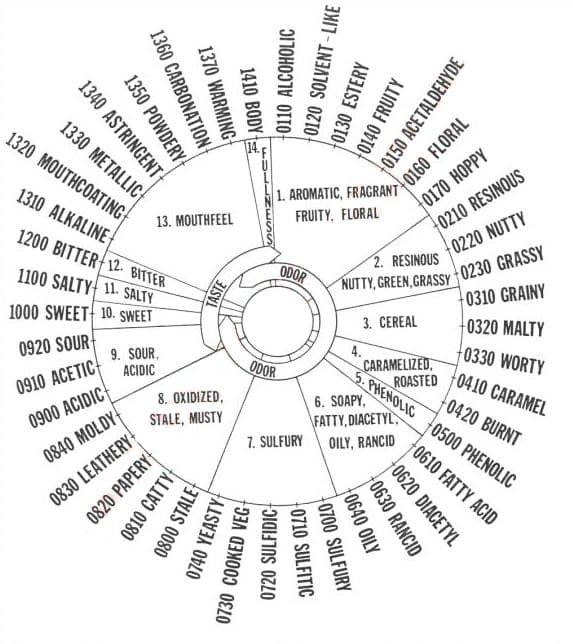
According to the studies of Morten Meilgaard, citric acids help neutralize lipid compounds on the palate.
2. Progressive Tasting Order
Starting with lighter beers and progressing toward more intense styles helps prevent robust flavors, such as those from roasted malts, from saturating the palate prematurely.
3. Adequate Intervals
Allowing a reasonable amount of time between tastings is fundamental for the sensory receptors to recover.
According to Lawless (1984), intervals of at least 2–3 minutes between samples are ideal for avoiding sensory fatigue.
4. Avoiding Intrusive Flavors
Foods containing yeast or strong spices can interfere with the perception of esters and phenols, key elements in the aromatic profile of many beers.
What Other Factors Should Be Considered?
There are other technical and environmental factors that directly influence the tasting experience, crucial for a more precise and enjoyable evaluation.
1. Serving Temperature
Serving temperature influences the release of volatile compounds responsible for aroma. Each beer style has an optimal temperature range that allows its full potential to be appreciated.
2. Oxygenation
Moderate aeration in certain styles can intensify the perception of complex aromas, while excess aeration can oxidize the beer, negatively altering its profile with notes of cardboard or paper.
Science in the Service of Sensory Pleasure
Palate cleansing during beer tasting is not a mere formality, but an essential practice backed by scientific principles.
Integrating these techniques into the tasting allows the nuances of each style to be appreciated with precision, transforming the experience into a deep and memorable sensory exploration.
The interaction between the senses and the environment is key to maximizing the enjoyment of beer, so the next time you participate in a tasting session, remember that a clean palate is the key to discovering the universe that each beer has to offer.
Frequently Asked Questions (FAQ)
1. Why is it advisable to avoid flavored sparkling water when cleansing the palate?
Although neutral carbonated water is effective, versions with artificial or added citrus flavors can introduce residual compounds (such as essential oils or sweeteners) that alter the perception of subtle flavors in the next tasting. Studies such as those by Spence (2015) show that even traces of these compounds can mask key aromas in delicate beers, such as lagers or Belgian ales.
2. How does the temperature of the water affect palate cleansing?
Cold water (between 8–12°C) is more effective than lukewarm water, as it temporarily contracts the taste buds, reducing the adhesion of sapid molecules. However, water that is too cold (<5°C) can numb the receptors, affecting the initial perception of the next sample. Bamforth (2009) suggests that this thermal balance optimizes neutralization without compromising sensitivity.
3. Is unleavened bread useful as an alternative to crackers?
Yes, but it must be plain white bread without added salt or fat (such as a traditional baguette). Its porous structure helps absorb residual compounds, but unlike crackers, its moisture can better flush out lipid particles (diacetyl). According to Meilgaard (1975), the starch in fresh bread has greater adsorption capacity than that of dry biscuits, though moderation is required to avoid filling the stomach during extended tastings.
References
- Bamforth, C. W. Beer: A Quality Perspective. Academic Press. doi.org/10.1016/B978-0-12-669201-3.X0001-8
- Shepherd, G. M. Smell images and the flavor system in the human brain. Nature, 444(7117), 316–321. doi.org/10.1038/nature05405
- Spence, C. Multisensory flavor perception. Cell, 161(1), 24–35. doi.org/10.1016/j.cell.2015.03.024
- Meilgaard, M. C. Flavor chemistry of beer: Part II: Flavor and threshold of 239 aroma volatiles. MBAA Technical Quarterly, 12(3), 151–168. www.mbaa.com/publications
- Dalton, P., Doolittle, N., & Breslin, P. A. S. The merging of the senses: Integration of subthreshold taste and smell. Nature Neuroscience, 3(5), 431–432. doi.org/10.1038/74756