

This post is also available in:
 Español
 Português
 Français
Along with bottled and canned beer, draft beer is one of the three most common formats for storing and distributing beer today, each with its own pros and cons, although kegs are especially common for craft beer.
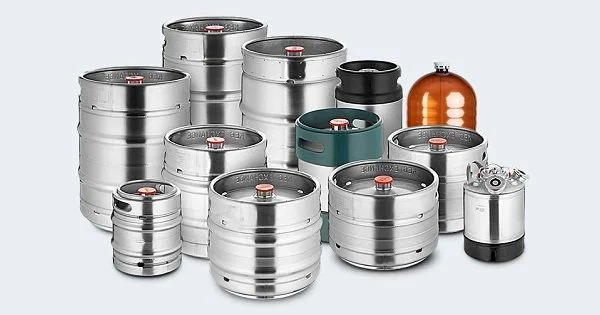
A beer barrel is, of course, a container meant to hold beer, although originally, when they were traditionally made of wood by coopers, barrels were used to transport goods as varied as nails, salmon, wine, butter, soap and gunpowder.

What Is a Beer Keg?
In Spanish, the word barril is a synonym of tonel, barrica, cuba or pipa and refers to any cylindrical container used to store liquids.
In English, on the other hand, barrel is also a unit of measurement, and the container used to serve beer is usually called a “keg” or a “cask”.
Today, beer kegs are made mainly of stainless steel, aluminum and PET plastic (polyethylene terephthalate) and are used to store, transport and serve beer, although they are also used for other drinks, alcoholic or not, carbonated or still.
Modern kegs have a single opening at the top, from which a dip tube runs down to the base. The opening has an automatic pressure valve that opens when a coupler is attached (tapping the keg), which lets CO2 in on one side and pushes the beer out on the other, through a beer tap.
How Many Liters Are in a Beer Barrel?
It depends on the country, because in the United States a beer barrel is legally 31 gallons (117.35 liters), while in the United Kingdom it is 36 imperial gallons (163.66 liters). By comparison, a wine barrel holds 31.5 gallons (119 liters) and an oil barrel 42 gallons (159 liters).
Naturally, beer keg sizes have evolved over the years and breweries around the world have developed their own formats.
This size standard varies from country to country and from brewery to brewery, and many countries use the metric system rather than the gallons used in the United States.
That is why, since beer keg sizes are not standardized, the keg cannot be used as a standard unit of measurement for liquid volumes.
How Much Does a Beer Keg Weigh?
The weight of a beer keg depends on its material, size and dimensions. As a general rule, each liter of beer weighs about one kilogram, plus the weight of the container.
A steel US half-barrel keg, for example, weighs about 13.5 kg (30 lb) empty, so when full with its 58.67 liters it comes to around 73 kg (160 lb).
Beer Kegs in the United States
Most American brewers sell their beer by the ½ barrel (15.5 gallons), ¼ barrel (7.75 gallons) or ⅙ barrel (5.17 gallons).
The terms half-barrel and quarter-barrel come from the fact that a beer barrel legally holds 31 US gallons (117.35 liters), so a 15.5 US gallon container is equivalent to the following measures.
- 12.9 imperial gallons
- 58.67 liters
- 103.25 imperial pints
- 124 US pints
- about 178 bottles of 330 ml
Types of Beer Kegs
Today the draft beer market offers several different keg formats, known as DIN, Euro, Cornelius, Mini Keg, KeyKeg, Dolium and EcoFass, each with its own features and particularities.
In Europe the most common capacity is 50 liters, even in the United Kingdom, where the standard keg holds 11 imperial gallons, almost exactly 50 liters in the metric system.
In recent years, formats driven by large breweries have also appeared, such as Heineken’s The Sub, discontinued in 2025, which used 2-liter kegs called Torps designed for the home.
1. DIN and Euro Kegs
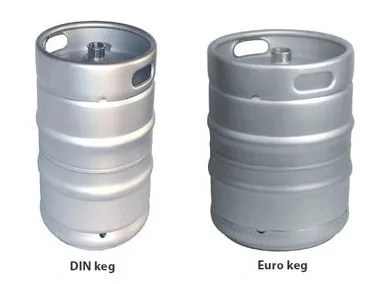
The German standards DIN 6647-1 and DIN 6647-2 define kegs of 20, 30 and 50 liters, while the more recent European regulation defines kegs of 20, 25, 30 and 50 liters.

The main difference between DIN kegs and Euro kegs lies in their shape. DIN kegs are wider and shorter, while Euro kegs are narrower and taller. Both generally use type A, G and S couplers.
2. Cornelius Keg
A Cornelius keg (also known as a Corny or soda keg) is cylindrical and made of stainless steel or aluminum.
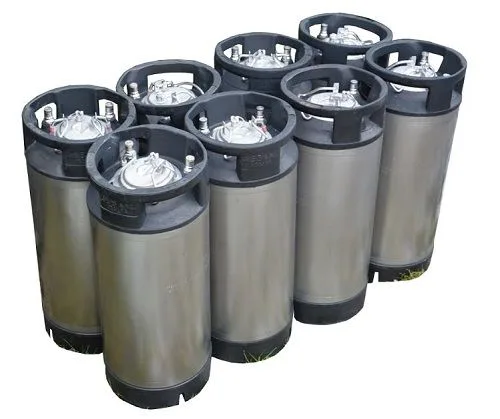
Originally designed and manufactured by IMI Cornelius, they were widely used in the soft drink industry, but their use began to decline after the arrival of new technologies such as bag-in-box (BIB) packaging.
Today the Cornelius keg is mainly used to store and dispense draft beer and is especially popular with homebrewers.

3. Mini Keg
Mini kegs hold 5 liters and are mainly used for direct sales to consumers. They are usually made of aluminum and are non-returnable, although they can be recycled.
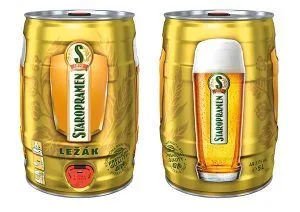
Some breweries add a small tap at the base through which the beer is dispensed by gravity, while others use a small pressure valve.
4. KeyKeg
The KeyKeg is a disposable beer keg built in three layers, an outer cardboard structure, a round PET plastic bag inside it and an additional plastic bag that actually holds the beer.

It is in the space between the two bags, with no direct contact with the beer, that carbon dioxide is injected, or even compressed air, to squeeze the bag and push the beer out through the tap.
They are ideal for exporting beer, use their own KeyKeg coupler and generally come in 20 and 30 liter formats.
5. Dolium Keg
Dolium kegs are disposable kegs made of clear PET plastic, so you can see their contents at all times.
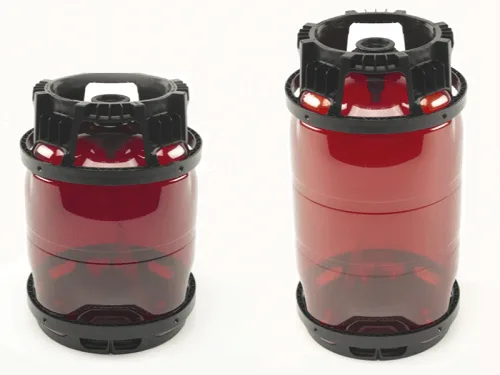
Like Euro and DIN kegs, these kegs have an internal tube that reaches the bottom of the keg and allows the beer to be pushed out by pressure applied directly from the top, which means CO2 must be used. They currently use type A, G and S couplers.
6. EcoFass Keg
EcoFass kegs have a reusable outer shell made of PET plastic that houses a disposable bag in which the beer is stored.
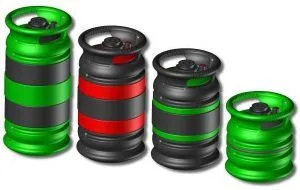
To serve the beer, carbon dioxide is injected through an internal channel between the outer container and the inner bag.
They come in 10, 20, 25 and 30 liter formats and mainly use type A and S couplers.
Types of Draft Beer Couplers
There are basically six types of keg couplers, types A, D, G, M, S and U, all of them made up of a two-port head, an inlet for carbon dioxide and an outlet for the beer.
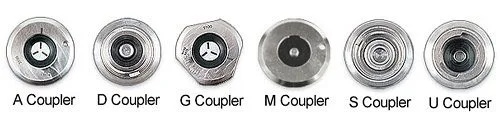
The only difference between them is the shape of the keg head. In the case of the Cornelius, the keg itself has the two connections, so it needs two additional special connectors.
CO2 in Draft Beer Dispensing
CO2 is a very important component in the structure and service of draft beer. Although the beer has already developed a level of carbonation according to its style, the CO2 added to the keg plays a double role during dispensing.
- On the one hand, it helps move the beer from the keg to the tap.
- On the other, it makes it possible to control the volume of CO2 in the beer.
To add CO2 to the keg you need a pressure regulator. This device lets you control the CO2 pressure inside the keg and keeps it constant by injecting CO2.

We know that the volume of CO2 dissolved in beer depends on the temperature of the beer and on the CO2 pressure in the keg.
- At constant pressure, as the temperature of the beer rises, the volume of CO2 in it decreases.
- At constant temperature, if the CO2 pressure in the keg increases, the volume of CO2 in the beer increases.
So the CO2 inlet pressure to the keg is not a trivial matter. Pressure that is too high or too low can spoil a beer.
When the distance between the keg and the tap is so great that the required CO2 pressure makes the beer hold too much dissolved CO2, other push systems are needed, such as mixed gas (CO2/N2) and electric beer pumps.
Frequently Asked Questions (FAQ)
1. How many liters are in a beer barrel?
It depends on the country and the format. The legal US barrel equals 117.35 liters and the UK barrel 163.66 liters, although in practice beer is sold in smaller containers. In Europe the most common keg holds 50 liters, with 20, 25 and 30 liter formats also available.
2. What is the English word for a beer barrel?
The most accurate words are “keg” or “cask”, depending on the type of container. “Keg” refers to the pressurized steel container served with gas, while “cask” is used for the vessel in which cask-conditioned beer matures. The word “barrel” works mainly as a unit of measurement in the brewing industry.
3. How much does a 50 liter beer keg weigh?
The beer weighs about 50 kg, because each liter is roughly one kilogram, plus the keg itself, whose weight varies by material and manufacturer. As a reference, a steel US half-barrel of 58.67 liters weighs about 13.5 kg empty and close to 73 kg full.
4. Which beer kegs are disposable?
KeyKegs and Dolium kegs are single-use kegs, made of plastic and designed mainly for export without needing to recover the container. The EcoFass reuses its plastic outer shell and only discards the inner bag, while the 5 liter Mini Keg is usually non-returnable, recyclable aluminum.
5. Which coupler does a beer keg need?
It depends on the keg, because couplers differ in shape. DIN, Euro and Dolium kegs usually take type A, G or S couplers, while the Cornelius has its two connections on the keg itself and needs two special connectors. It is worth checking the valve type before buying dispensing equipment.

Recommended
- The Best Beer Kegs to Enjoy at Home
- The Beer Can Is Almost 100 Years Old and This Is Its History, Everything You Need to Know