This post is also available in:
 Español
  Português
The evolution of brewing technology has shifted passive clarification methods toward high-precision mechanical systems.
Centrifugation today presents itself as the most efficient solution for balancing production speed with product integrity.
Unlike barrier filters, the centrifuge leverages density differences to separate solids without removing essential compounds that define the character of the beer.
Physics of Separation and Centrifugal Acceleration
The process is based on the application of mechanical forces that multiply natural gravity.
In a maturation tank, yeast and other particles settle according to Stokes’ law, a process that can take days or weeks depending on particle size and medium viscosity.
When beer is introduced into a rotor spinning at high revolutions, a centrifugal force is generated that can reach between 5,000 and 10,000 times the Earth’s gravity. This acceleration reduces sedimentation time to fractions of a second.
To maximize efficiency, the operator must consider that the sedimentation rate depends on the square of the particle diameter.
This means the centrifuge is extremely effective at removing yeast cells (relatively large), but requires finer configuration to capture smaller turbidity particles or precipitated proteins.
The liquid density also plays a critical role; a beer with a high final gravity or a large residual sugar load will offer more resistance to particle movement toward the equipment’s periphery.
Mechanical Design and Flow Dynamics
The interior of the centrifuge is not an empty chamber, but contains a pack of conical discs that divide the beer volume into thin layers. This design is what allows a compact machine to process large volumes of liquid.
By reducing the distance a particle must travel to be captured, the probability of separation before the liquid exits the clarification zone is dramatically increased.
The flow dynamics inside the disc pack must be laminar to prevent the re-mixing of already separated solids. Particles hit the lower surface of the discs and slide outward, accumulating in the bowl’s solids chamber.
Meanwhile, clarified beer moves toward the center of the rotor and is expelled under pressure. This design minimizes turbulence that could compromise the final product’s brilliance.
Flow Management and Clarity
The feed flow rate is the most flexible variable and, often, the most poorly managed. There is a direct correlation between the volume of beer entering per hour and the final turbidity.
If the flow rate is too high, the beer’s residence time within the centrifugal field decreases, allowing finer particles to escape through the outlet.
- Set the EBC target according to the beer style.
- Gradually adjust the feed flow rate while monitoring the outlet turbidity meter.
- Reduce flow if yeast carryover above the established limit for maturation or packaging is detected.
- Maintain a constant inlet pressure to avoid fluctuations in the internal flow pattern.
In beers with heavy dry-hopping, the flow rate must be significantly reduced because the load of polyphenols and hop residues is greater and their density is close to that of beer, making rapid expulsion into the sludge chamber difficult.
Dissolved Oxygen Pickup
Oxygen is beer’s primary enemy for shelf life and a poorly configured centrifuge can act as a massive aerator.
The risk occurs mainly at interfaces where the liquid comes into contact with ambient air, especially near the rotation axis and at the centripetal outlet pumps.
To mitigate this risk, professional equipment employs several protection systems.
The most common technique is hydrohermetic sealing, where a ring of degassed water acts as a physical barrier. Additionally, it is imperative to maintain adequate back pressure in the outlet line.
If back pressure is insufficient, dissolved CO₂ can be released, creating cavitation and allowing air to infiltrate the beer flow.
Monitoring dissolved oxygen (DO) before and after the centrifuge is a mandatory practice to ensure the increase does not exceed 5–10 parts per billion (ppb).
Temperature, Viscosity and Efficiency
Process temperature directly influences beer’s dynamic viscosity.

According to the physical laws governing movement in fluids, an increase in temperature reduces viscosity, which facilitates particles moving faster through the liquid.
However, in brewing practice, temperature is generally kept low to protect other quality attributes.
- Centrifugation is typically performed between -1 and 2 degrees Celsius.
- At these temperatures, cold haze precursors have already precipitated, allowing for mechanical removal.
- Thermal degradation of volatile hop aromatic compounds is prevented.
- Dissolved CO₂ stability is maintained, facilitating internal pressure control.
If extreme clarification is sought for a lager-style beer, cooling the product to the limit of its freezing point before centrifugation maximizes the removal of protein-polyphenol complexes that would cause haze on the shelf.
Sludge Discharge and Losses
As the centrifuge operates, the solids chamber fills. If not evacuated in time, separation efficiency drops to zero. Modern centrifuges allow partial or total discharges without stopping rotation.
Partial discharge opens the bowl for milliseconds to expel concentrated sludge, while total discharge completely cleans the solids chamber, although it entails greater liquid loss.
Automating these discharges is critical to minimize beer losses. The use of light sensors or turbidity meters in the feed allows triggering discharge only when the chamber is truly saturated.
Too-high discharge frequency increases product losses and mechanical wear, while too-low frequency risks filtrate quality. The ideal balance depends on the initial yeast load in the fermentation tank.
Impact on Foam and Hop Oils
One of the greatest benefits of centrifugation over diatomaceous earth filtration is respect for macromolecules.
Depth filters tend to indiscriminately retain proteins that are fundamental for foam formation and persistence.
The centrifuge, based exclusively on density, allows these medium molecular weight proteins to remain in the final product.
In the case of heavily hopped beers, such as IPAs, the centrifuge is superior for retaining essential oils.
Many of these oils have a density very similar to that of beer and are not affected by centrifugal force, remaining in suspension.
This results in a much fresher and more vibrant aromatic profile compared to beer that has passed through filter beds that adsorb these compounds.
| Attribute | Mechanical Centrifugation | Plate/DE Filtration |
|---|---|---|
| Essential oil retention | Very high | Low to moderate |
| Foam persistence | Preserved | Frequently reduced |
| Bacteria removal | Partial | Almost total (sterile) |
Long-Term Colloidal Stability
Although centrifugation is excellent for removing visible solids, long-term colloidal stability requires additional attention.
Permanent haze and cold haze are caused by particles so small that standard centrifugal force sometimes fails to remove them completely if residence time is short. For this reason, many brewers use fining agents before centrifugation.
The use of agents such as silica gel or PVPP helps flocculate proteins and polyphenols, creating larger diameter particles that the centrifuge can expel easily.
Without these agents, a centrifuged beer could emerge brilliant from the machine but develop haze weeks later inside the bottle or can.
The combination of chemical stabilization and mechanical separation offers the gold standard for products with extended shelf life.
Operational Integration in the Cellar
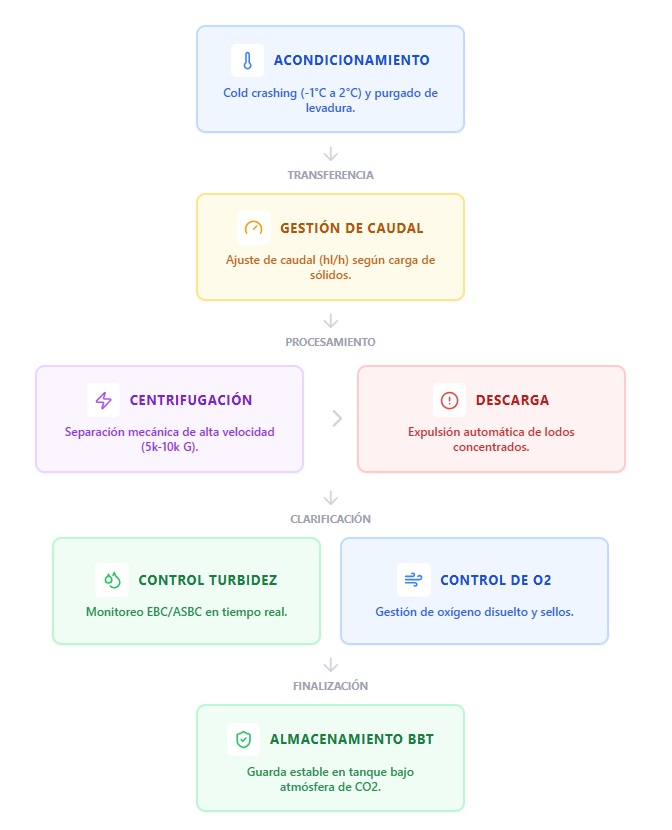
For the centrifuge to be effective, it must be correctly integrated into the plant’s flow diagram. Its usual position is between the fermentation/maturation tank and the bright beer tank (BBT).
A common mistake is attempting to centrifuge directly from a fermenter that has not had a minimum rest time, which unnecessarily overloads the machine with heavy sludge.
- Perform a preliminary yeast purge from the fermenter cone.
- Cool the beer to process temperature before entering the centrifuge line.
- Ensure transfer pumps do not generate shear force, which could rupture yeast cells and release unwanted flavors.
- Coordinate centrifuge flow with the BBT’s receiving capacity to avoid frequent stops and starts.
Cleaning and Preventive Maintenance
Cleaning a centrifuge is a highly demanding technical procedure. Protein residues and hop resins compact under centrifugal force, creating a hard film on the discs.
A CIP (Cleaning In Place) cycle must include high-temperature caustic soda phases and frequent discharge cycles to ensure the bowl’s moving mechanisms do not jam.
Preventive maintenance must focus on vibration monitoring. Any minimal imbalance in the rotor, caused by accumulated dirt or component wear, can be catastrophic at high speeds.
It is essential to inspect mechanical seals and gaskets every set number of operating hours to prevent product leaks and, most importantly, oxygen ingress that would compromise batch quality.
Recommended
- The role of non-traditional yeasts in the flavor of non-alcoholic beers
- 10 classic German beers you should try at least once in your life