This post is also available in:
 Español
  Português
On the afternoon of October 16, 1814, residents of the Saint Giles neighborhood in London heard a loud explosion; the largest tank at the local brewery had burst.
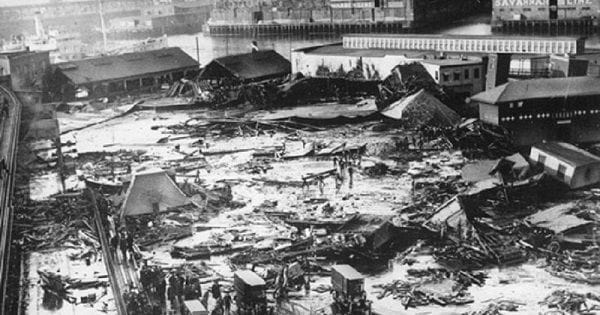
In just a few moments, a tsunami of thousands of liters of beer devastated the neighborhood, causing a genuine tragedy — what history remembers as the London Beer Flood.
Meux’s Brewery Co Ltd, founded in 1764, was a London brewery owned by Sir Henry Meux. Like many modern manufacturers, the company had been built up through the acquisition of smaller breweries; one of them was the Horse Shoe Brewery.
Horse Shoe Brewery
The Horse Shoe Brewery was famous for its Porter beer and was located in London, at the junction of Tottenham Court Road and Oxford Street.
The factory building was surrounded by apartment blocks and houses, while the upper part of the brewery was occupied by several giant vats. The largest held Porter beer.
A monster standing 6.6 meters tall and capable of holding up to 511,920 liters of beer — one of the largest in London — held together by 29 iron hoops.
The Day of the Beer Flood
In October 1814, the beer had already been fermenting for several months in the vat, as Porter-style beer requires.
Although the brewery workers had not noticed, the metal and wood of the vat had begun to show signs of fatigue caused by aging and the pressure they were under, having to support such a vast quantity of beer.
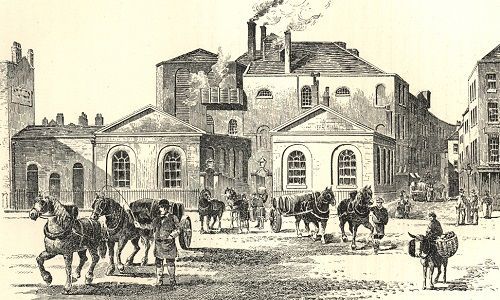
Suddenly, at around 6 in the evening, one of the vat’s iron hoops made a sharp cracking sound and broke. The contents of the vat then exploded, triggering a chain reaction in the neighboring vats.
The noise, likened to a dynamite explosion, was reportedly heard more than 8 kilometers away. A total of 1,224,000 liters of pressurized beer crashed against the brick walls of the building and began to spill out onto the surrounding streets.
The Saint Giles Neighborhood in London
Saint Giles was a poor neighborhood where many people lived in overcrowded conditions; entire families lived in a single room, basement, or attic.
Many of these residents were caught off guard by the waves of beer. The luckiest tried to escape by climbing to higher ground — rooftops, upper floors, or even trees.
The beer flood entered houses, flooding basements and demolishing two of them in its path. The Tavistock Arms pub on Great Russell Street was also affected; one of its barmaids was trapped for 3 hours under the rubble.
According to a report in The Times on October 19, the bursting of the brewery’s walls and the collapse of its wooden beams worsened the situation by compromising the structure of neighboring buildings.
In the midst of the chaos, some people tried to take advantage of the situation. Dismayed by such a great waste of beer, hundreds of people — some who had come from other neighborhoods after hearing the news — armed with jars, teapots, and pots, tried to collect it; others simply crouched down and tried to drink the beer by lapping it up from their hands.
However, the flood was too powerful for many, who ended up in hospital, where an almost-brawl broke out among other patients who, upon smelling so much beer, believed they had been excluded from a great celebration.
Consequences of the Flood
The true consequences of the tragedy became clear once the beer tsunami had passed: nine people dead — some drowned, others from injuries sustained as they were swept along by the flood.
A final victim died days later from alcohol poisoning, perhaps in their heroic attempt to hold back the tide by drinking as much beer as they could swallow.
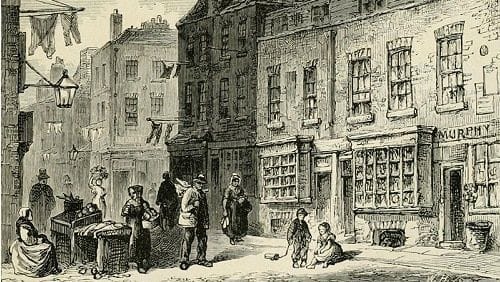
Due to the poverty of the area, the relatives of the drowned victims put their bodies on display in their homes and charged admission to view them.

Such was the concentration of onlookers that in one house so many people gathered that the floor gave way and they all fell into the basement, which was still half full of beer.
Faced with this setback, the “exhibitors” moved their business to a nearby house, which attracted even more “clients” — but also the police, who shut down the exhibition. The funerals were paid for by the people of Saint Giles.
It is said that the stench of beer in the neighborhood lasted for months; the rudimentary pumps of the era could not collect it all.
The flood was a catastrophe for many people in Saint Giles; most of the victims were poor, and beyond the nine lives lost, many more were left with nothing.
The Trial of Meux’s Brewery
Meux’s Brewery was taken to court over the accident, but the judge ruled that, despite its devastating consequences, the flood was an “act of God” — meaning it could not have been foreseen nor, had it been, could it have been prevented. The dead were therefore considered simply victims of fate.
Despite the favorable verdict, the disaster left the company in a difficult financial position. The beer had been lost and could not be sold, and revenues would fall.
As a last resort, the company petitioned Parliament to have the taxes on the lost beer — which had already been paid — refunded.
Parliament agreed, and the company was able to continue operating with the returned money.
The brewery building was demolished in 1922, though the company continued operating until 1961, when it was sold to Friary, Holroy and Healy’s Brewery. Three years later it was sold again, passing into the hands of Ind Coope.
Frequently Asked Questions (FAQ)
Who were the known victims of the London Beer Flood?
Historical records name eight or nine victims. Among them were Eleanor Cooper (14 years old, barmaid), Mary Mulvey (30) and her son Thomas Murray (3), as well as Hannah Banfield (4) and Ann Saville (60). Most were poor women and children, residents of the overcrowded St Giles rookery. Five of the victims, including Thomas Murray, died when a house collapsed during a wake held in a flooded basement.
How did the London press react to the flood?
The press, including The Times, covered the tragedy with graphic details about the destruction and poverty of the neighborhood. However, popular myths emerged that modern historians have debunked, such as rumors of “drunken mobs” drinking directly from the streets and supposed “riots” at Middlesex Hospital. These accounts often exaggerated the behavior of St Giles residents, reflecting the era’s bias against the poor working-class and immigrant population.
Was the tank failure caused by fermentation pressure?
At trial, key witness George Crick, a brewery employee, testified that the Porter beer was already 10 months old and that the natural fermentation process had “passed.” This led to the conclusion that the explosion was not due to active fermentation pressure, but rather a structural failure (the iron hoop) that, upon giving way, released the immense hydrostatic pressure and force of the accumulated liquid mass.
What changed in brewery design after the accident?
The disaster, though ruled an act of God, generated strong indirect pressure on the industry. Although change was not immediate, the trend accelerated. Brewers gradually began abandoning the use of enormous, extremely tall wooden vats, replacing them with smaller tanks and eventually moving toward safer materials with more dispersed storage structures to mitigate the risk of chain reactions.
What was the total mass of beer that flooded the Saint Giles neighborhood?
The total volume of 1,224,000 liters (including the chain reaction) translates to a mass of approximately 1,250 metric tons of liquid. Considering that the main tank of 511,920 liters contained a mass of approximately 571 tons (some sources place it closer to 600 tons including barley water and residues), this massive force caused the structural collapse of neighboring buildings, far beyond mere liquid pressure.
[amazon box=”8416223416″]
Recommended
- Beers made with patented transgenic grains: the debate looming over Europe
- Randy Mosher: “Monopolies can’t stop the Rock & Roll of beer”