This post is also available in:
 Español
  Português
Duvel is an emblematic Belgian beer that, since its creation in the 1920s, has achieved iconic status in the beer world for its complexity and balance.
General information
Name: Duvel Belgian Strong Ale
Brewery: Duvel Moortgat
Origin: Breendonk-Puurs, Belgium
Style: Belgian Strong Ale
ABV: 8.5%
IBU: 32
Calories: 255 kcal
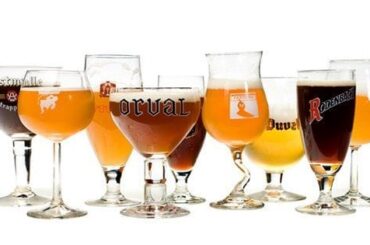
Glassware: Tulip, Tumbler, Chalice
Tasting notes and impressions
Recognized for its meticulous fermentation process lasting around 90 days, Duvel presents an aromatic richness and intensely hoppy flavor that distinguishes it among Belgian Strong Ales.
1. Appearance
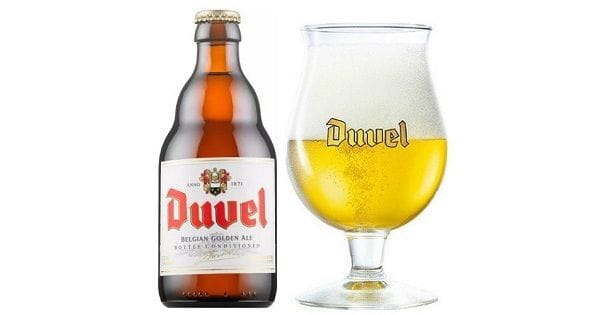
Straw-golden color, slightly hazy, allowing a clear view of a bubbly, very fine, and constant carbonation, supporting a white, brilliant, creamy, and homogeneous foam with very good retention and lacing.
2. Aroma
Its aromatic development is diverse, a succession of floral and citrusy characteristics, herbal and spicy, of grapefruit and dried orange peel, rosemary and white pepper, balanced with underlying notes of clove and yeast, of raw bread dough, altogether a light nutty character, giving way to a transition that finally ascends very fruity in the deep nose, to red apple and white grapes, to soft caramel, with piney, mineral traces and a very subtle touch of vanilla.
3. Flavor
Its start establishes itself on a soft but broad malty base in the mouth, with nuts and some biscuit, which grounds an immediate spicy and citrusy evolution of orange zest and white fruits, of clove and yeast, which then gives up all its prominence to a zigzagging counterpoint that rises to a medium-high sweetness, quickly descending to land on a medium and defined bitterness, piney and herbal, clean and well-integrated, which manages to connect a transition that still leaves some dryness before deploying a long, bittersweet, and fruity aftertaste with a secondary presence of alcohol.
4. Mouthfeel
Medium body, effervescent and silky, still creamy due to the foam that does not abandon the drink and that, as it fades in the mouth, leaves a slight roughness on the tongue, with a mild alcoholic warmth only at the very end of the throat.
5. General impression
Duvel is one of those beers about which one could speak at length; you just need to establish the starting point. First of all, like many other Belgian beers, it is a reference in itself, a beer that all others in its type have studied before their own existence. Its development is a roller coaster of characteristics that seems to want to leave you without adjectives but that finally manages to conjugate a global idea of what Duvel is as a beer, where simplicity is clearly not its goal. An experience whose breakpoint seems to be a somewhat elevated sweetness just before the final deployment in the mouth, which is immediately compensated by a very well-integrated, fine, and elegant bitterness no longer seeking prominence at that point. Drinking it at a rather cool temperature rounds out its character. Just a matter of taste. “Nen echten duvel” (“A real devil”).
Suggested pairings
Duvel is a versatile Belgian Strong Ale that lends itself well to multiple pairings. Here are some recommendations to complement and enhance its aromas and flavors.

1. Main courses
Roasted meat cuts, especially lamb with herbs, complement Duvel’s dry and spicy profile, balancing its carbonation and acidity.
2. Cheeses
Aged and strong-flavored cheeses, such as goat cheese or aged Gouda, harmonize well with Duvel’s earthy and spicy notes. The combination is further enhanced with nuts and honey.
3. Vegetarian dishes
Duvel complements ratatouille and other Mediterranean dishes well, highlighting the herbal and spicy notes of the beer while enhancing the flavor of the vegetables.
4. Desserts
A homemade apple tart harmonizes perfectly with Duvel’s fruity and spicy touches, creating an interesting contrast between the dessert’s sweetness and the beer’s dry finish.
Frequently Asked Questions (FAQ)
1. What causes the aromatic notes in a blonde beer like Duvel?
Although these descriptors evoke the direct use of spices in the brew kettle, in Duvel’s case they are the direct result of a biochemical phenomenon called yeast metabolism during fermentation. The unique originating yeast strain produces compounds called volatile phenols, specifically 4-vinyl-guaiacol, when interacting with Pilsner malt proteins and sugars. These phenols are responsible for naturally providing those spicy notes of pepper and clove, which are balanced with the herbal essential oils injected by the noble Saaz and Styrian Goldings hops.
2. Why is the mouthfeel silky and creamy despite being a medium-bodied, dry-profile beer?
This textural contrast is one of the brewery’s greatest technical feats and is achieved through prolonged conditioning and bottle refermentation. During the ninety days of the entire process, the remaining yeast meticulously consumes residual sugars in a closed environment, forcing the carbon dioxide to dissolve perfectly and ultra-finely into the liquid. When served, this constant carbonation supports a massive, homogeneous foam head that envelops the sip, giving a creamy texture and a silky passage across the tongue that disguises the final dryness and the beer’s high alcohol content.
3. Why does Duvel leave a mild alcoholic warmth only at the very back of the throat?
The discretion with which Duvel’s 8.5% alcohol is perceived in the mouth is due to the very low concentration of higher alcohols in the finished product. When fermentation is improperly managed or at uncontrolled temperatures, yeast produces heavy alcohols that generate an aggressive, solvent-like, unpleasant sting on the tip of the tongue. Duvel strictly controls its temperature peaks during the first four days of primary fermentation, ensuring that ethanol develops purely and cleanly, manifesting itself only as a subtle and elegant thermal warmth in the retronasal area and when swallowing.
4. Why are fatty goat cheese or aged Gouda perfect partners for pairing with this beer?
The pairing between Duvel and intense, aged cheeses operates under a principle of chemical cutting and flavor harmony. Mature cheeses possess a high concentration of fats and proteins that quickly saturate the taste buds, numbing the palate. Duvel’s very high carbonation acts as a mechanical cleaner that sweeps away the dairy fat from the tongue after each bite. At the same time, the cheese’s earthy notes blend with the beer’s yeast and bread dough descriptors, while the malt’s fruity sweetness compensates for the natural saltiness of aged Gouda.
5. What does serving Duvel in a tulip-shaped glass contribute to its organoleptic development?
The tulip-shaped glass is the optimal design specifically engineered to enhance Duvel’s attributes. The wide, rounded base of the bowl allows the liquid to come into subtle contact with the taster’s hand temperature, stimulating the volatilization of fruity esters reminiscent of apple and white grapes. For its part, the neck’s narrowing concentrates the spicy aromatic compounds towards the nose, while the slight final flaring of the rim distributes the sip broadly across the mouth, balancing the hoppy bitterness with the malty base.
Recommended
- Beer and Chinese food pairing guide: How to explore its full potential?
- Wheat muday recipe: Mapuche ancestral beer